



A waste and recycling operation is several workplaces under one route. Kerbside collection, the sorting line, the materials recovery facility, the composting hall, the transfer station, and the landfill each carry a different hazard profile, and the kit that is right on a sorting belt can be wrong — or dangerous — beside a reversing loader or inside a waste pit. Buying PPE for waste and recycling workers therefore starts with the task and the location, not the catalogue.
This guide walks through the kit task by task, explains which standards govern each item, and closes with the buying checks that keep a workforce consistent: sizing, inspection, replacement, and certification verification.
Start With the Hazard Assessment, Not the Catalogue
Under OSHA’s general PPE rule, 29 CFR 1910.132, the employer must assess the hazards of each work area, select the PPE that controls them, and make sure it is used and maintained. Our PPE hazard assessment guide explains the process step by step, from walking the site to writing the specification.
A practical way to run the assessment is to map the operation into tasks and list the dominant hazard of each: sharps and needles hidden in household waste, cuts from broken glass and torn metal, biological exposure from rotting organics and sewage, dust from sorting and shredding, noise from compactors and loaders, struck-by risk from reversing vehicles, and slips on wet tipping floors. One worker may cross several of these in a shift, so the kit has to be layered — a base kit worn all day, plus task-specific items added at the location. Where workers may contact blood or other infectious material, the bloodborne pathogens standard, 29 CFR 1910.1030, also applies — sharps in mixed waste are the classic exposure route, and it is the reason puncture resistance is not optional in this sector.
The Task-by-Task Kit
Collection crews. Kerbside and commercial collection is a traffic job as much as a waste job. High-visibility clothing to EN ISO 20471 is the first item — see our hi-vis classes guide for choosing the right class for road speeds — followed by cut- and puncture-resistant gloves for lifting bags and bins, and safety boots with a puncture-resistant midsole for the nails and glass underfoot; see our safety footwear standards guide. Hard hats to EN 397 come out where bins are lifted overhead or compactors are serviced, and weatherproof outer layers keep the hi-vis visible in rain instead of hidden under a dark coat.
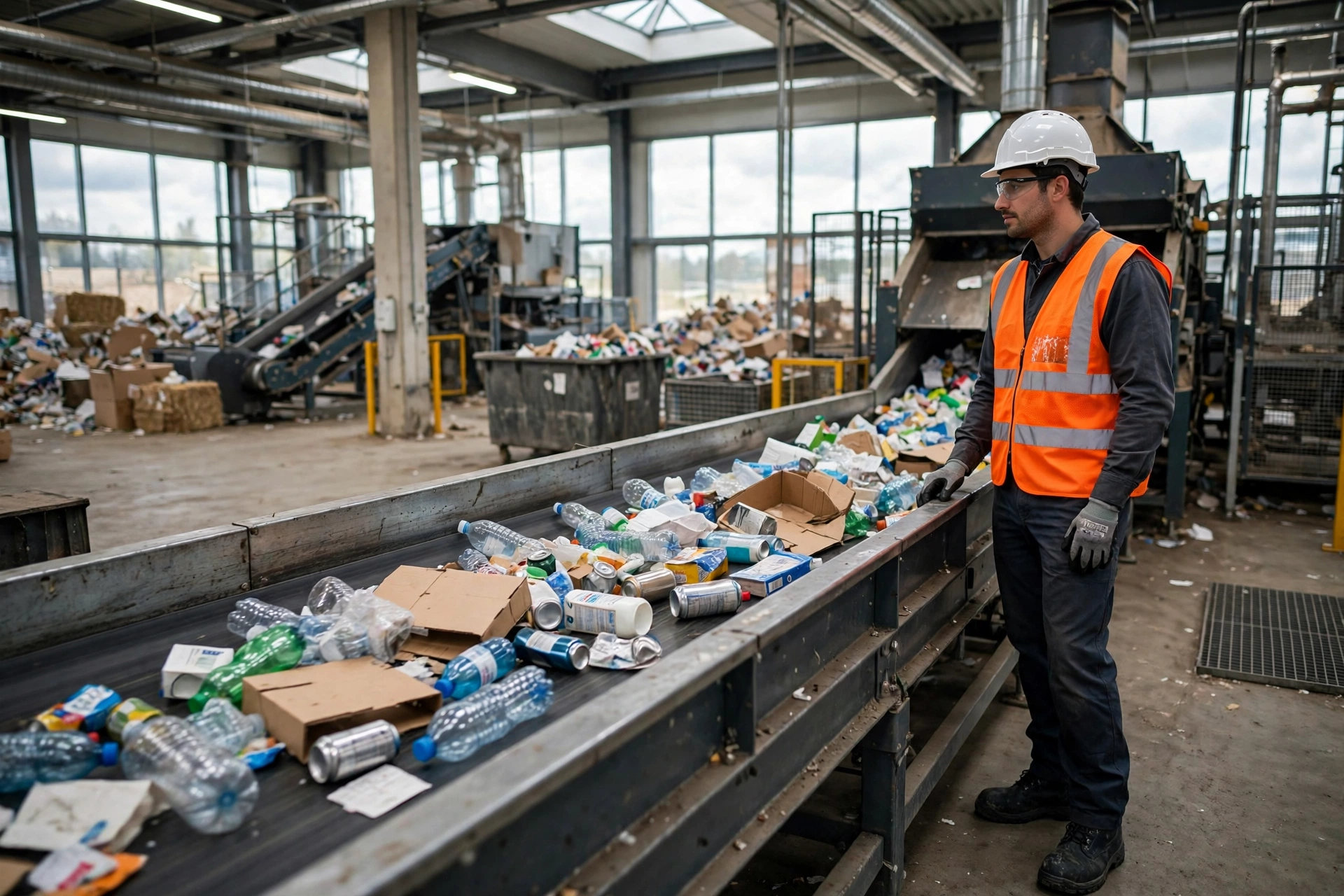
Sorting lines and materials recovery facilities. The sorting belt is where hands meet the waste, and it sets the glove specification: cut resistance rated to ANSI/ISEA 105 for glass, cans, and torn metal, puncture resistance for needles and sharp objects, and enough grip and dexterity to pick small items all shift. Our cut-resistant gloves guide explains how cut levels work and why the highest level is not always the right choice — a glove too stiff to grip slows the line and gets taken off. Eye protection to EN 166 guards against flying fragments from the belt, and hearing protection is needed wherever compactors, shredders, and balers run — many facilities exceed the 85 dBA action level in 29 CFR 1910.95; see our SNR vs NRR guide. Sleeves and aprons protect forearms and torsos from abrasion, and no loose clothing or jewellery is allowed near conveyors and rotating equipment.
Composting and organic waste. Composting halls and green waste handling add biological aerosols and dust to the list: mould spores, bacteria, and fine organic dust released when piles are turned. Respiratory protection selected under 29 CFR 1910.134 is the answer, with a fit test before first use — our respirator ratings guide explains what N95, FFP2, and FFP3 actually filter, and our fit testing guide explains why a respirator that leaks at the seal protects no one. Add sealed eye protection, gloves that can be washed or disposed of at shift end, and a strict hygiene routine: handwashing before eating, changing out of contaminated clothing before going home, and laundry handled as contaminated, not domestic.
Landfill and transfer stations. At the tipping face and the transfer station the dominant risks are heavy vehicles, dust, and heat. Hi-vis clothing, hard hats, and safety boots are the base kit, with hearing protection near compactors and dust masks where dry waste is tipped and pushed. In hot weather the kit becomes a heat problem of its own — our heat stress and PPE guide covers work-rest schedules, hydration, and cooling for outdoor crews. Where workers climb onto trailers or work at height on station structures, fall protection applies — see our fall protection harness inspection guide.
Hazardous household waste and spill response. Paints, solvents, batteries, and pesticides turn up in mixed waste, and the hazardous waste operations standard, 29 CFR 1910.120, governs planned cleanups and emergency response. Chemical gloves are chosen against the safety data sheet of the substance involved — our chemical glove breakthrough time guide explains how to read a permeation chart — and chemical protective clothing is graded by type; see our chemical protective clothing types guide. Unknown chemicals are never handled bare-handed, and a spill kit with the right gloves and eye protection belongs on every collection vehicle, not just at the depot.
Sharps, needles, and biological risk. Needles in household and clinical waste are the sharpest single risk in this sector, and they defeat ordinary work gloves: the glove must be rated for puncture resistance, and even then the rule is never to reach blindly into a bag or bin. Sharps go straight into a rigid sharps container, never into a pocket or a soft bag, and every needlestick is reported the same day so post-exposure steps can start. Under the bloodborne pathogens standard employers must offer hepatitis B vaccination to exposed workers and keep an exposure control plan — a buyer should confirm the plan exists before arguing about glove models, because the plan decides what the gloves have to survive.
Gloves: Cut, Puncture, and Grip
Gloves are the most replaced item in waste and recycling, so getting them right pays for itself. Cut resistance is rated on a scale — ANSI/ISEA 105 runs from A1 to A9 — and the right level is the lowest that survives the task, because higher cut levels usually mean a stiffer glove and a slower hand. Puncture resistance is a separate rating and matters more than cut level wherever needles and nails are present. Grip matters too: a glove that slips on a wet bin or a greasy container gets discarded, whatever its rating. Measure hands and order across the size range — see our safety glove size chart — and set a change rule in advance: gloves are replaced when cut, punctured, or worn smooth, not when they fall apart. Nitrile disposables have a place for dirty or infectious tasks, and our nitrile glove thickness guide explains the 4, 6, and 8 mil choice.
Buying for a Whole Workforce
Size it properly. A glove that is too tight tears and fatigues the hand; one that is too loose catches on conveyors and loses grip. The same applies to hi-vis, helmets, and boots: a fleet buys the size range, not the average size, and wear-tests the shortlist with the crew who will wear it.
Plan inspection and replacement from day one. Gloves wear out in days or weeks on a sorting line, boots in months, helmets on a fixed schedule after any impact, and hi-vis when its fluorescence fades. A written inspection and replacement schedule keeps the fleet protective instead of decorative — see our PPE inspection and replacement guide. Ask the supplier for the manufacturer’s retirement instructions in writing before the first order, and confirm that identical models will still be available in a year: a fleet of mixed, incompatible models is far harder to inspect than a standardised one.
Verify the certificates before the bulk order. A cut-resistance or puncture claim is only as good as its test report, and a wrong claim is invisible until it fails. Ask for the certificate and the test report behind it, check the model number matches the product you are buying, and confirm the expiry date — our PPE certification verification guide walks through the checks. Judge the supplier, not just the price: consistent sizing across batches, a stable model range, honest lead times, and a willingness to supply samples are worth more than a small unit-price saving. Our guide to choosing a PPE manufacturer and our protective clothing suppliers checklist set out the questions that separate a reliable partner from a one-off shipment.
Related Guides
For the details behind this guide, see our PPE hazard assessment guide, our cut-resistant gloves guide, and our PPE inspection and replacement guide.
Waste and recycling rewards buyers who specify per task and test before they commit. If you are putting together a kit for your operation — cut-resistant gloves, hi-vis, helmets, and boots in bulk — contact us with your task list and headcount. We supply free samples so your crew can wear-test the shortlist on your site before you order, and you cover only the shipping.


