



Disposable nitrile gloves are sold by a single number — the mil — and buyers are expected to know whether 4, 6, or 8 mil is “right.” Get it wrong in one direction and gloves tear mid-task, burning through boxes and patience. Get it wrong in the other and workers lose the fingertip feel the job depends on, then quietly stop wearing them. This guide explains what the mil number actually measures, why two gloves with the same mil rating can perform very differently, and how to match thickness to task.
What “Mil” Actually Means
One mil is one-thousandth of an inch — 0.001″, or about 0.0254 mm (25 microns). So a 4 mil glove is roughly 0.10 mm thick, a 6 mil glove about 0.15 mm, and an 8 mil glove about 0.20 mm. For context, a human hair is around 0.07 mm: even the heaviest disposable nitrile is a film, not armor.
The catch is where the measurement is taken. A glove is not uniformly thick: fingertips are usually the thickest zone, the palm slightly thinner, and the cuff thinnest of all. Some manufacturers quote the palm measurement, some the fingertip, and some — the ones to avoid — quote the thickest point they can find. Two “8 mil” gloves can differ by 30% at the palm. When comparing suppliers, ask for the minimum palm thickness on the spec sheet, and compare that number, not the headline.
4 Mil: The Dexterity End
Four-mil nitrile is the world of exam gloves and light-duty disposables: maximum tactile sensitivity, minimum material. It suits laboratory splash protection, food handling, light assembly, cleaning with mild detergents, and any task where the glove is a hygiene barrier first and armor second. Expect easy tearing on sharp edges, fast snagging on rough surfaces, and short wear time in mechanical work. In medical settings these gloves fall under exam-glove rules — the US FDA’s medical glove guidance covers the regulatory side — but industrial buyers should treat 4 mil as light duty regardless of marketing language.
On the medical side of the same thickness question, one nitrile examination glove is FDA listed, tested to EN 455-1/2/3/4, and manufactured under ISO 13485 — the exam-glove end of the range, where 4 mil dexterity meets a regulated barrier standard. That listing does not make a thicker glove safer against chemicals: thickness buys mechanical durability, chemistry stays a separate specification.
6 Mil: The Working Middle
Six mil is where disposable nitrile starts behaving like a work glove. Puncture and abrasion resistance step up noticeably, tear propagation slows (a nicked cuff doesn’t run as fast), and the glove survives a full task instead of half of one. This is the default choice for janitorial work with real chemicals, food processing, painting, printing, and general maintenance. Tactile feel is reduced versus 4 mil but still workable for most handling tasks. If your team burns through 4 mil gloves three pairs at a time, 6 mil is usually cheaper per shift despite the higher unit price.
8 Mil: The Heavy Disposable
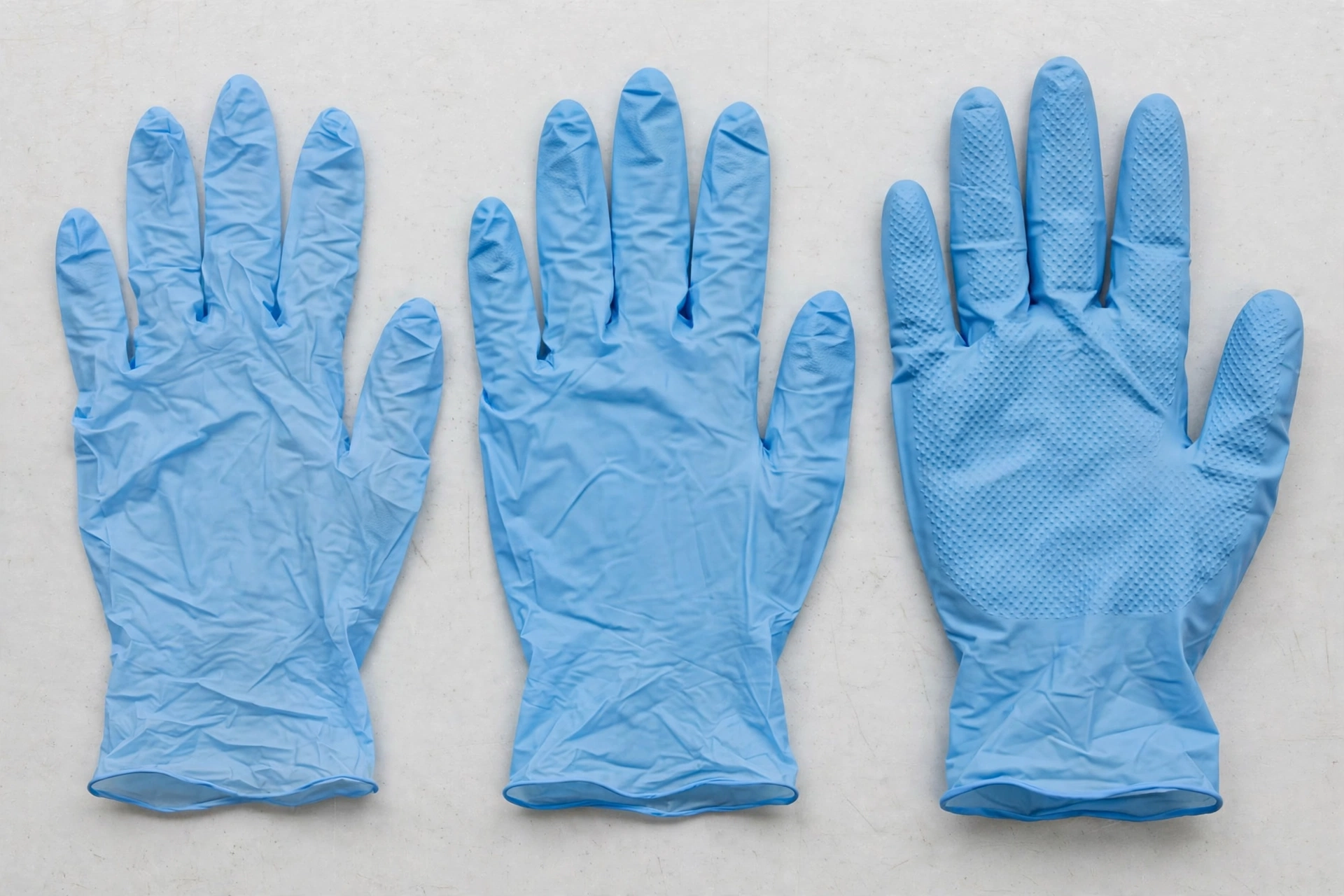
Eight-mil nitrile — often with a raised textured or diamond-grip palm — is the heavy end of the disposable range: automotive work, machinery repair, waste handling, chemical splash tasks, and oily environments where grip matters as much as the barrier. The film resists tearing on bolt threads and sheet edges, and holds up through longer wear periods. The trade-offs are real: fingertip sensitivity drops, hand fatigue rises on precision work, and cost per pair roughly doubles versus 4 mil. Eight mil is a tool for mechanical abuse, not a universal upgrade.
Thicker Is Not Automatically Safer
The most expensive misconception in nitrile buying is that thickness equals chemical protection. Chemical resistance is primarily a property of the material and its formulation, not its thickness. A thicker glove does extend protection time somewhat — there is more material for a chemical to permeate through — but a solvent that defeats nitrile will defeat 8 mil nitrile too, just a few minutes later. Chemical safety is governed by chemical glove breakthrough time measured for the specific chemical against the specific glove, and no mil number substitutes for that data. Thickness buys mechanical durability; chemistry is a separate specification.
The second misconception: mil ratings are standardized across brands. They are not — there is no enforced industry convention for the measurement point on industrial disposables, which is exactly why headline mils inflate. Buy on the full spec sheet: palm thickness, fingertip thickness, tensile strength, and AQL (acceptable quality level for pinholes — 1.5 is industrial-grade, 2.5–4.0 is lighter duty).
Fit, Fatigue, and the Real Cost per Shift
Thickness interacts with fit. A thick glove in a size too small strains at the web of the thumb and tears early; too large, and the excess film folds, catches, and destroys the dexterity you paid for. For mixed fleets, the practical approach is a two-tier stock: a mid-weight glove (6 mil) as the default, and 8 mil reserved for the tasks that demonstrably eat gloves. Track consumption by department for a month — the numbers will tell you exactly where the upgrade pays and where it is waste.
For long-duration chemical work, also consider when to step out of disposables entirely: reusable supported nitrile gloves (typically 11–22 mil equivalents with a fabric liner) outlast any disposable in repeated chemical handling, and their cost per use collapses over months. Disposables win on hygiene change-out and convenience, not on endurance.
Double-Gloving and Change-Out Habits
Two thinner gloves can outperform one thick one in the right job. Double-gloving — common in laboratory and pharmaceutical work — lets the wearer strip the contaminated outer glove mid-task and continue with a clean barrier, something no 8 mil single glove offers. The pair also provides a visual tell: many facilities stock a contrasting color underneath, so a breach of the outer layer shows instantly. The costs are doubled consumption and reduced feel, which is why double-gloving belongs to contamination-critical and chemical-splash work, not general handling. Whatever the configuration, build change-out triggers into the task: visible contamination, a tear or snag, a set time limit on chemical work, and always between product batches in food and lab settings.
Storage and Shelf Life: The Forgotten Variable
Nitrile is a polymer, and it ages. Heat, ozone, UV light, and proximity to electric motors all degrade the film over time; a case stored beside a sunlit window or above a hot pipe run will tear at rates no thickness upgrade can fix. Manufacturers state a shelf life for their gloves — commonly three to five years under proper storage — and it deserves the same respect as any expiry date in the building. Store cases cool, dark, and dry; rotate stock first-in, first-out; and if a fresh case suddenly tears more than the last, suspect storage before you suspect the spec. Buyers comparing suppliers should also ask about tensile strength and elongation after accelerated aging, a standard datasheet line that predicts how the glove will behave in month eighteen, not just on delivery day.
Stocking nitrile for a mixed workforce? Aceppe supplies disposable and reusable nitrile gloves in bulk for industrial buyers, with full spec sheets — palm thickness, AQL, and test data — on request. Tell us your tasks and consumption through our contact page and we will recommend the thickness tiers that cut your cost per shift.
🧪 Free Tool: Glove Chemical Compatibility Checker
Check 60 chemicals against 6 glove materials with four-tier ratings and breakthrough data — verify your exact chemical before thickness even enters the decision. Free, no signup.


