



Order respirators from a US catalogue and a European catalogue and the same white disposable mask can carry two different names: N95 on one side of the Atlantic, FFP2 on the other. Add FFP3 to the shelf and buyers face a genuine question — are these three ratings rungs on one ladder, or three different ladders? The honest answer is closer to the second. N95 is a US approval under NIOSH, while FFP2 and FFP3 are European classes under EN 149, and the tests behind them measure different things in different ways. This guide explains what each rating guarantees, where the numbers do not compare directly, and how to choose a rating that survives contact with the real job.
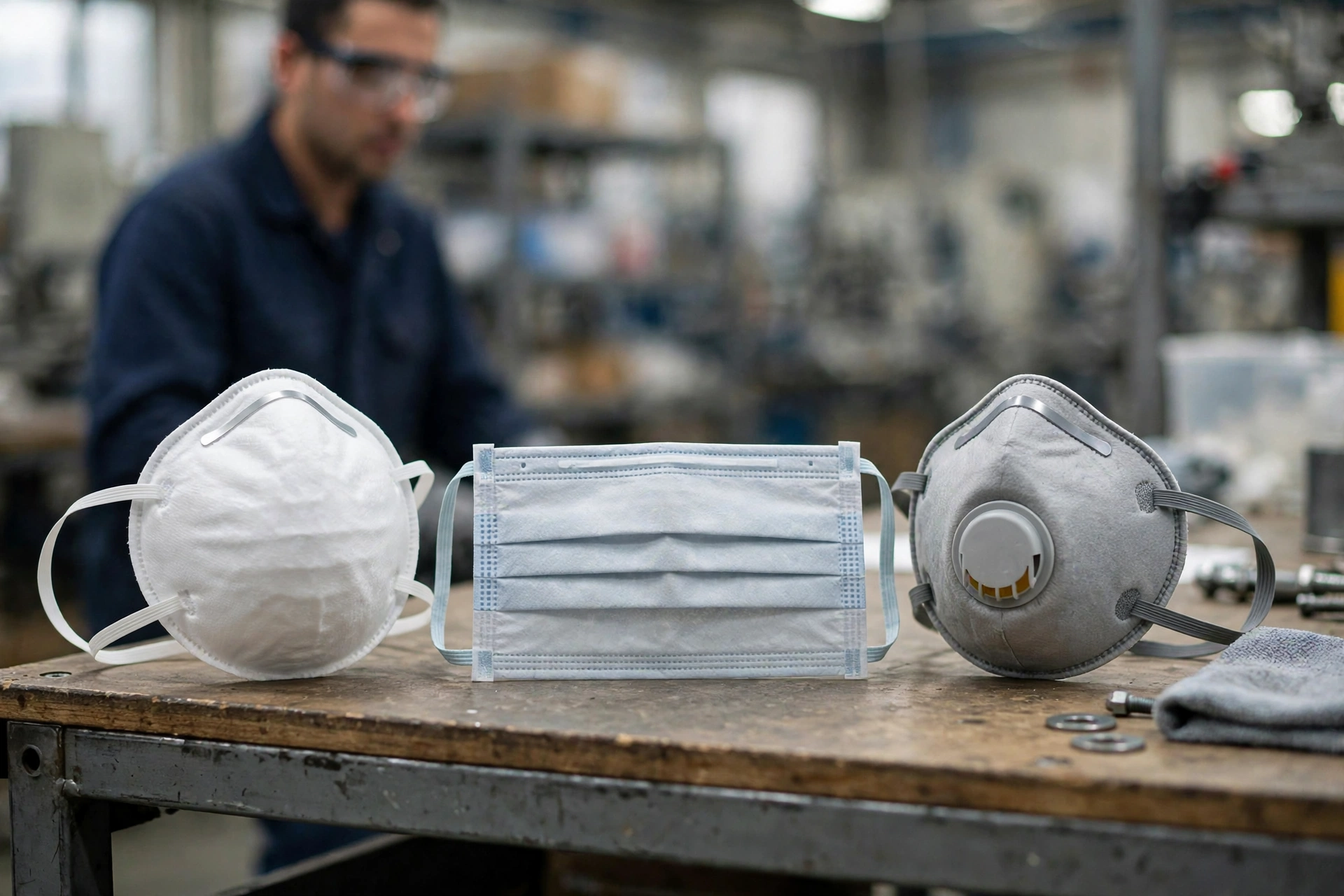
The Three Ratings at a Glance
| Rating | Standard | Minimum filtration | Total inward leakage limit | Typical use |
|---|---|---|---|---|
| N95 | NIOSH 42 CFR Part 84 (US) | ≥ 95% of test particles | Not specified as a TIL limit | General dust, grinding, sanding, healthcare |
| FFP2 | EN 149:2001+A1:2009 (EU) | ≥ 94% | ≤ 8% | Construction dust, metal fume, woodworking |
| FFP3 | EN 149:2001+A1:2009 (EU) | ≥ 99% | ≤ 2% | High-risk dust, bioaerosols, fine particulates |
The table looks like a simple ranking, and filtration efficiency is the number most buyers quote first. But a respirator protects through two routes at once — what the filter catches and what leaks around the seal — and only the European classes put a number on the second route. A higher filtration number does not automatically mean higher protection in use.
N95: The US Standard
An N95 is a filtering facepiece respirator approved by the US National Institute for Occupational Safety and Health (NIOSH) under 42 CFR Part 84. The letter N means the filter is not resistant to oil — it is tested against a non-oil aerosol and is not suitable where oil mist is present. The number 95 means the filter captures at least 95% of the most penetrating test particles, measured with a sodium chloride aerosol at a particle size around 0.3 microns. The same NIOSH system defines N99 (at least 99%) and N100 (at least 99.97%), plus R and P series for oil-resistant and oil-proof filters, so N95 is the entry level of a nine-class family.
Every genuine NIOSH-approved respirator carries a testing and certification approval number printed on the facepiece, in the form TC-84A-XXXX, together with the NIOSH name and the protection level. That number is the buyer’s verification tool: it can be checked against the NIOSH Certified Equipment List, which is the authoritative record of approved models. NIOSH’s filtering facepiece respirator page explains the nine filter classes and the required approval markings, and it is worth reading before placing a first order with an unfamiliar supplier — a missing or unverifiable TC number is a warning sign.
In US workplaces, N95 use sits inside a regulatory framework, not a purchasing decision alone. OSHA’s respiratory protection standard, 29 CFR 1910.134, requires employers who mandate respirator use to run a written programme covering selection, medical evaluation, fit testing, training, and maintenance. OSHA’s summary of the major requirements of 1910.134 sets out the programme elements, including the rule that fit testing is required before first use, whenever a different facepiece is used, and at least annually thereafter.
FFP2: The European Middle Ground
FFP2 is the middle class of the European disposable respirator standard EN 149:2001+A1:2009. It requires a minimum filtration efficiency of 94% and a maximum total inward leakage of 8% — total inward leakage being the share of test aerosol that reaches the wearer through the filter, the seal, and the exhalation valve combined. That second number is the feature that separates the EN 149 classes from a pure filtration rating: it tests the respirator as worn, on human subjects, rather than the filter material alone.
Two markings on an FFP2 tell a buyer more than the class alone. NR means non-reusable: the respirator is intended for a single shift. R means reusable: it can be used for more than one shift within the manufacturer’s stated limits. A D marking means the respirator passed the dolomite clogging test, which indicates it holds up better over a long shift in dusty conditions. None of these markings changes the filtration class, but they change what the respirator costs per shift and how it should be managed on site.
FFP2 is the workhorse rating for construction dust, metal fume, woodworking, and general industrial particulates across Europe. It is the rating most often specified where the hazard is a solid or liquid particulate and the exposure is moderate — the same territory where a US buyer would reach for an N95. The two are often treated as equivalents in procurement, but that is a practical judgement, not a certified equivalence: the tests differ, so no authority issues a conversion.
FFP3: The Highest Disposable Class
FFP3 is the top class under EN 149, requiring at least 99% filtration efficiency and no more than 2% total inward leakage. That combination — a better filter and a tighter leakage limit — is what makes FFP3 the specified choice where the consequence of exposure is higher: fine toxic dusts, work with biological agents, and tasks where the airborne particulate is hazardous at low concentrations. The tighter leakage limit also means FFP3 facepieces are generally built with a closer, more structured seal, and they usually feel more restrictive to breathe through over a long shift than an FFP2 of the same style.
Buyers sometimes specify FFP3 everywhere, assuming more protection can never hurt. It can: a respirator that is harder to breathe through gets worn less consistently and removed more often. Protection that is not worn protects no one. The right question is not which rating is highest but which rating matches the exposure — and that answer comes from the hazard assessment for the specific task, not from the catalogue page.
Why the Numbers Do Not Compare Directly
Three differences stop buyers from ranking N95, FFP2, and FFP3 on one scale. First, the test aerosols differ: NIOSH tests with a sodium chloride aerosol, while EN 149 tests with both sodium chloride and paraffin oil, so an FFP filter must pass against an oil-based aerosol that an N-series filter is never tested against. Second, only EN 149 measures total inward leakage on wearers; NIOSH approval tests the filter media, and the seal is handled separately through the employer’s fit testing programme. Third, the pass thresholds differ — 95% versus 94% — which reflects different test protocols rather than a real performance gap.
None of this makes one system better than the other. It means a buyer who writes “N95 or equivalent” into a specification should say what equivalent means for that site: which test the substitute must pass, which approval marking must appear on the product, and who verifies it. Our guide to verifying PPE certifications before a bulk order covers the document checks that belong in that process, including how to confirm an approval number against the issuing body’s own list rather than trusting a supplier’s datasheet.
Fit Decides Whether the Rating Works
The most important number in respirator protection is not printed on the box. A filtering facepiece only protects when its edge seals against the face, and leakage around the seal can dwarf the difference between 94% and 99% filtration. That is why fit testing exists: a qualitative test using a challenge agent the wearer can taste or smell, or a quantitative test using an instrument that measures leakage directly. Under OSHA’s rule the test is required before first use, when the facepiece changes, and at least annually — and the result belongs to a specific make, model, and size on a specific face, not to the rating in general.
Three fit facts catch buyers out. First, facial hair that crosses the sealing surface breaks the seal: a respirator cannot be fit tested over a beard, and a worker who grows one afterwards needs a new assessment. Second, a user seal check — covering the mask and breathing in and out sharply — should be done every time the respirator is put on; it catches a badly seated mask before the shift starts, but it is not a substitute for a fit test. Third, face shapes differ, so a bulk order should include more than one model and size, with the fit test deciding which model each worker wears. A single-model order that fails half the workforce’s fit tests is wasted.
Valved or Unvalved?
An exhalation valve lets warm, moist air leave the mask easily, reducing breathing resistance, heat build-up, and fogging of eyewear. For long shifts of physical work, a valved respirator is noticeably more comfortable and more likely to stay on. The trade-off is that exhaled air leaves unfiltered, so a valved respirator does not protect other people from the wearer’s breath. That makes valved models the wrong choice for sterile environments, for close-quarters healthcare work where source control matters, and for any site whose rules require unvalved models. The valve is a comfort feature with a real limitation, and the choice belongs in the site’s respiratory rules rather than in individual preference.
Choosing the Right Rating: A Short Framework
Start with the hazard, not the catalogue. Identify the airborne contaminant for each task — dust, fume, mist, or biological agent — and its exposure limit. Silica dust, welding fume, and pharmaceutical powder point to different ratings, and one site can need two ratings for two jobs. If the work involves gases or vapours, none of these three ratings is the answer: filtering facepieces protect against particles only, and gas protection needs a different respirator type entirely.
Then match the rating to the exposure and the wearer. Moderate particulate exposure with a fit-tested workforce is the territory of N95 or FFP2. Higher-risk particulates, or work where the leakage limit matters as much as the filter, point to FFP3. Confirm the approval marking on the product itself — TC-84A number for NIOSH, CE marking with the EN 149 reference for European classes — and keep the approval documents with the order. Trial the chosen model on the real workforce and the real task before committing to volume: a model that passes the fit test for most wearers is worth more than a higher rating that half the crew cannot wear. In sectors with mixed hazards, respirators sit alongside other controls: our guide to PPE for the oil and gas industry shows how they fit with gas detection and escape equipment.
Common Buying Mistakes
- Treating the ratings as interchangeable. N95, FFP2, and FFP3 come from different test systems. Write the acceptable approval into the specification instead of assuming equivalence.
- Buying on filtration alone. The seal matters as much as the filter. Budget for fit testing and for more than one model and size.
- Skipping the approval check. A TC-84A number that cannot be found on the NIOSH Certified Equipment List, or a CE mark with no EN 149 reference, should stop the order.
- Reusing a single-shift respirator. NR-marked FFP respirators are intended for one shift. Reuse beyond the manufacturer’s limits is a false economy that trades protection for a small saving.
- Specifying a valved model for source-control settings. Valves help the wearer and do nothing for the people around them. Match the valve choice to the site’s rules.
Get Samples Matched to Your Site Hazards
If you are specifying respiratory protection for your workforce, send us the hazard list, the standards your site works to, and the size range you need. We can recommend respirators against that specification and provide free samples for fit testing and task trials; the buyer covers shipping. Start with the contact form and include your work areas, the particulates and fumes handled, and your quantities, and we will respond with matched options rather than a generic catalogue.
Related Guides
How to Conduct a PPE Hazard Assessment (OSHA Guide) | How to Verify PPE Certifications Before a Bulk Order | PPE for Oil and Gas Industry: A Buyer’s Guide


