



A respirator can carry the right filter, the right rating, and the right certification — and still protect nobody. The weak point is rarely the filter media. It is the thin line where the facepiece meets the wearer’s skin. If that seal leaks, contaminated air bypasses the filter entirely, and the protection factor printed on the box becomes a fiction. That is why respirator fit testing exists: it is the only step that proves a specific mask seals on a specific face, before that person is allowed to rely on it.
Why Fit Matters More Than the Filter Rating
Respirator ratings describe what the filter can do. An FFP3 or N95 filter captures at least 99% or 95% of the test aerosol, and a P100 filter captures 99.97%. But those numbers are measured on a sealed test rig. On a human face, the air follows the path of least resistance — and a gap at the nose bridge or cheek offers far less resistance than a dense filter. Studies of workplace protection consistently find that face-seal leakage, not filter penetration, is the dominant route for contaminants to reach the wearer.
That is the logic behind the assigned protection factor, or APF. In the United States, OSHA assigns a half-face respirator an APF of 10 and a full-face respirator an APF of 50 — meaning the respirator is expected to reduce the contaminant concentration to one-tenth or one-fiftieth of the ambient level. Those factors assume a tested, verified seal. Without fit testing, there is no evidence the wearer achieves anything close to them. Choosing between respirator ratings is only half the decision; the other half is proving the chosen mask fits.
What Fit Testing Actually Measures
A fit test measures how much of a challenge agent leaks into the facepiece while the wearer performs a set of standard exercises: normal breathing, deep breathing, turning the head side to side, moving it up and down, talking, grimacing, and bending over. The result is expressed as a fit factor: the ratio of the challenge concentration outside the mask to the concentration inside it. A fit factor of 100 means the air inside the mask is 100 times cleaner than the air outside.
OSHA’s respiratory protection standard, 29 CFR 1910.134, sets the pass thresholds: a fit factor of at least 100 for a half-face respirator, and at least 500 for a full-face respirator. Anything below the threshold is a fail — the wearer must try a different size or a different model and test again. In the UK, the Health and Safety Executive’s guidance on respiratory protective equipment takes the same position: tight-fitting respirators must be fit tested, and the test must be recorded.
Qualitative vs Quantitative Fit Testing
There are two families of fit test, and buyers should know which one their programme uses — the choice affects cost, defensibility, and which masks can be tested.
Qualitative fit testing (QLFT)
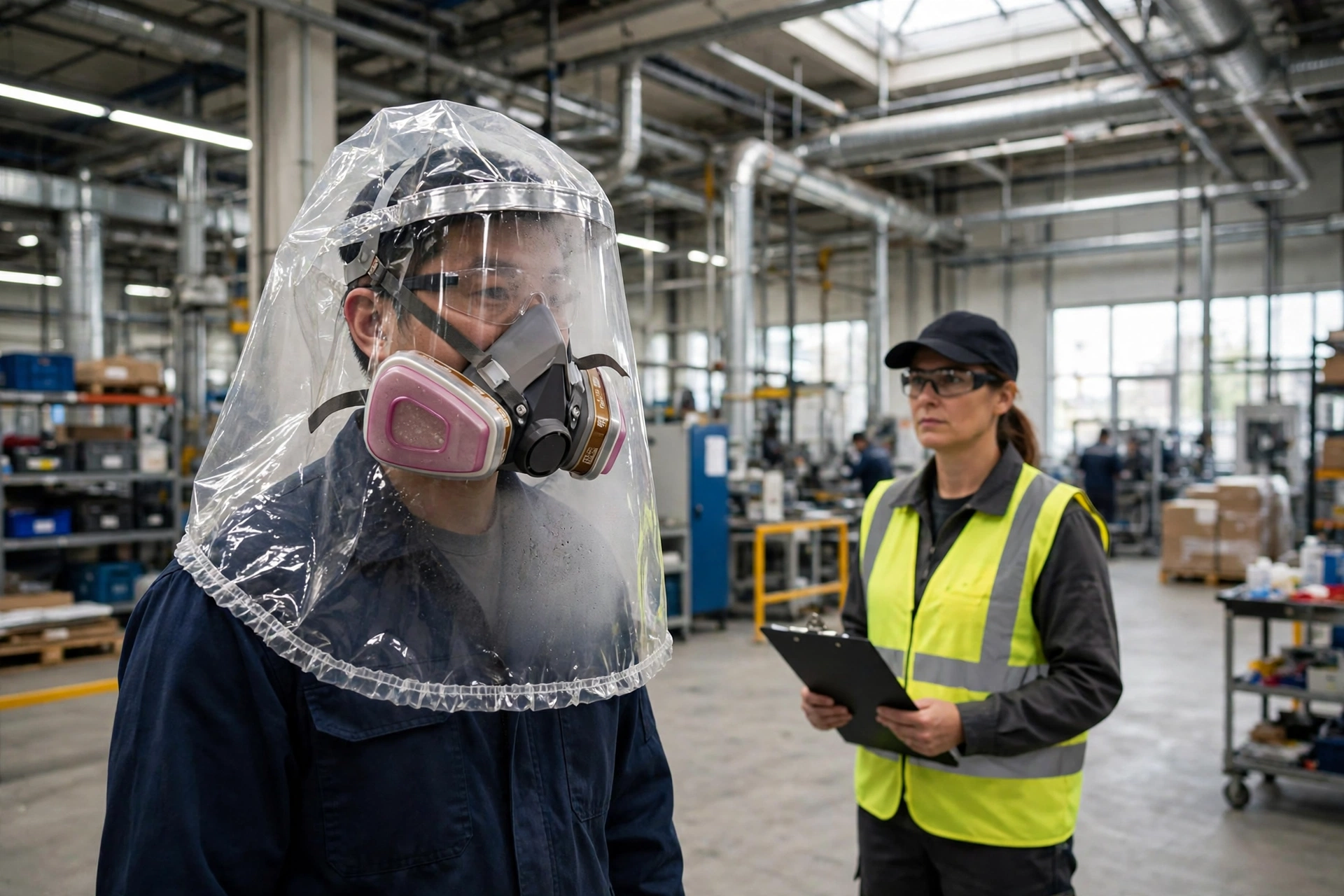
QLFT relies on the wearer’s senses. The wearer puts on the respirator and a test hood, and a challenge agent is introduced: a sweet-tasting saccharin mist, a bitter Bitrex solution, banana-scented isoamyl acetate, or irritant smoke. If the wearer tastes or smells the agent — or coughs at the smoke — the seal has failed. QLFT is cheap, portable, and needs no instrument, which is why it is common for disposable and half-face masks. Its weakness is subjectivity: it gives a pass or fail, not a number, and it depends on the wearer reporting honestly and having normal taste and smell. It cannot be used for full-face respirators under OSHA, because a full-face mask needs a measured fit factor of 500.
Quantitative fit testing (QNFT)
QNFT measures the leak with an instrument. The most common method, condensation nuclei counting, uses a device such as a PortaCount to count particles inside and outside the facepiece and compute a fit factor directly. A second method, controlled negative pressure, briefly draws a small vacuum in the mask and measures how fast air leaks back in. QNFT produces a number that can be filed, audited, and compared across retests — and it is the only option for full-face respirators. It costs more per test and needs calibrated equipment, but it removes the guesswork and gives the employer a defensible record.
Neither method is “better” in the abstract. QLFT is a sound, low-cost choice for a stable workforce wearing half-face or disposable masks; QNFT is the right choice when the hazard demands a full-face mask, when records will be audited, or when you need to know how much margin a good fit actually has.
When Fit Testing Is Required
Under OSHA 1910.134, fit testing is required before an employee first uses a tight-fitting respirator, and then at least annually. It is also required whenever the facepiece changes — a different size, model, or style — and whenever the wearer’s face changes in a way that could affect the seal: significant weight change, dental work, facial surgery, or scarring. A respirator programme that tests once and never again is not compliant, and it is not protective: faces and masks both change over time.
Two steps that often get confused with fit testing are not substitutes for it. A medical evaluation must come first: a physician or licensed healthcare professional must clear the worker to wear a respirator at all, since breathing through a filter adds effort that some medical conditions cannot tolerate. And a user seal check — the quick positive- and negative-pressure check the wearer does every time they put the mask on — is a daily habit, not a test. A seal check catches gross errors such as a twisted strap; it cannot measure a fit factor and cannot replace the annual test.
Five Reasons Fit Tests Fail
Most failures are preventable, and most of them are discovered at the test rather than on the job — which is exactly the point. The common causes:
1. Facial hair in the sealing area
Stubble, a beard, or a moustache that crosses the sealing surface breaks the seal — there is no respirator that seals through hair. OSHA prohibits tight-fitting respirators where facial hair interferes with the seal, and the HSE says the same. A clean-shaven policy for respirator wearers is not a grooming preference; it is a condition of the protection working. Workers who cannot or will not shave need a loose-fitting alternative such as a powered air-purifying hood, which does not rely on a face seal.
2. The wrong size
Faces come in more shapes than most catalogues admit. A mask that is too large gaps at the chin; one that is too small rides up and leaks at the nose. This is why a programme should stock at least two sizes — and ideally two models — of any half-face respirator it issues. A worker who fails in one model is not a problem worker; they are a worker who needs a different mask. Bulk buyers who standardise on a single size to simplify ordering usually pay for it in failed tests and unused stock.
3. Glasses, straps, and headgear conflicts
Temple arms that cross the sealing surface, a hard-hat suspension that pushes the mask, or straps worn over a hood all create leak paths. Spectacle wearers often need a full-face mask with a spectacle kit, or contact lenses, rather than glasses worn under a half-face piece. Test the mask with the other PPE the worker actually wears on the job — not in isolation.
4. Wrong donning technique
Straps in the wrong order, the nose clip unshaped, the chin cup sitting on the lip instead of under the chin — small errors that a five-minute training session fixes. Every fit test should include a donning demonstration, because a worker who passes the test but cannot repeat the fit on Monday morning is not protected.
5. A mask that was never meant for the hazard
A disposable FFP2 that fits beautifully still does not protect against gases, and a half-face mask with particulate filters does not protect against oxygen deficiency. Fit testing proves the seal; it does not prove the selection. Selection starts with the PPE hazard assessment — identify the contaminant, its concentration, and the required protection factor first, then choose the respirator class, then fit test it.
Running a Fit Testing Programme That Holds Up
A defensible programme has five parts: medical clearance before the first test; a documented test for every tight-fitting respirator wearer, before first use and annually; the right method for the mask class — QLFT for half-face and disposable masks, QNFT for full-face; training on donning, seal checks, and limitations; and records kept for each worker showing the mask model, size, method, result, and date. The record is what an inspector asks for, and it is what a buyer should ask a supplier’s programme to produce.
For buyers, the practical lesson is to treat fit as a procurement criterion, not an afterthought. Ask whether the respirator comes in multiple sizes, whether the supplier can provide more than one model for workers who fail in the first, and whether test adapters or fit-test kits are available for the model you are buying. A cheap mask that only fits half your workforce is the expensive option.
Frequently Asked Questions
How often is respirator fit testing required?
Under OSHA 1910.134, before first use and at least annually thereafter, plus whenever the facepiece model or size changes or the wearer’s face changes. The HSE expects the same discipline for tight-fitting respirators used under COSHH in the UK.
Can you fit test a disposable respirator?
Yes. Disposable FFP/N95 masks can be qualitatively fit tested with saccharin or Bitrex, and many programmes do test them. Quantitative testing is also possible with a probed test mask of the same model. A seal check alone is not a fit test.
Does a beard always fail a fit test?
If the hair crosses the sealing surface, yes — no tight-fitting respirator seals through facial hair. The alternative is a loose-fitting powered air-purifying respirator with a hood or helmet, which does not depend on a face seal.
Specifying Respirators for Your Team?
If you are standardising respiratory protection across a site or a resale range, put the product in your hands before you commit: request a free sample kit — the samples are free, you only cover shipping. For bulk and OEM supply across our full PPE range, see our PPE manufacturer and wholesale supplier page, or send your target spec and quantity for a quote.


