



Chemical protective clothing is sold by “type”, and the type number is the single most important thing on the label. It does not describe the fabric. It describes how the whole garment, including seams, zippers, and closures, performs against a defined form of chemical exposure. Choosing the wrong type means the suit can be made of the right material and still fail, because the weak point is the seam or the closure, not the cloth. This guide explains Types 1 to 6, what exposure each one is built for, and how to match a type to a real job before you order.
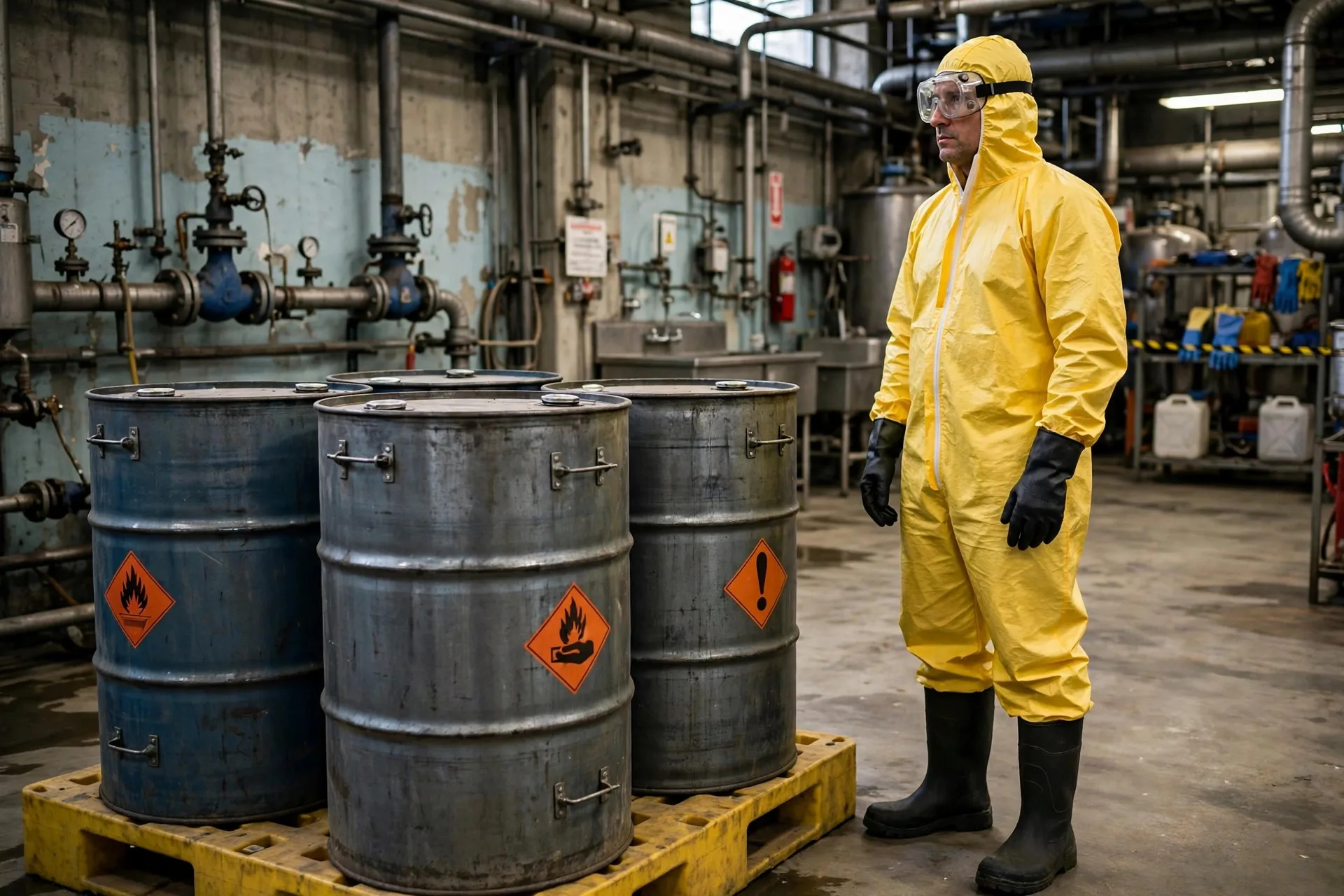
How the Type System Works
Under the European PPE system, chemical protective clothing falls into the highest risk category, because the hazards it guards against can cause serious or irreversible harm. Garments are tested as complete suits, not as fabric swatches. A garment earns its type by passing whole-suit tests for the exposure it claims to resist: gas tightness, liquid penetration under pressure, spray penetration, particle penetration, or limited splash resistance. That is why two suits made from similar material can carry different types, and why a type claim should always be backed by the garment standard and test data for that exact model.
One more principle first: the type system classifies the garment, not the chemical. A Type 3 suit is not “safe against chemical X” in the abstract. Safety depends on the chemical, its concentration, the temperature, and how long contact lasts. Always check the manufacturer’s chemical permeation data for the specific substances in your workplace, and read it alongside the type. For gloves, the same discipline applies: permeation, degradation, and penetration are three different failure modes, and confusing them leads to false confidence.
Type 1: Gas-Tight Protection
Type 1 garments are gas-tight suits for use where exposure to gases, vapours, and liquids could be immediately dangerous. They are the highest level of chemical clothing protection, tested to the EN 943 family of standards, and they are used with breathing apparatus, either worn inside or outside the suit depending on the design. Typical settings are chemical emergency response, tank entry, and work in atmospheres where a toxic gas could be present. Type 1 suits are also the most expensive and the least comfortable for long wear, so they are specified only where the exposure genuinely justifies them, never as a default.
Type 2: Non-Gas-Tight, Positive-Pressure Suits
Type 2 suits are also tested to EN 943, but they are not gas-tight. They maintain a positive pressure of breathing air inside the suit, so that any leakage flows outward rather than letting contaminants in. They suit similar high-hazard environments to Type 1 where full gas tightness is not required but a high level of protection against gases, vapours, and liquids is. In practice, Type 1 and Type 2 are specialist garments for emergency and high-risk chemical work, and most routine industrial buyers will never need them. Their presence in a catalogue does not make them the right choice for a splash or spray job.
Type 3: Liquid-Tight Protection
Type 3 garments protect against pressurised liquid chemicals, such as a jet or stream from a pressurised line, and are tested to EN 14605. The seams are liquid-tight, which is the defining difference from lower types. Choose Type 3 where workers could be hit by a directed jet of liquid chemical: line breaking, pressure washing with chemical solutions, or spraying at close range with a pressurised lance. If the liquid arrives as a jet rather than a mist, a spray-rated suit is not enough, because the pressure drives liquid through closures that resist a fine spray.
Type 4: Spray-Tight Protection
Type 4 garments, also tested to EN 14605, protect against saturation by liquid chemicals in spray form. They are spray-tight rather than liquid-tight: the seams resist spray penetration but are not built for a pressurised jet. This is the right level for many routine chemical-handling jobs, including spray application, washdown, and handling tasks where splashes and aerosols are the main risk. Type 4 is the workhorse type for plant maintenance and chemical processing, and it is often the correct answer where a buyer is tempted to over-specify Type 3 or under-specify Type 6.
Type 5: Protection Against Airborne Particles
Type 5 garments protect against airborne solid particulates and are tested to EN ISO 13982-1. They are the standard choice for dusty work: asbestos removal under controlled conditions, handling fine powders, pharmaceutical manufacturing, and clean-up of dry particulate contamination. A Type 5 suit is about keeping particles out of the garment and off the skin and under-clothing, so seam and closure design matters as much as fabric filtration. Type 5 garments are not liquid chemical suits, and they should not be substituted for Type 3, 4, or 6 where liquid exposure is the hazard.
Type 6: Limited Protection Against Liquid Splashes
Type 6 garments give limited protection against light spray and splashes of liquid chemicals and are tested to EN 13034. “Limited” is doing real work in that sentence: Type 6 is for low-risk, low-volume splash scenarios where the wearer can move away and remove the garment promptly, such as incidental splashes during handling or sampling. It is not a suit for standing in a spray, working under a leaking line, or handling concentrated chemicals at close range. When buyers over-rely on Type 6, it is usually because the garment is light, cheap, and comfortable, and the exposure assessment was never done properly.
Choosing the Right Type: A Practical Sequence
Match the type to the form of the chemical, not to the chemical’s name. Gas or vapour that could be immediately dangerous points to Type 1 or 2. A pressurised liquid jet points to Type 3. Liquid spray or saturation points to Type 4. Airborne particles point to Type 5. A light, incidental splash points to Type 6. Where several forms are present at once, the highest-risk form sets the type, and the garment system must be checked as a whole, including gloves, boots, and respiratory protection worn with it. A Type 4 coverall with the wrong gloves is a system failure, not a garment failure.
Then check three things beyond the type. First, permeation data for your actual chemicals: how long the material resists each substance at working concentration. Second, the garment’s use limits: single-use or reusable, decontamination procedure, and how damage or wear affects protection. Third, the certification documents for the exact model you are buying, which is where many bulk orders go wrong. Our guide to verifying PPE certifications before a bulk order explains what to ask for and what a test report alone does not prove.
Specifying Chemical Clothing for a Bulk Order
When you approach a supplier, specify the type, the garment standard, the chemicals and exposure form, the size range, and whether you need single-use or reusable garments. Ask for permeation data for your substances and a sample in your sizes for fit trials. If you are comparing suppliers, our protective clothing suppliers checklist sets out what to check first, and how to choose chemical resistant gloves covers the hand protection that completes the system. A supplier that cannot produce type-specific test data for the model quoted is not offering a comparable product, whatever the price suggests.
Remember that chemical clothing is regulated as PPE in both the US and the EU, and employers have a general duty to provide protection that fits the assessed hazard. OSHA’s PPE guidance and the general PPE standard 1910.132 set out the employer’s duty to assess hazards and select equipment that fits the exposure. The type system is how that duty is translated into a purchase decision for chemical clothing.
Get Samples Matched to Your Chemical Exposure
If you know your exposure form and your chemicals, send us the details and we can recommend garments by type with matching gloves and accessories, and provide free samples for fit and performance trials; the buyer covers shipping. Use the contact form and include the chemical names, exposure form, size range, and quantities, and we will respond with matched options rather than a generic catalogue.
Related Guides
Protective Clothing Suppliers: What to Check First | How to Choose Chemical Resistant Gloves: 6 Steps | How to Verify PPE Certifications Before a Bulk Order


