



A railway is several workplaces laid out along one line. The ballast gang, the inspection team, the electrification crew, and the depot fitters each face a different hazard profile, and the protective kit that works on the track can be wrong — or dangerous — near live traffic or overhead power lines. Buying PPE for railway workers therefore starts with the task and the location, not the catalogue.
This guide walks through the kit task by task, explains which standards govern each item, and closes with the buying checks that keep a workforce consistent: sizing, inspection, replacement, and certification verification.
Start With the Hazard Assessment, Not the Catalogue
Under OSHA’s general PPE rule, 29 CFR 1910.132, the employer must assess the hazards of each work area, select the PPE that controls them, and make sure it is used and maintained. That assessment is the document a buyer should ask for before ordering anything: it names the hazards per task and per location, and the kit follows from it. Our PPE hazard assessment guide explains the process step by step, from walking the site to writing the specification.
A practical way to run the assessment is to map the work into tasks and list the dominant hazard of each: moving trains and road vehicles at crossings, sharp ballast and hand tools during track work, noise from passing traffic and machinery, dust in tunnels and ballast handling, and electrical hazards near overhead lines and traction power equipment. One worker may cross several of these in a shift, so the kit has to be layered — a base kit worn all day, plus task-specific items added at the location.
The Task-by-Task Kit
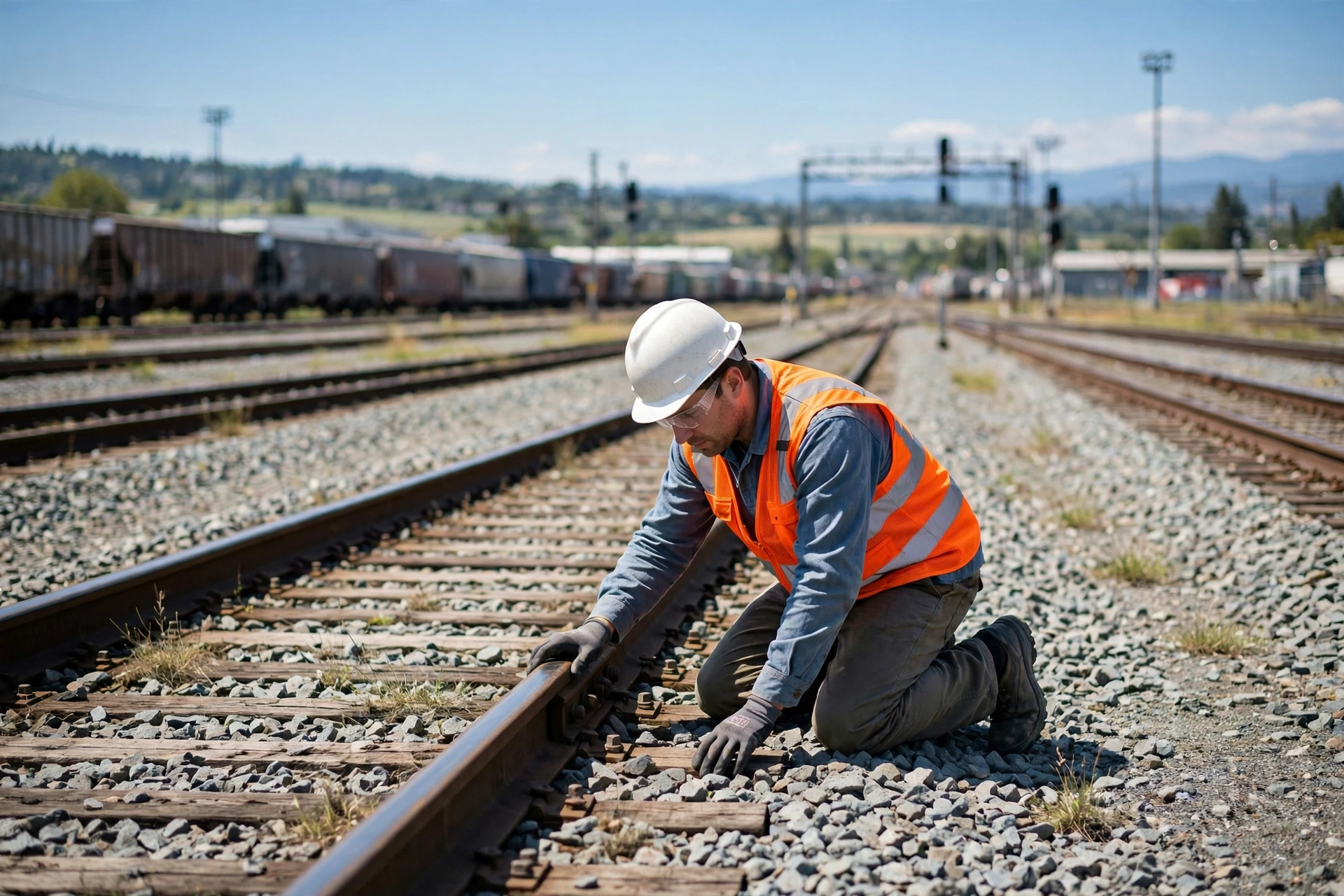
Track inspection and maintenance. The ballast bed is the everyday hazard: sharp stone, uneven footing, and hand tools used close to the body. The core items are puncture-resistant safety boots, cut-resistant gloves for handling rail fastenings and tools, eye protection against stone chips and dust, and high-visibility clothing so the gang is visible to drivers and machine operators. OSHA’s foot protection rule, 29 CFR 1910.136, requires protective footwear wherever falling, rolling, or piercing objects threaten the foot — ballast work meets that test on all three counts. Our EN ISO 20345 safety footwear standards guide explains toe protection, puncture-resistant soles, and slip ratings.
Working near live traffic. The defining risk of track work is a train arriving on an adjacent line. PPE cannot stop a train, so the controls are lookout procedures, possession arrangements, and warning systems — but high-visibility clothing is the last line that makes a worker seen in time. Specify garments to EN ISO 20471, and choose the class for the speed and light conditions of the line, not the lowest price. Fluorescent orange is the usual railway choice because it stands out against ballast, vegetation, and steel. Keep hi-vis clean and replace it when the fluorescence fades: a dirty vest is a failed vest.
Electrified lines and traction power. Overhead lines and third rails must be treated as live unless they have been isolated and proven dead under the railway’s own rules. The PPE side of that discipline is insulated gloves and dielectric footwear where the task requires working near energised equipment, plus strict separation between the electrical kit and the general kit — an insulating glove with a cut or a puncture is not an insulating glove. Check test dates before every use, store insulating gloves away from sharp tools and sunlight, and retire any pair that fails its air test. Ordinary work gloves must never be substituted for the rated item.
Night work and bad weather. Much track work happens at night, when traffic is lighter — and when visibility is worst. Night shifts need the highest class of hi-vis, with reflective tape on both torso and legs, and headlamps that leave both hands free. Wet ballast is slippery ballast, so sole grip matters as much as toe protection; rain also degrades hi-vis fluorescence, which is another reason to retire faded garments rather than stretch their life. Cold and heat change glove choice too: a glove that is warm enough to keep on is safer than a better-rated glove that gets taken off.
Tunnels, cuttings, and enclosed spaces. Dust is the slow hazard of railway work: ballast dust, brake dust, and diesel exhaust in tunnels and depots. Where the assessment shows airborne particles, fit-tested respirators are the answer, not loose dust masks. Our respirator ratings guide explains N95, FFP2, and FFP3, and our fit testing guide explains why a respirator that leaks at the seal protects no one. Eye protection with a dust seal is the matching item for tunnel work.
Head, Eye, and Hearing Protection
A helmet to EN 397 is the baseline for track and depot work — falling tools, low structures, and overhead equipment all argue for it. Where electrical work is involved, the helmet must carry the electrical insulation marking as well, and the chin strap should be worn: a helmet that falls off at the first bend is decoration. Eye protection to EN 166 should be matched to the task — impact-rated lenses for cutting and grinding, sealed goggles for dust, and tinted lenses for bright outdoor work.
Noise is easy to underestimate on a railway because the loudest events are brief: a passing train, a tamper, a grinder. OSHA’s noise rule, 29 CFR 1910.95, sets the framework, and the practical step is hearing protection rated for the task — ear muffs that fit under a helmet, or plugs for workers who also need to hear warning signals. Our hearing protection ratings guide explains SNR and NRR so the buyer can compare products on the same basis. The rule for the crew is simple: if you have to raise your voice to be heard at arm’s length, the protection goes on.
Gloves and Sizing: The Item Most Often Got Wrong
Gloves fail in two ways on a railway: they are too light for the task, or they do not fit. A loose glove snags on fastenings and tools; a tight glove numbs the hand and gets taken off. Track work needs a cut-resistant palm for handling rail, fastenings, and cable, plus grip in wet conditions — see our cut resistant gloves for metal work selection guide and our safety glove size chart for the measuring method. Order the full size range from the start and run a wear trial with the gang before committing: hands differ, and a size run ordered blind becomes a drawer of unworn gloves.
Heat is a real factor too. Track work in summer sun combines physical effort with radiant heat from ballast and steel, and PPE that traps heat gets discarded. Our heat stress and PPE guide covers scheduling, hydration, and choosing lighter garments where the risk assessment allows it. The kit that stays on the worker is the only kit that protects.
Buying in Bulk: The Checks That Keep a Fleet Consistent
Verify certificates before you pay. Every item in the kit should arrive with a certificate or declaration that matches the standard claimed on the label — and the certificate must name the model you actually received, not a similar one. Our PPE certification verification guide explains what to ask for, how to read an EU type-examination certificate, and the red flags that mark a claim as untested.
Plan inspection and replacement from day one. Gloves wear out in weeks, boots in months, helmets on a fixed schedule after any impact, and hi-vis when its fluorescence fades. A written inspection and replacement schedule keeps the fleet protective instead of decorative — see our PPE inspection and replacement guide. Ask the supplier for the manufacturer’s retirement instructions in writing before the first order, and confirm that identical models will still be available in a year: a fleet of mixed, incompatible models is far harder to inspect than a standardised one.
Judge the supplier, not just the price. Consistent sizing across batches, a stable model range, honest lead times, and a willingness to supply samples are worth more than a small unit-price saving. Our guide to choosing a PPE manufacturer and our protective clothing suppliers checklist set out the questions that separate a reliable partner from a one-off shipment.
Related Guides
For the details behind this guide, see our PPE hazard assessment guide, our EN ISO 20471 hi-vis classes guide, and our EN ISO 20345 safety footwear standards guide.
Railway work rewards buyers who specify per task and test before they commit. If you are putting together a kit for your gang — hi-vis, helmets, hearing protection, gloves, and boots in bulk — contact us with your task list and headcount. We supply free samples so your crew can wear-test the shortlist on your track before you order, and you cover only the shipping.


