



A chemical plant asks personal protective equipment to do one job that no other industry demands in the same way: keep a substance that can burn, corrode, poison, or sensitise away from skin, eyes, and lungs, shift after shift, in heat, in confined spaces, and under time pressure. The wrong glove is not an inconvenience — it is a breakthrough that reaches the skin while the worker still believes they are protected. This guide explains what to specify for each area of a chemical plant, which standards to ask for, and how to buy it in bulk.
Why Chemical Plant PPE Is Different
Three things set chemical plants apart. The first is that the hazard is specific to the substance: the glove that holds back one solvent can fail in minutes against another, and the suit that protects against a splash may be useless against a vapour. Generic claims — “chemical resistant” with no chemical named — are worth nothing. The second is that exposure is often invisible: vapours have no colour, and a glove can look intact while the chemical has already passed through it. The third is that the consequences escalate fast: a splash, a leak, or a loss of containment can turn a routine task into an emergency in seconds, so the PPE has to work together with emergency showers, eyewash stations, and escape respirators, not as a standalone purchase.
Regulation sits underneath all of it. In the United States, OSHA’s hazard communication standard requires employers to inform workers about the chemicals they handle — labels, safety data sheets, and training — and OSHA’s process safety management standard covers the handling of highly hazardous chemicals, including the PPE that goes with each process. OSHA’s general PPE standard requires the employer to assess the hazards of each task and provide the matching protection. The standards buyers most often need to name on a purchase order are EN ISO 374 for chemical gloves, EN 14605 and EN 13034 for chemical protective clothing, EN 166 for eye protection, EN ISO 20345 for safety footwear, and EN 140/143 for respiratory filters and half masks.
Chemical Protective Clothing: Types and Selection
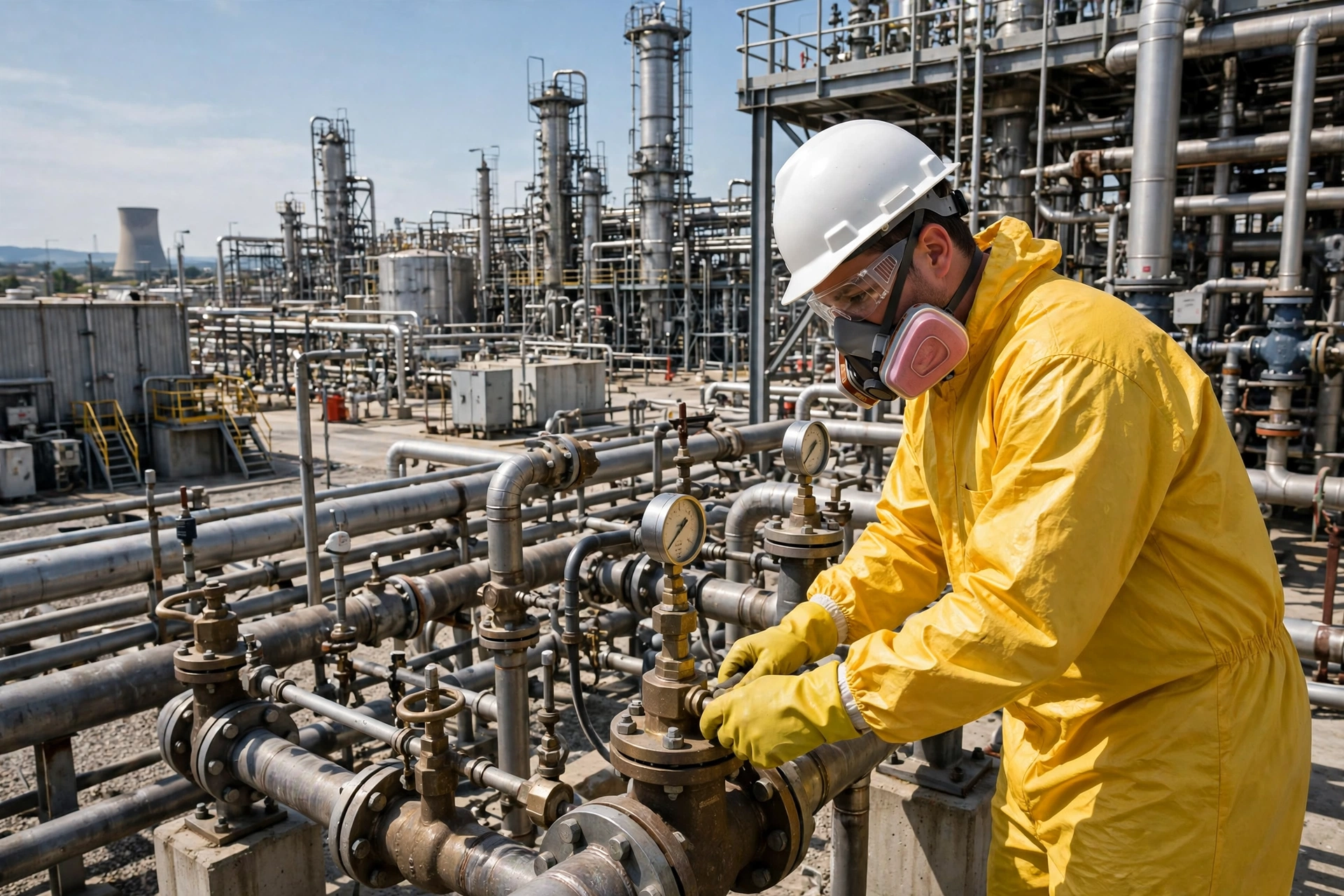
Chemical protective clothing is classified by the type of exposure it is built for, and the classification is the first thing to get right. Type 1 is gas-tight, Type 2 is non-gas-tight, Type 3 protects against pressurised liquid jets, Type 4 against liquid spray, Type 5 against airborne solid particulates, and Type 6 against light spray — the lower the number, the heavier the protection. Our guide to chemical protective clothing types 1–6 explains the full system. Most routine chemical plant work — sampling, drum handling, maintenance in a process area — sits at Type 4 or Type 6, while entry into a vessel or a known leak needs Type 1 or 2 with breathing apparatus. Buying a Type 6 suit for a Type 3 job is not a saving; it is an exposure.
The suit must be chosen from permeation data for the specific substances in the plant, covering the concentration and temperature in use, not a laboratory best case. The seams and closures are the second weak point: a suit is only as strong as its weakest seam, and zips, cuffs, and hoods are where splashes get in. Specify sealed or taped seams where the task calls for them, and check the suit for damage before every use — a pinhole is a failure. For light contamination work, disposable coveralls are often enough; our guide covers how to choose between types.
Gloves: Breakthrough Time and Compatibility
Gloves are the most-used item in a chemical plant and the easiest to get wrong. The decisive number is breakthrough time — how long it takes a chemical to pass through the glove material — and it is specific to one chemical, one material, and one thickness. Our explainer on chemical glove breakthrough time shows how to read it: a glove rated for eight hours against one solvent may fail in fifteen minutes against another, and a thicker glove of the same material lasts longer but costs dexterity. Always check the manufacturer’s chemical compatibility chart for the exact substances in your plant — our guide to how to read a glove chemical compatibility chart walks through it — and never rely on a generic “chemical resistant” label.
Material choice follows the chemical. Nitrile is the usual default for disposable handling: it resists oils, greases, and many solvents, and it is latex-free, which matters because latex proteins can trigger allergies in workers. Butyl rubber suits ketones and esters that defeat nitrile; PVC suits acids and alkalis; neoprene covers a broad middle range. No single material covers everything, and a plant that handles several chemical families will need several glove types on the shelf, each labelled for its use. Our comparison of nitrile vs latex vs vinyl gloves sets out the trade-offs. Fit matters as much as material: measure hands properly before ordering — see our safety glove size chart — and change gloves on a schedule based on breakthrough time, not when they look worn.
Eye, Face, and Respiratory Protection
Eye protection in a chemical plant means sealed goggles, not open safety glasses, wherever splashing is possible — sampling, pouring, mixing, and line breaking. A face shield goes over the goggles where a larger splash is possible; it is a second layer, not a replacement. Our guide to EN 166 eye protection markings explains what the lens and frame ratings mean, including the liquid-splash and large-dust markings buyers should ask for. Eyewash stations must be within reach of every area where chemicals are handled, and workers need to know where they are before they need them.
Respiratory protection depends on the contaminant and the concentration. Particulate filters cover dusts; gas and vapour cartridges cover solvents and process gases; a combination filter covers both. A half mask with the right cartridges suits most routine tasks, while a full face mask adds eye protection and a higher protection factor, and a supplied-air system is needed where oxygen may be low or the concentration is unknown — confined-space entry and emergency response. Every wearer must be fit tested on the exact model they will use — our guide to respirator fit testing explains why it matters — and cartridges must be changed on a schedule, not when the wearer starts to smell the chemical, because by then the cartridge has already failed. Our comparison of N95 vs FFP2 vs FFP3 respirator ratings helps match the filter class to the particulate level.
Head, Hearing, Footwear, and Hi-Vis
Hard hats to EN 397 are the baseline wherever overhead work, pipe racks, and suspended loads are part of the day, and the shell and harness must be checked for chemical damage as well as impact damage — solvents and UV degrade a helmet over time. Our guide to safety helmet standards explains the ratings and the inspection routine. Hearing protection belongs in the kit wherever pumps, compressors, and steam lines run loud for a full shift; our comparison of SNR vs NRR hearing protection ratings helps match protectors to the measured noise level.
Safety footwear to EN ISO 20345 is the baseline across the plant — toe protection where drums, pallets, and pipe sections move, and slip resistance on floors that carry spilled product and wash water. Our guide to safety footwear standards explains the S1–S7 ratings; in chemical areas the sole and upper also need resistance to the substances on the floor, and chemical-resistant boots are a separate specification from a general safety boot. High-visibility clothing to EN ISO 20471 matters wherever vehicles, forklifts, and tankers move — the loading bay, the tank farm, and any area shared with moving equipment. Our guide to EN ISO 20471 hi-vis classes explains the class system.
Emergency Response and Decontamination
Chemical plant PPE is not complete without the emergency kit: escape respirators kept within reach of process areas, gas-tight suits and breathing apparatus for the emergency team, and a decontamination routine for everything that comes out of a contaminated area. Used chemical gloves and suits must be treated as contaminated waste, not returned to a shared rack, and workers need a clear routine for removing gloves and suits without touching the outside surface. Training should cover it practically: how to put on and take off a chemical suit without contaminating hands, when to change a glove, where the nearest shower and eyewash are, and what to do in the first minute of a splash.
Buying in Bulk: What to Check Before You Order
Chemical plant PPE is bought in volume — boxes of chemical and disposable gloves every week, plus seasonal runs of suits, respirators, and boots. That makes the supplier check more important, not less. Before placing a bulk order, verify the certificates behind the products: EN ISO 374 for chemical gloves, EN 14605 or EN 13034 for chemical clothing, EN 166 for eye protection, EN ISO 20345 for footwear. Ask for the EU declaration of conformity and the test reports, and check them against the model you are actually buying — a certificate for one model does not cover another. Our guide on how to verify PPE certifications before a bulk order walks through the checks step by step.
Size mix is the detail most bulk orders get wrong. A crew is not one size, and gloves, suits, and boots that do not fit are not worn — or are worn badly. Order a size range based on a real headcount, not a guess, and include a small trial quantity of any new product before committing to the season’s volume. Check the supplier’s lead time and re-order reliability too: running out of chemical gloves mid-shift is not a problem you want to solve at retail prices. For the wider supplier questions — MOQ, sampling, audits — see how to choose a PPE manufacturer and what PPE distributors look for in a manufacturer partner.
Fit, Training, and Storage
Even the right equipment fails if it is not fitted and used correctly. Gloves need the right size so workers keep dexterity on valves and instruments; respirators need fit testing on the exact model; suits need adjusting to the wearer so cuffs and hoods seal. A short fitting session at the start of a season — with the actual products, on the actual workers — pays for itself in compliance. Training should be practical: how to read a compatibility chart, when to change a glove, how to check a suit for pinholes, and how to remove contaminated kit safely. Storage matters as well: keep PPE away from sunlight, heat, and the chemicals it protects against, and keep clean kit separate from used kit. See our guide to PPE inspection and replacement schedules for the routine that keeps the kit honest.
Related Guides
For the standards behind the choices in this guide, read Chemical Protective Clothing Types 1–6 Explained, Chemical Glove Breakthrough Time Explained, and How to Conduct a PPE Hazard Assessment.
Get a Quote for Your Plant
Aceppe supplies chemical plant PPE in bulk — chemical and disposable gloves, chemical protective suits and coveralls, respirators, sealed goggles and face shields, helmets, safety boots, and hearing protection — built to the standards above and shipped worldwide. Tell us the substances your plant handles, the tasks your crew does, and your headcount, and we will put together a chemical-matched kit with samples before you commit. Free samples are available — the buyer covers shipping. Contact us for a quote today.


