



Static electricity is invisible until it is expensive. A charge built up by walking across a floor, standing up from a chair, or removing a garment can discharge through a sensitive electronic component and damage it without leaving a mark anyone can see. Electrostatic discharge control exists to stop that chain, and footwear is one of its most practical links — because everyone in a protected area is already wearing shoes. This guide explains ESD workwear footwear from first principles: what ESD shoes are, how they work as part of a system, where they are used, and how to choose the right pair for electronics workplaces.
What ESD Shoes Actually Are
ESD shoes are safety or work shoes built with static-dissipative soles. The key word is dissipative: the sole lets accumulated charge flow away gradually, through the shoe and into a suitable floor, instead of building up and discharging in a sudden spark. This is different from ordinary safety shoes, whose soles are typically insulating — they neither generate a controlled path nor prevent charge buildup — and different again from fully conductive footwear, which drains charge very fast and belongs to different environments with their own rules. For most electronics workplaces, dissipative footwear is the intended middle path: controlled drainage, not insulation and not a short circuit.
The dissipative property lives in the sole construction, not in a label. Soles achieve it through dissipative materials and construction, and the finished shoe is verified as a unit rather than by its appearance. Two shoes that look identical can behave differently, which is why buyers should ask how dissipation is verified for the specific shoe being offered and what documentation can be provided on request to support it. Appearance, brand markings, and price tell you nothing about dissipation on their own.
How ESD Shoes Work — As a System, Not Alone
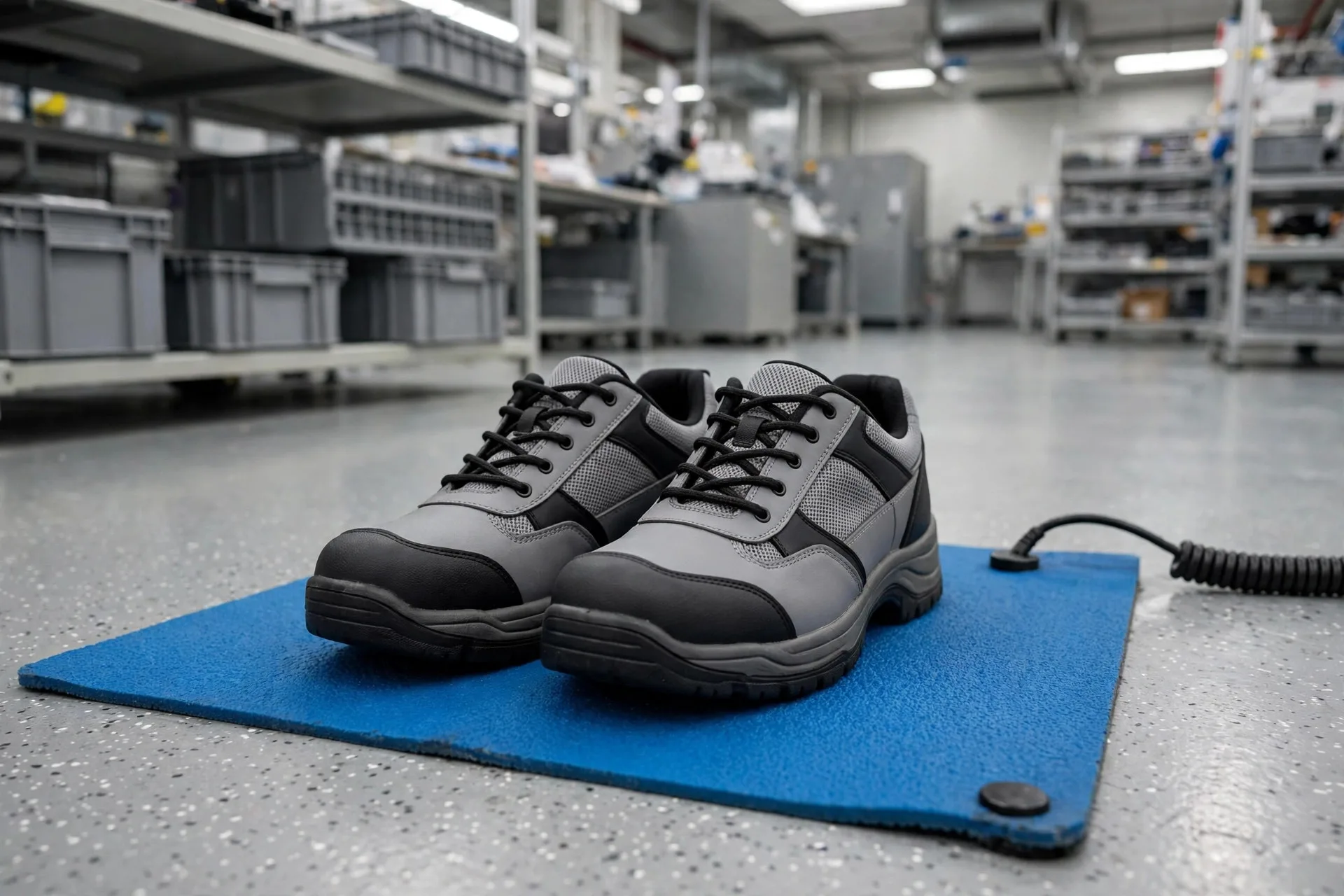
The most important idea in this guide is that an ESD shoe does not work alone. Charge drains from the person, through the shoe, into the floor, and then to ground through the flooring system. If any link in that chain is missing — the shoe is dissipative but the floor is an ordinary insulator, or the wearer is standing on a mat that is not part of the grounded system — the shoe cannot do its job. This is why footwear decisions belong inside an electrostatic protected area (EPA) plan, alongside flooring, worksurfaces, garments, and handling rules, rather than as a standalone purchase.
That system view also explains the most common disappointment with ESD footwear: shoes bought for an area whose floors were never made dissipative. Before specifying shoes, check the floors they will stand on. Dissipative or conductive flooring, properly installed and maintained, is the partner the shoe needs. If your floors are not part of a grounded system, the honest next step is to address flooring first or to use another grounding method for seated and standing work, rather than expecting shoes to compensate for a missing link.
The wearer’s other clothing matters too. Socks and insoles sit between the foot and the shoe, and an insulating insole or thick non-dissipative sock can break the path the shoe is meant to provide. When you introduce ESD shoes, ask the supplier whether insoles and socks affect performance for that shoe, and what the supplier recommends wearing with it. A shoe tested with one insole and worn with another is a different system from the one that was verified.
Where ESD Shoes Are Used
Electronics assembly is the classic case: operators moving between benches, handling boards and components, standing and walking on dissipative floors. But the same logic applies anywhere static-sensitive items are handled by people on foot — electronics repair, component warehousing and kitting, cleanroom-adjacent production, and quality inspection areas where devices are handled outside their protective packaging. In each case, the question is the same: do people move around the sensitive items, and is there a grounded floor system for their shoes to work with? If both answers are yes, dissipative footwear belongs in the plan.
Seated work is a partial case worth understanding. A seated operator’s shoes may not be in reliable contact with the floor, which is why wrist straps and grounded worksurfaces carry the primary role at benches. Footwear still matters for the same operator’s movement — walking to stores, to test, between benches — and for everyone else who moves through the area. Treat shoes as the mobile grounding layer and wrist straps as the seated layer; they complement each other rather than replacing each other.
Choosing ESD Shoes: The Selection Points
Start with the safety requirements of the workplace, then add the static requirement, not the other way around. If the area needs toe protection, puncture resistance, slip resistance, or chemical resistance, those come first in the specification, and dissipation is specified alongside them. A shoe that dissipates beautifully but fails the site’s safety requirements is not a candidate. Ask suppliers to confirm both sides — safety properties and dissipative properties — for the same shoe, with documentation available on request for each.
Fit and comfort decide whether the system works in practice, because shoes that hurt get modified: insoles swapped, laces loosened, shoes left unworn where they are most needed. Trial the shoe on the people who will wear it, for full shifts, on the actual floors, doing the actual movement the job involves. Check fit across the size range, comfort over a shift, grip on your floors, and whether the shoe stays comfortable with the socks and any insoles your site standardizes on. A trial that only covers standing still is not a trial of work footwear.
Ask how dissipation is verified, and how often it should be re-checked. Suppliers should be able to explain the verification approach for their shoes and what routine checks look like in service — typically a regular footwear check as part of the EPA routine, using the site’s own test arrangement. Agree on that routine before purchase, because a shoe whose verification routine nobody follows will drift out of compliance silently: soles wear, insoles get swapped, floors get coated, and nobody notices until an audit or a failure.
Sole and upper choices follow the workplace. Smooth floors, wet areas, oily areas, and outdoor movement each push toward different sole patterns and materials; cleanroom-adjacent areas may need low-lint uppers and easy cleaning. Discuss these with the supplier in terms of your floors and tasks, and trial on your floors — grip and wear that feel right on one surface can be wrong on another. Comfort features such as cushioning and breathability matter over long shifts, but they are secondary to safety, dissipation, and grip, in that order.
Use, Care, and Replacement
ESD shoes need a use routine, not just a purchase. Wear them only in the protected area where possible, or accept that outside wear brings in dirt and contamination that affect both floors and soles. Keep the routine checks running on schedule, and treat a failed check as a maintenance event: inspect the shoe, check insoles and socks, check the floor contact, and replace or repair before returning the shoe to service. Record checks per person or per pair where your programme requires it, so drift shows up as a pattern rather than a surprise.
Replace shoes when they no longer pass their routine check, when soles are worn enough to change contact or grip, or when damage affects safety or dissipation. Do not judge replacement by appearance alone: a clean-looking shoe with a worn sole can fail while a scuffed shoe passes. The check result, not the calendar or the appearance, should drive replacement — and the replacement should be the same verified shoe or a freshly trialled alternative, not whatever is nearest in the store.
Common Mistakes With ESD Footwear
- Buying the shoe without the floor. Dissipative shoes on insulating floors cannot drain charge. Check the flooring system first.
- Assuming any safety shoe qualifies. Ordinary safety shoes are typically insulating. Dissipation must be specified and verified for the specific shoe.
- Breaking the path with insoles or socks. Insulating insoles or socks can interrupt drainage. Standardize what is worn with the shoe and check it.
- Skipping routine checks. Soles wear, floors change, and insoles get swapped. Without scheduled checks, the system drifts silently out of compliance.
- Judging by label alone. Dissipation is a property of the finished shoe, verified as a unit. Ask how it is verified and what documentation supports it.
Frequently Asked Questions
Look for shoes with a static-dissipative sole — not merely antistatic — that are qualified as a system with your floor. The footwear–flooring system must pass the walking test in ANSI/ESD STM97.1 / IEC 61340-4-5: resistance to ground below 10^9 ohms and body voltage under 100 volts. If the job also needs toe protection, choose ESD safety shoes that combine both, and always ask the supplier for the test report. Daily checks on a footwear tester catch worn soles before they fail an audit. See the ESD Association’s ANSI/ESD S20.20 standard and IEC 61340-4-5.
Related Guides
- ESD Workwear — the pillar guide for building an electrostatic-safe workwear programme.
- Anti-Static Clothing — how dissipative garments and footwear work together in a protected area.
Next Step: Request a Sample Kit
The fastest way to judge ESD footwear is a trial on your own floors. Request a free sample kit through the contact form — free samples, you only cover shipping — and run the fit, grip, and routine-check trials above before committing to volume. A supplier worth a bulk order will welcome that sequence, because it is the same sequence that protects both sides once supply starts.


