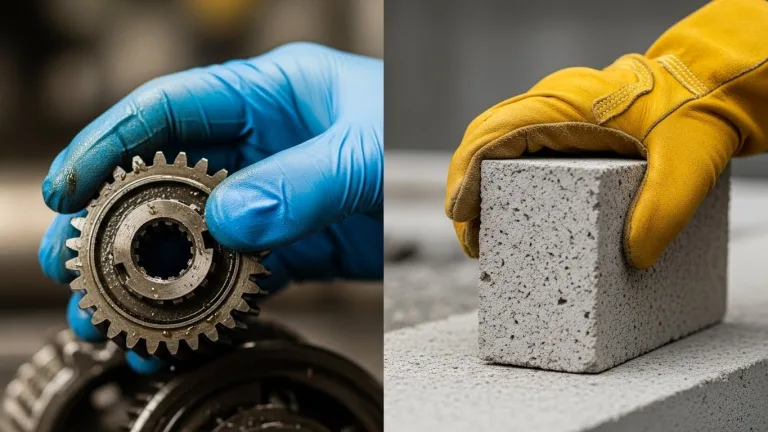



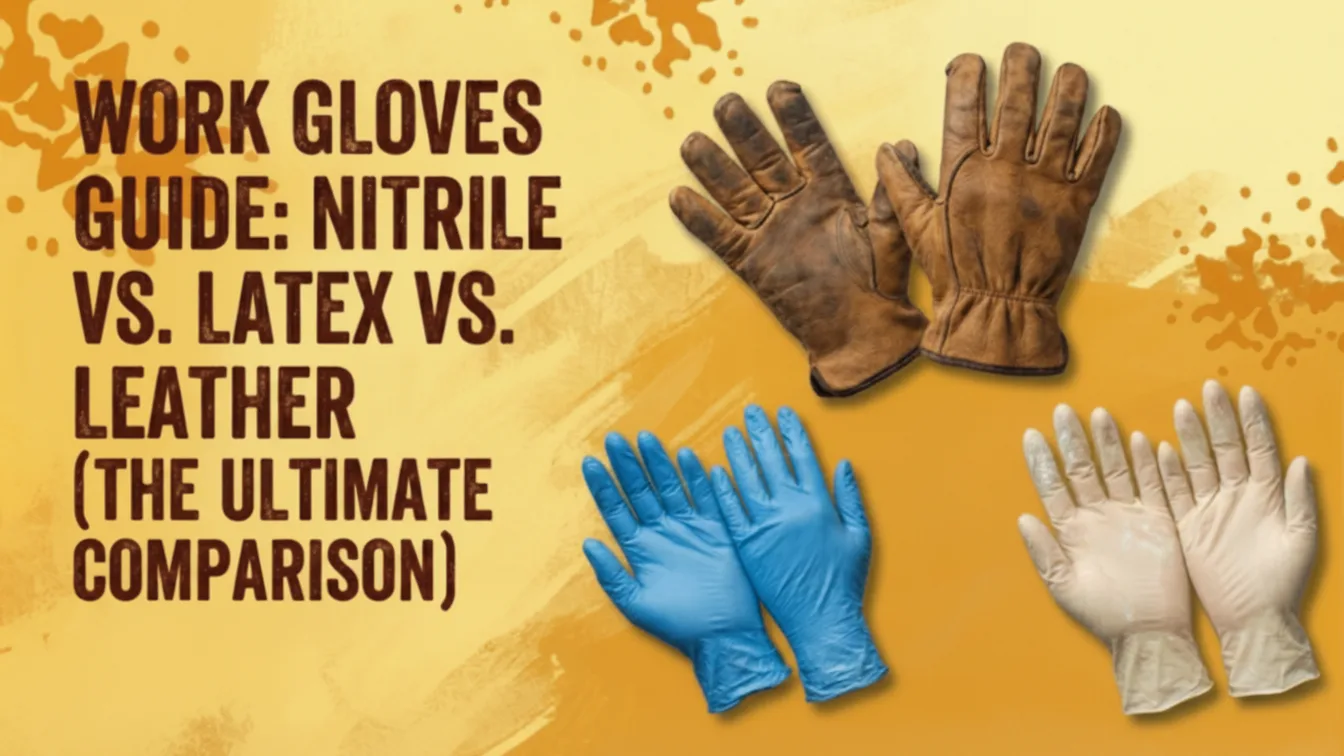
Choosing between nitrile, latex, and vinyl disposable gloves is not about finding the “best” material — it is about matching the glove to the hazard. Each polymer trades off chemical resistance, fit, allergen risk, and cost differently, and a poor choice can mean anything from a torn glove mid-task to a serious allergic reaction. This guide compares the three materials head to head and gives you a practical selection framework you can apply on the shop floor, in the lab, or at the clinic.
Nitrile vs Latex vs Vinyl: Quick Comparison
| Property | Nitrile | Latex (natural rubber) | Vinyl (PVC) |
|---|---|---|---|
| Chemical resistance | Excellent against oils, fuels, many solvents | Good for acids/alkalis; poor against oils and solvents | Limited; for low-risk tasks only |
| Puncture resistance | Best of the three | Good | Lowest |
| Allergen risk | Latex-free; low allergy risk | Natural latex proteins can trigger allergies | Latex-free; low allergy risk |
| Fit & dexterity | Snug, conforming; very good | Most elastic; superior comfort and tactile sensitivity | Looser fit; least dexterous |
| Durability in use | High | High | Low; prone to micro-tears |
| Typical cost | Medium–high | Low–medium | Lowest |
Keep this table as a starting reference — the sections below explain what each line really means in practice.
Nitrile Gloves: The All-Round Workhorse
Nitrile is a synthetic rubber (acrylonitrile-butadiene) engineered as a latex substitute. It is now the default choice for most industrial and medical settings, and for good reason:
- Best puncture resistance among the three materials — a critical advantage where sharps, burrs, or abrasive parts are present.
- Strong chemical barrier against petroleum products, oils, greases, and many solvents. For tasks involving chemicals, nitrile is the clear front-runner.
- Latex-free, eliminating natural rubber allergy risk for both wearer and patient.
- Good fit — nitrile conforms to the hand with body heat, giving solid dexterity for detailed work.
Trade-offs: nitrile costs more than vinyl or latex, and very low-quality nitrile gloves can split at the cuff if the compound or thickness is inadequate. Powder-free is now the norm — powdered gloves are discouraged because airborne powder can carry latex proteins and contaminate wounds.
Latex Gloves: Unmatched Comfort, With an Allergy Caveat
Natural rubber latex remains the most elastic and comfortable disposable material. Surgeons and precision assembly workers have long preferred it for its “second skin” feel:
- Superior elasticity and tactile sensitivity — the best fit and dexterity of the three.
- Good resistance to acids, alkalis, and water-based chemicals, though it degrades on contact with oils, fuels, and many organic solvents.
- Generally the most economical among high-performance options.
The decisive drawback is latex allergy. Natural rubber contains proteins that can cause reactions ranging from contact dermatitis to life-threatening anaphylaxis — and repeated exposure can sensitize people who initially had no problem. For this reason, many hospitals, food plants, and industrial facilities have moved to latex-free policies, replacing latex with nitrile as the standard. If any wearer or nearby person has a known latex allergy, latex gloves are simply off the table.
Vinyl Gloves: Budget Option for Low-Risk Tasks
Vinyl gloves are made from PVC plasticized with additives. Their main selling point is price — they are the cheapest disposable glove by a wide margin:
- Lowest cost, attractive for high-volume, short-duration use such as food handling, light cleaning, or visitor areas.
- Latex-free, so no rubber-allergy concern (some people are sensitive to certain plasticizers, but this is rare).
But the protection is genuinely limited: vinyl has the weakest barrier integrity of the three, with higher rates of micro-tears and leaks, especially during longer wear or when stretched. It offers little real chemical resistance and fits loosely, reducing dexterity. Rule of thumb: vinyl is acceptable for short, low-risk tasks where glove failure has minor consequences — food prep, housekeeping, janitorial work — but not for chemical handling, mechanical work, or any setting where barrier failure could cause harm.
How to Choose: A Practical Decision Framework
1. Start with the chemical hazard
What will the glove touch? If the task involves solvents, oils, fuels, or industrial chemicals, nitrile is usually the right answer — but “nitrile” alone is not enough. You need to match the specific chemical against breakthrough time data: the tested time it takes for that chemical to permeate the glove at a molecular level. Manufacturers publish chemical resistance charts; learn how to read them before standardizing a glove. Our guide to chemical glove breakthrough time explains permeation vs. degradation vs. penetration and how to use the ratings.
2. Rule out latex when allergies are possible
Check your workforce and any people they serve. If anyone has a latex allergy — or if you cannot be sure — go latex-free (nitrile or vinyl). Many organizations simply standardize on nitrile to remove the question entirely.
3. Match durability to task duration
A disposable glove is meant for a limited wear period, but tasks differ. Vinyl may survive a ten-minute food-prep shift but is a poor bet for a two-hour lab session. For extended or demanding tasks, the puncture and tear resistance of nitrile pays for itself in fewer changes and less rework.
4. Fit matters more than most buyers think
An oversized glove tears more easily, snags on equipment, and reduces grip — all of which create hazards of their own. Fit-test across sizes; nitrile and latex conform to the hand, while vinyl tends to run loose. If fine motor control matters (instrument work, small fasteners), latex offers the edge in feel, nitrile is close behind.
5. Total cost, not unit price
Vinyl looks cheapest per box, but if gloves fail twice as often, the real cost includes doubled consumption, task interruptions, and potential exposure incidents. For most industrial buyers, mid-priced nitrile is the lowest total cost once failures are counted.
What Disposable Gloves Will Not Protect Against
An important reality check: disposable gloves — of any material — are not cut-resistant gloves. Thin polymer films tear readily against blades, sheet metal edges, and glass. If your task involves cut hazards, you need a dedicated cut-protection glove rated under EN 388 cut levels (Coupe or TDM test), worn either instead of or over the disposable glove depending on the contamination risk. Do not assume a “durable” nitrile exam glove offers meaningful cut protection — it does not.
Regulatory and Handling Notes
- Medical use: exam gloves used in healthcare are regulated as medical devices in many jurisdictions (e.g., by the FDA in the US). Buy from suppliers who can provide the required certifications; cheap unbranded imports have repeatedly failed barrier tests.
- Workplace programs: OSHA’s PPE guidance requires employers to assess hazards and select protective equipment that fits the exposure — gloves included.
- Storage: keep gloves in a cool, dry place away from UV light and ozone sources. Natural latex degrades fastest; nitrile and vinyl are more storage-stable. Respect printed expiry dates — expired gloves fail more often.
- Single use means single use. Disposable gloves should never be washed and reused; washing degrades the barrier and creates a false sense of security.
Bottom Line
For most industrial and medical buyers, nitrile is the safest default: the best combination of chemical and puncture resistance with no latex-allergy risk. Choose latex only when top-tier dexterity justifies it and latex-free conditions can be guaranteed. Choose vinyl only for short, low-risk tasks where barrier failure is inconsequential. Whatever you pick, select against the actual hazard, verify chemical compatibility with breakthrough-time data, and buy from suppliers who can document their claims.
AceppePro is an industrial PPE manufacturer offering safety gloves, respiratory protection, and protective workwear for demanding work environments. If you are sourcing gloves in bulk or need OEM/ODM support, you are welcome to browse our product range and start a conversation at aceppe.com.