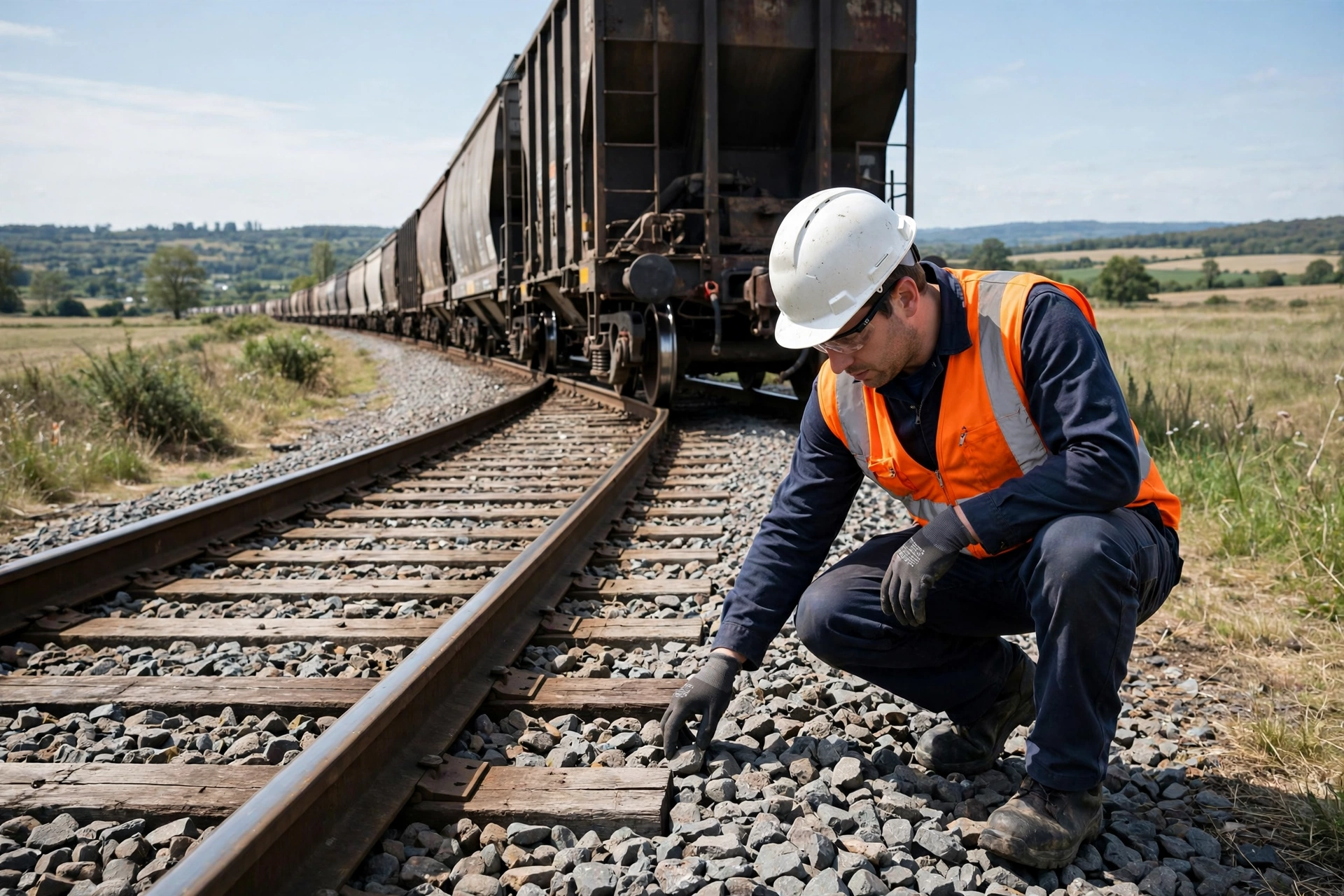
A railroad gang works in three hazard zones at once: a live track where a train can arrive with little warning, a ballast bed of loose stone, dust, and heavy steel, and the weather on an open right-of-way for hours at a time. The kit that is right for inspecting track can be wrong — or dangerous — beside a running tamper, under a lifted rail, or in a tunnel full of diesel exhaust. Buying PPE for railroad workers therefore starts with the task, not the catalogue.
This guide walks through the kit task by task, explains which standards govern each item, and closes with the buying checks that keep a whole gang consistent: sizing, inspection, replacement, and certification verification.
Start With the Hazard Assessment
Under OSHA’s general PPE rule, 29 CFR 1910.132, the employer must assess the hazards of each work area, select the PPE that controls them, and make sure it is used and maintained. On a railroad the assessment has to cover the track, the machines, and the materials together: moving trains change the visibility plan, ballast and heavy rail change the footwear and glove plan, and diesel exhaust, solvents, and treated timber change the respiratory plan. Our PPE hazard assessment guide explains the process step by step, from walking the site to writing the specification. Railroad work is also governed by the Federal Railroad Administration’s roadway worker rules, which set the procedures for working on or near live track — PPE is one layer of that system, and it only works when the lookout, the warning time, and the visible clothing are planned together.
A practical way to run the assessment is to map the job into tasks and list the dominant hazard of each: struck-by risk from moving trains and road-rail vehicles during track inspection, hearing damage from horns, tampers, and ballast regulators, cuts and crush injuries from rail, fastenings, and hand tools, eye injuries from ballast chips and grinding, slips and ankle injuries on loose ballast, and dust and chemical exposure from ballast cleaning, cutting, and treated timber. One worker may cross all six in a single shift, so the kit has to be layered — a base kit worn all day, plus task-specific items added at the location.
The Task-by-Task Kit
High-visibility clothing: being seen is the first control
On a live railway, being seen early is what buys the seconds a worker needs to clear the track. Hi-vis clothing to EN ISO 20471 is the base layer of the kit: the fluorescent fabric makes the worker stand out in daylight and at dusk, and the reflective tape makes them visible in a locomotive’s headlights at night. Class 3 garments, which cover the torso, arms, and legs, are the right call for track work, because a vest alone can disappear against ballast and scrub. Keep the hi-vis clean and replace it when the fluorescence fades — a grey, sun-bleached vest is a visibility failure, not a uniform. In yards and on the right-of-way, the hi-vis should be worn over everything, including cold-weather layers, so that a jacket never hides the one thing that keeps a worker visible.
Hearing protection
Locomotive horns, tampers, ballast regulators, and impact tools all add up over a long shift, and hearing damage is cumulative and irreversible. OSHA’s noise standard, 29 CFR 1910.95, sets the action level at 85 dBA as an 8-hour time-weighted average, and requires a hearing conservation programme above it. Earplugs or earmuffs should be part of the base kit, not something fetched when the machine starts — and they need to be the kind a worker can still hear a warning shout or a lookout’s horn through, so level-dependent earmuffs are worth considering for track gangs. Our hearing protection guide explains SNR and NRR ratings and how to choose between plugs and muffs for a long shift.
Hands: cuts, crush, and grip on steel
Rail, fastenings, and hand tools cut and crush hands every day, and a glove that slips on a wet rail is a dropped load. Cut-resistant gloves rated under ANSI/ISEA 105 are the everyday choice, with the cut level matched to the task — a higher level usually means a thicker, stiffer glove, so the gang should test the shortlist on real rail handling before ordering for everyone. For heavy lifting, a glove with a reinforced palm and good grip matters more than the highest cut level, and for work with oils and solvents, a chemical-resistant glove is a different product entirely — our chemical glove breakthrough time guide explains how long a glove actually protects against a given chemical. Measure hands and order across the size range: a glove that is too tight tears and fatigues the hand, one that is too loose catches on fastenings and loses grip on a rail. Our safety glove size chart shows how to measure correctly.
Feet on ballast
Ballast is loose, uneven, and sharp, and a day on it punishes ankles and soles. Foot protection is governed by 29 CFR 1910.136, and the footwear itself should meet EN ISO 20345: a steel or composite toe cap for dropped rail and tools, a puncture-resistant midsole for spikes, broken fastenings, and sharp ballast, and an ankle-high cut with a sole that grips wet stone. Boots should be broken in before a long shift on the track, and the gang should agree on one standard model — a mixed fleet of different boots is far harder to inspect and replace than a standardised one. For wet yards and drainage work, a waterproof boot keeps feet dry and blister-free through a long shift.
Head, eyes, and respiratory protection
A hard hat to EN 397 is the base for head protection, and on track work it should have a chin strap, so it stays on when a worker bends under a vehicle or climbs a structure. Eye protection to EN 166 is needed for grinding, cutting, and any work near ballast that can be thrown up by a machine, and sealed goggles are the right call for dusty ballast cleaning. Respiratory protection is governed by 29 CFR 1910.134, which requires a written programme, medical evaluation, and fit testing — a respirator that leaks at the seal protects no one. Ballast dust can contain respirable crystalline silica, which is covered by 29 CFR 1926.1153 with a permissible exposure limit of 50 micrograms per cubic metre as an 8-hour time-weighted average, so dusty cutting and cleaning work needs a proper respirator and a dust control plan. Diesel exhaust in tunnels and chemical exposure from solvents and treated timber are covered by the hazard communication standard, 29 CFR 1910.1200: workers need to know what they are handling and which glove and respirator matches it. Our respirator ratings guide explains what N95, FFP2, and FFP3 actually filter, and our fit testing guide explains why the seal matters more than the filter class. Cold and heat matter too on an open right-of-way — our heat stress and PPE guide covers the work-rest schedules that keep a gang working safely in the heat, and our cold work PPE guide covers the layering that keeps hands dexterous in winter.
Buying for a Whole Gang
Size it properly. A glove that is too tight tears and fatigues the hand; one that is too loose catches on fastenings and loses grip on a rail. Measure hands and order across the size range, and do the same for boots, helmets, and earmuffs, where a poor fit leaves gaps and loose straps. A gang that shares one size of everything ends up with kit that protects no one properly.
Plan inspection and replacement from day one. Cut-resistant gloves wear out in weeks on a busy gang, boots on a fixed schedule after sole or toe-cap damage, hard hats after any impact, and hi-vis when its fluorescence fades. A written inspection and replacement schedule keeps the fleet protective instead of decorative — see our PPE inspection and replacement guide. Ask the supplier for the manufacturer’s retirement instructions in writing before the first order, and confirm that identical models will still be available in a year: a fleet of mixed, incompatible models is far harder to inspect than a standardised one.
Verify the certificates before the bulk order. A glove claim is only as good as its test report, and a wrong claim is invisible until it fails. Ask for the certificate and the test report behind it, check the model number matches the product you are buying, and confirm the expiry date — our PPE certification verification guide walks through the checks. Judge the supplier, not just the price: consistent sizing across batches, a stable model range, honest lead times, and a willingness to supply samples are worth more than a small unit-price saving. Our guide to choosing a PPE manufacturer and our protective clothing suppliers checklist set out the questions that separate a reliable partner from a one-off shipment. For gangs that also work in construction and heavy industry, our construction PPE guide and our mining workers’ guide cover the shared kit.
Related Guides
For the details behind this guide, see our PPE hazard assessment guide, our hearing protection guide, and our EN ISO 20471 hi-vis classes guide.
Railroad work rewards buyers who specify per task and test before they commit. If you are putting together a kit for your gang — cut-resistant gloves, hi-vis clothing, hearing protection, helmets, and steel-toe boots in bulk — contact us with your gang size and job types. We supply free samples so your crew can wear-test the shortlist on your site before you order, and you cover only the shipping.