



A construction site is not one workplace — it is a dozen workplaces stacked on top of each other. The electrician pulling cable overhead, the steelworker bolting a frame, the mason cutting block, and the roofer working at height face different hazards, and the PPE that protects one of them can be useless — or dangerous — for another. That is why construction PPE requirements should be set trade by trade, not from a single generic list. A trade-based PPE matrix is the fastest way to stop the two most common failures on site: workers wearing the wrong protection, and workers wearing protection that does not fit the task.
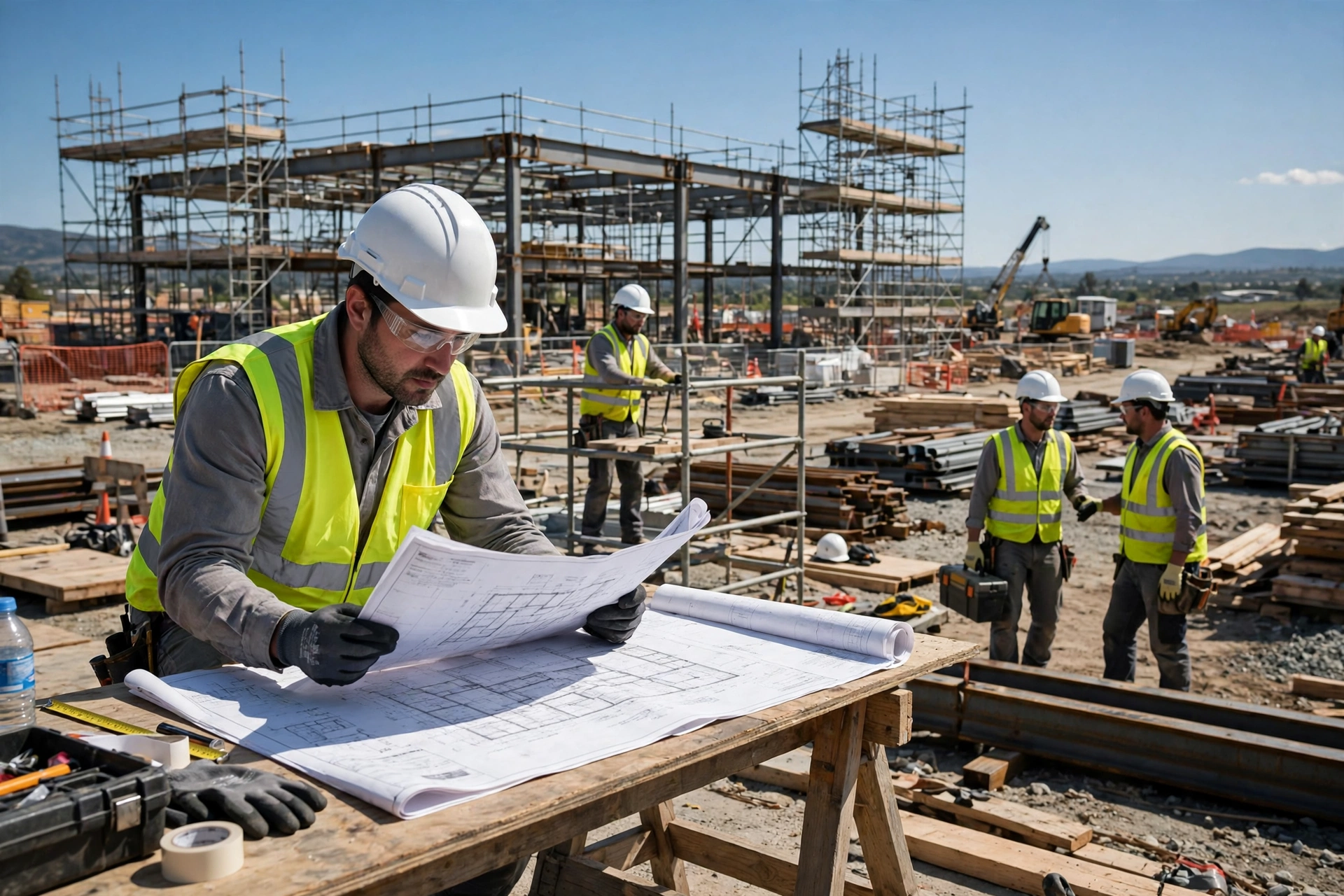
The Regulatory Baseline: What Every Trade Shares
In the United States, OSHA’s construction standards set the floor. 29 CFR 1926 Subpart E requires employers to assess the hazards on site and provide the PPE that controls them, at no cost to the worker, and to make sure it is used and maintained. Hard hats are required where there is a risk of falling objects or head impact, eye and face protection where there is a risk of flying particles or chemical splash, and fall protection where workers are exposed to falls from height. The UK takes a similar approach: the Health and Safety Executive’s construction guidance expects PPE to be the last line of defence after the hazard has been designed out or controlled, and the Construction (Design and Management) Regulations 2015 put the duty to plan it on the principal contractor.
That shared baseline is where the similarities end. What changes by trade is the hazard mix — and therefore the kit. A good PPE matrix starts from a hazard assessment for each trade on the project, then specifies the items, the standards, and the replacement triggers. The table below is a starting point for a typical commercial build; adapt it to the actual tasks, materials, and site conditions.
PPE by Trade: The Matrix
General labourers and site operatives
The broadest exposure and the least predictable tasks. The core kit is a Type I hard hat, safety glasses, general-purpose work gloves, S3 safety boots with toe protection and puncture-resistant soles, and Class 2 hi-vis. Labourers move between trades, so their PPE must be the versatile kind: gloves with decent dexterity rather than a single-task specialist glove, and boots that handle mud, rebar, and scaffold boards. The most common gap is hearing protection — labourers working near cutting and breaking often skip it because it is not in their personal kit.
Electricians
Electrical work adds two hazards other trades do not carry: shock and arc flash. Insulating gloves rated to the working voltage are the critical item, tested and date-stamped, worn with leather protectors over them — and replaced on schedule, not when they look worn. Eye protection must handle arc flash as well as impact, and clothing should be arc-rated where the risk assessment calls for it. A standard hard hat is not enough where live work is possible: the helmet must be electrically insulating, and metal components in other PPE — such as a steel toecap’s exposed metal — should be checked against the task. Cotton gloves and ordinary work boots have no place in live electrical work.
Steelworkers and ironworkers
Heavy, sharp, and at height. Cut-resistant gloves with a high EN 388 cut level, a hard hat with a chin strap — a helmet that falls off at height protects no one — and fall protection as a system: full-body harness, lanyard, and a verified anchor point. Safety boots need toe protection and a puncture-resistant midsole for walking on decking with protruding fixings. Welding and cutting during steel erection adds eye, face, and respiratory protection, and the gloves must switch from handling gloves to heat-resistant gloves when the task changes.
Masons, concrete workers, and plasterers
Wet cement is the hazard most often underestimated. Fresh concrete is strongly alkaline and causes cement burns and dermatitis on prolonged skin contact, so chemical-resistant gloves and waterproof boots are mandatory, not optional — ordinary leather gloves soak through and hold the alkali against the skin. Add eye protection for splashes, and respiratory protection when cutting or grinding masonry, where respirable crystalline silica is the long-term risk. Knee protection matters too: masons spend hours kneeling on hard surfaces, and knee pads are a cheap defence against a chronic injury.
Roofers
Height, heat, and slope. Fall protection is the defining item — a harness system with an anchor rated for the roof structure — but the supporting kit is what gets missed: slip-resistant safety boots with good grip on pitched surfaces, gloves that balance grip and dexterity for handling membranes and tiles, and sun protection for long outdoor exposure, including a hard hat with a brim or neck shade. In hot weather, breathable hi-vis and scheduled hydration matter as much as any single item of PPE.
Carpenters and joiners
Cutting and sawing dominate the risk profile. Eye protection is non-negotiable around saws, and hearing protection is the item most often skipped — circular saws and nail guns both exceed safe exposure levels over a shift. Gloves need to protect against splinters and cuts without snagging in rotating machinery: close-fitting, cut-resistant gloves, removed before operating saws and drills where the manufacturer’s guidance says so. Dust masks are required for MDF and hardwood cutting, where the dust is a sensitiser as well as an irritant.
Demolition crews
The highest-hazard trade on most sites, and the one where PPE is most likely to be treated as an afterthought. Full-face protection or goggles plus a hard hat, heavy-duty cut- and impact-resistant gloves, S3 boots, and respiratory protection rated for the dust in question — including asbestos awareness and the correct respirator class where the survey identifies it. Hi-vis must be Class 3 where demolition operates near live traffic or moving plant. Demolition is also where hearing protection is most critical: breaking and crushing are among the loudest tasks on any site.
Head to Toe: The Items That Change by Trade
Four items cause most of the confusion when a single site stocks PPE for several trades. Getting these right is the difference between a matrix that works and one that sits in a drawer.
Hard hats: type, class, and chin straps
A Type I helmet protects against top impact; a Type II helmet also protects against lateral impact, which matters for steelwork and demolition. Electrical work needs a Class E (electrical) helmet rated to 20,000 volts. And any trade working at height or on a slope should have a chin strap — a helmet on the ground is not protecting a head. Our guide to safety helmet standards explains the EN 397 types and markings in detail.
Footwear: S1P, S3, and the sole that fits the surface
S3 boots — toe protection, puncture-resistant sole, waterproof upper — are the default for most construction trades, but they are heavy and hot. S1P gives the same toe and puncture protection with a perforated upper for hot-weather work. The sole matters as much as the rating: SRC slip resistance for wet steel and scaffold boards, and a cleated tread for muddy ground. See the EN ISO 20345 footwear standards guide for the full S1–S7 ladder.
Hi-vis: class by traffic, not by habit
Class 2 hi-vis suits most site work; Class 3 — full torso and limb coverage — is required where workers are near live traffic or fast-moving plant. Buying one class for the whole site is a false economy if the demolition crew next to the road needs Class 3. The EN ISO 20471 hi-vis classes guide sets out when each class applies.
Gloves: task first, then the rating
A cut-resistant glove that cannot grip a trowel will be taken off; a chemical glove that soaks through in wet concrete is worse than useless. Match the glove to the task’s dominant hazard — cut, chemical, heat, electrical, or grip — and stock more than one type per trade. Check the EN 388 markings before ordering, and remember that a glove’s rating is only valid while the glove is intact: inspect before each use and retire damaged pairs.
The Gaps Buyers Miss
Four mistakes show up again and again when a site’s PPE is audited. First, sizing: a standard order of medium helmets and large gloves leaves a third of the workforce in ill-fitting kit, and ill-fitting PPE is PPE that gets removed. Order a size range and keep the distribution record. Second, compatibility: glasses that break a respirator seal, a harness that cannot be worn with a tool belt, a hard hat that will not take ear defenders. Test the combination, not the item. Third, replacement triggers: PPE has a service life — helmets after an impact or after five years, gloves when the coating wears through, hi-vis when the fluorescence fades — and “until it breaks” is not a trigger. Fourth, storage: PPE left in a damp container or in direct sun degrades before it is worn. A dry, labelled store with a first-in-first-out rule costs nothing and saves the stock.
Specifying PPE for a Mixed-Trade Workforce
For a contractor or distributor buying across trades, the practical approach is to standardise where the hazard is shared — one helmet platform, one boot range, one hi-vis supplier — and specialise where the hazard diverges: electrical gloves for electricians, chemical gloves for concrete crews, fall systems for roofers and steelworkers. Standardising the shared items simplifies ordering and training; specialising the divergent items is what actually protects people. Before committing to a bulk order, verify the certifications behind the products — our guide on how to verify PPE certifications before a bulk order sets out what to ask for and how to check it.
Frequently Asked Questions
Who pays for construction PPE?
The employer. Under OSHA’s construction standards the employer must provide required PPE at no cost to the employee, and under UK law the employer must provide it free of charge where the risk assessment shows it is needed. Workers may not be charged for replacements needed because of wear or damage in normal use.
Can one PPE kit cover every trade on a site?
No. A basic kit — helmet, glasses, gloves, boots, hi-vis — is a starting point, but electricians need insulating gloves, masons need chemical-resistant gloves and waterproof boots, roofers need a fall system, and demolition crews need respiratory and face protection. The matrix above shows where each trade diverges from the baseline.
How often should construction PPE be replaced?
By condition and by the manufacturer’s service life, not by calendar alone. Replace hard hats after any significant impact and at the end of their stated life (typically up to five years), gloves when the coating or fabric is worn through, hi-vis when the colour has faded, and footwear when the sole or toe cap is damaged. Inspect before each use and record the inspection for harnesses and fall equipment.
Specifying Construction PPE for Your Project?
If you are standardising PPE across trades on a project or a resale range, put the product in your hands before you commit: request a free sample kit — the samples are free, you only cover shipping. For bulk and OEM supply across our full PPE range, see our PPE manufacturer and wholesale supplier page, or send your target spec and quantity for a quote.


