



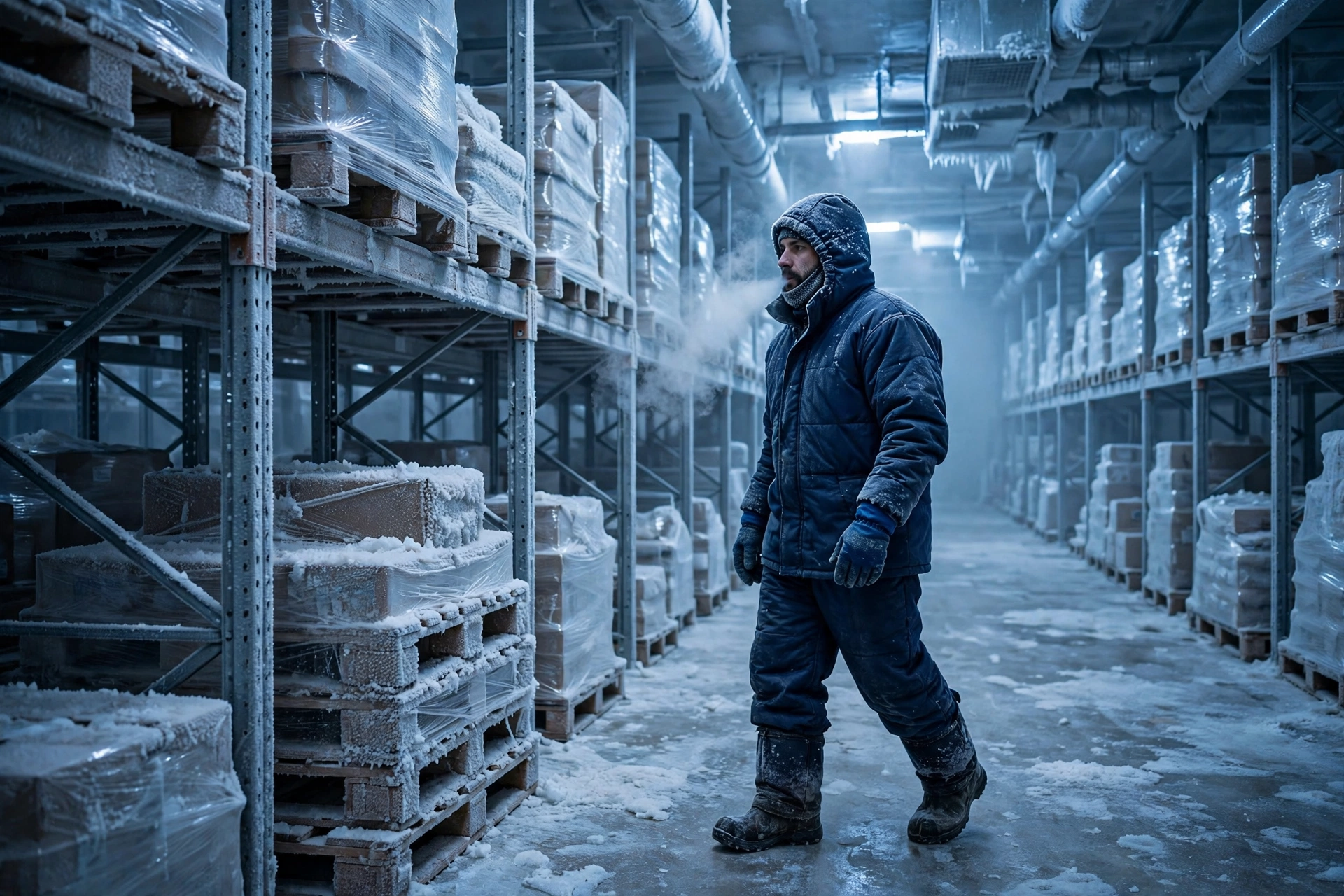
Cold storage work looks deceptively calm: no sparks, no noise, no obvious hazard. But a freezer warehouse at −25 °C punishes the body quietly — hands lose dexterity within minutes, core temperature drifts down over a shift, and a slip on an icy floor hurts just as much as one on a dry one. The right PPE for cold storage is not a thicker jacket; it is a system of rated clothing, gloves, footwear and work routines, each matched to the temperature the worker actually faces. This guide explains how to build it.
What “Cold” Means in a Warehouse
Cold storage is not one temperature. Chill rooms run around 0 °C to 4 °C, frozen storage typically sits at −18 °C or below, and blast freezers and deep-frozen stores can reach −30 °C or lower. Air movement makes it worse: fans, forklift draughts and open dock doors strip away the warm air layer around the body, so the effective cold is greater than the thermometer reading. The standards draw their lines in the same place: clothing for cool environments is rated for −5 °C and above, while clothing for true cold is rated for below −5 °C. Knowing which side of that line your workers stand on is the first specification decision.
The health effects are well documented. OSHA’s winter weather guidance lists hypothermia, frostbite, trench foot and chilblains as the core cold-stress injuries, and notes that workers new to cold environments are at greatest risk before they acclimatise. Early signs — shivering that stops, clumsiness, slurred speech, confusion — are the point to act, not the point to finish the task. Employers must treat cold as a hazard to be assessed like any other: our guide to conducting a PPE hazard assessment applies the same method to cold rooms as it does to chemical or cut hazards.
The Clothing System: EN 342 vs EN 14058
Two European standards cover cold-weather clothing, and the split between them is the −5 °C line:
| Standard | For | What the label shows |
|---|---|---|
| EN 14058 | Cool environments, −5 °C and above | Thermal resistance class 1–4 (Rct 0.06 to 0.25 m²K/W and above), air permeability class, optional water penetration class |
| EN 342 | Cold, below −5 °C — cold stores and extreme cold | Effective thermal insulation Icler (minimum 0.265 m²K/W), undergarment type B, C or R, air permeability class, optional water penetration class |
EN 342 is the freezer standard. Its insulation value is measured on a moving thermal manikin wearing the garment as a set, with a stated undergarment — B for a standard set, C for a specific set, R for a reference set — so the number on the label only holds if the worker wears the undergarment the test assumed. The standard also publishes the resulting temperature limits for light, medium and heavy activity, which is the number a buyer should actually use when matching a garment to a shift pattern. EN 14058 is the chill-room standard: it rates the fabric’s thermal resistance in four classes, and it covers garments such as jackets and trousers for moderate cold, including indoor food-processing work.
Both standards rate the clothing only — footwear, gloves and separate hoods are outside their scope and must be selected separately. And both assume layering done properly: a moisture-wicking base layer, an insulating mid-layer, and the rated outer garment. Cotton base layers are a classic mistake in cold stores: cotton holds sweat, and wet fabric against skin accelerates heat loss. Specify synthetic or wool base layers, and make sure the outer garment still fits over them — a jacket that is too tight compresses its own insulation and performs worse, not better.
Gloves for Frozen Work: EN 511
Hands are the first thing cold takes. EN 511:2006 rates gloves against cold with three digits after the pictogram: A for convective cold (0–4), B for contact cold (0–4), and C for water penetration (0 or 1). Convective cold is the cold air around the hand; contact cold is the heat a frozen product pulls out of the hand when it is gripped. A glove marked 2-3-1, for example, is level 2 against convective cold, level 3 against contact cold, and waterproof.
Two practical points decide whether an EN 511 glove works on the floor. First, the cold ratings are gated by mechanical performance: a glove must reach at least level 1 in EN 388 abrasion and tear to claim level 1 convective cold, and level 2 to claim level 2 or above — so a genuinely warm glove is also a reasonably tough one. Second, dexterity is a trade-off, not a free extra: the warmest glove is useless if the worker takes it off to pick small items or operate a scanner. For mixed tasks, specify a warm liner glove under a rated outer glove, and keep spare dry pairs at the warming station — a wet glove in a freezer is worse than a thin dry one, because water conducts heat away from the hand far faster than air.
That trade-off is the same one that governs glove choice everywhere: match the glove to the hazard, not to the catalogue headline. Our nitrile glove thickness guide shows the same logic applied to disposable gloves, and the principle holds for insulated ones too.
Footwear: Insulated Boots and Slip Resistance
Freezer floors are a slip hazard before they are a cold hazard: condensation, frost and ice form on surfaces that look dry, and a fall in a cold store carries the added risk of a worker lying injured in sub-zero air. Safety footwear for cold stores should carry the CI marking under EN ISO 20345 — cold insulation tested at −17 °C — on top of the usual toe protection, and SRC slip resistance, the highest rating, tested on both steel and ceramic surfaces with water and glycerol. Our guide to EN ISO 20345 safety footwear standards explains the full S1–S7 ladder and the CI, WR and SRC markings in detail.
Fit matters more in the cold than anywhere else: boots are worn over thick socks, sometimes two pairs, and a boot sized for summer socks will cut circulation in winter socks and make feet colder. Size freezer boots with the actual sock system the worker will wear, and check that the insulation is not compressed by a tight fit. Keep a dry spare pair of socks at the warming station — damp socks are the fastest route to cold feet, and cold feet are the first reason workers cut corners on safety procedures.
Head, Face and Eyes
The head loses a disproportionate share of body heat, and in a freezer the face is exposed to the same cold air as the hands. A balaclava or insulated hood that fits under a helmet or hard hat closes the biggest gap in the system — but it must be compatible with the rest of the kit: it should not push safety glasses off the nose, fog them, or muffle hearing protection. Fogging is the recurring complaint in cold stores, because warm breath meets cold lenses; anti-fog coatings and vented goggles help, and the practical fix is to fit eyewear after the hood and balaclava, not before. Where a hard hat is required, check that the cold-weather liner is rated for the helmet model — an improvised liner can void the helmet’s certification. Our guide to EN 397 safety helmet standards covers the optional cold-temperature rating for helmets, which is worth specifying for outdoor winter work alongside freezer work.
Work-Rest Routines and Warm-Up Breaks
PPE alone does not make a cold shift safe. The routine around it does:
- Scheduled warm-up breaks. Set break intervals by temperature and workload before the shift starts, not when someone feels cold. A heated break room close to the cold store is part of the PPE system, not a luxury.
- Acclimatisation. New starters and returning workers need a gradual build-up over days. The HSE temperature guidance stresses that workers should be able to warm up, drink warm fluids, and report symptoms early — and that supervisors should watch for the signs, because a cold worker’s judgement deteriorates before they notice it themselves.
- Buddy system. Nobody works alone in a deep-freeze area. A second person is the fastest way to spot shivering, confusion or a fall — and the only way to get help if a worker is injured where radios and phones may not work reliably.
- Dry spares. Gloves, socks and balaclavas get damp. Rotate them at breaks, and never let a worker re-enter a freezer in wet kit.
- Exposure records. Log who entered, at what temperature, for how long. It is the evidence that the routine is working — and the first thing an inspector will ask for.
Buying Checklist for Cold Storage PPE
- Match the standard to the temperature: EN 14058 for chill rooms at −5 °C and above; EN 342 for freezers below −5 °C. Ask for the Icler or Rct value, not just the standard number.
- Buy the set, not the jacket: insulation values are measured on the garment set with a stated undergarment. Quote the set, and state the undergarment in the purchase order.
- Check glove and boot ratings together: EN 511 A/B/C digits for gloves, CI + SRC for boots. A warm jacket with unrated gloves and boots is an incomplete system.
- Size over layers: fit-test clothing, gloves and boots with the actual base layers and socks the worker will wear.
- Plan laundering: insulation degrades with the wrong wash. Confirm wash instructions and expected life before ordering in bulk, and budget for replacement on a schedule, not on failure.
- Verify certificates: request the EU type-examination certificate for each rated item and check that the model number on the certificate matches the model number on the goods. Our guide to verifying PPE certifications before a bulk order explains the checks.
Frequently Asked Questions
What temperature counts as cold storage work?
Chill rooms run around 0 °C to 4 °C, frozen storage at −18 °C or below, and blast freezers down to −30 °C or lower. The standards split at −5 °C: EN 14058 covers cool environments at −5 °C and above, EN 342 covers cold below −5 °C. Specifying against the wrong side of that line is the most common buying error.
Can one jacket cover both chill and freezer work?
Not well. A garment rated EN 342 for a −25 °C freezer will be too warm and restrictive for a 2 °C chill room, and a garment rated EN 14058 for the chill room will not hold its insulation value in a freezer. Where workers move between zones, specify the freezer-rated set and manage overheating with layering and break routines.
How often should freezer PPE be replaced?
On condition and on schedule, not on failure. Inspect insulation, seams, zips and closures regularly; compressed or torn insulation loses its rating even if the garment looks intact. Set a replacement schedule in the purchase plan and keep the inspection records with the exposure logs.
Kitting Out a Cold Store Team?
If you are specifying PPE for a cold storage or food-processing site, put the product in your hands before you commit: request a free sample kit — the samples are free, you only cover shipping. For bulk and OEM supply across our full PPE range, see our PPE manufacturer and wholesale supplier page, or send your target spec and quantity for a quote.


