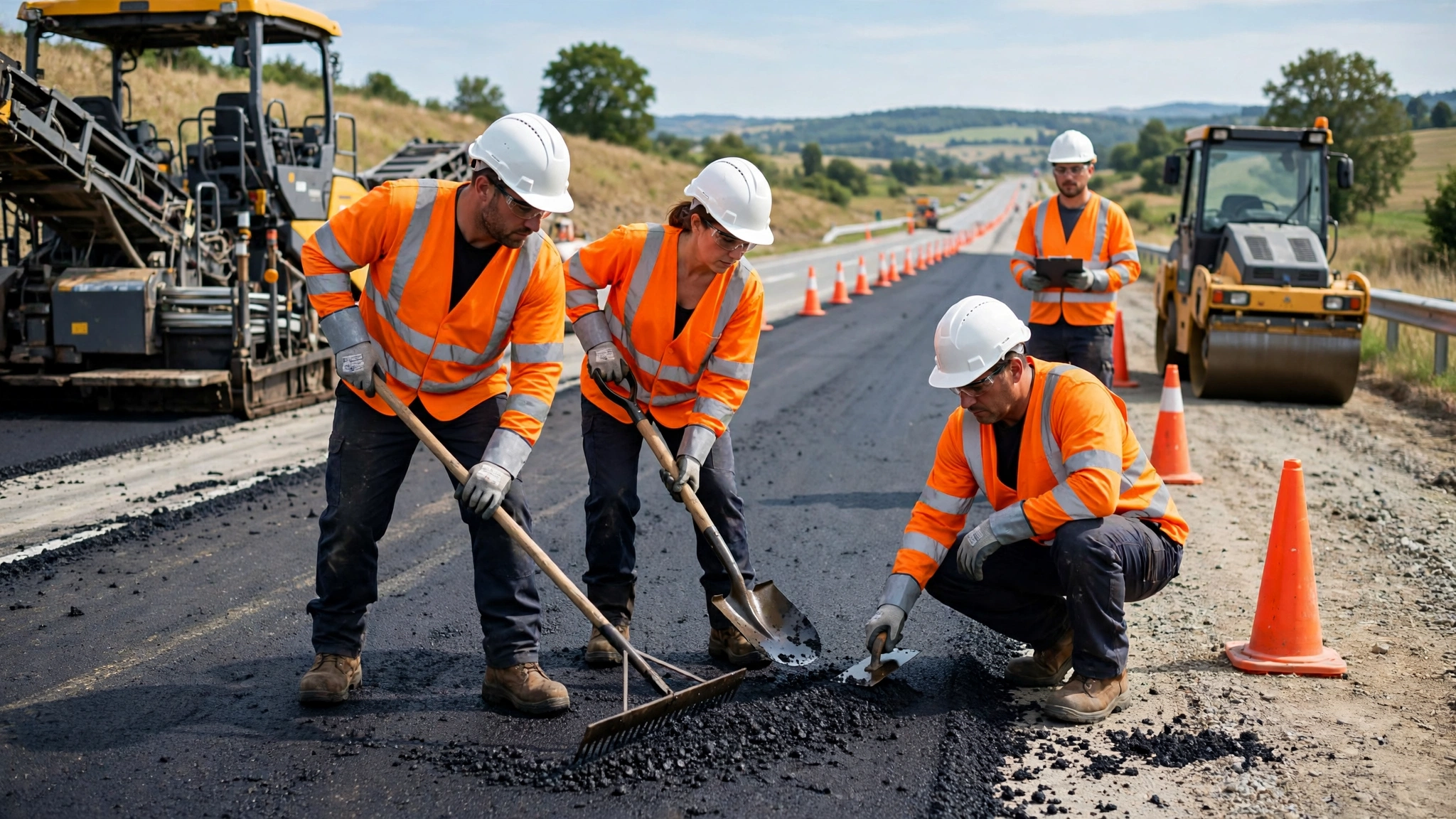
A highway construction worker’s shift crosses several hazard zones before lunch: live traffic passing a few feet from the crew, hot asphalt and milling dust, heavy plant moving in reverse, and summer sun on open blacktop. The kit that is right for a flagger standing at the taper can be wrong — or dangerous — for a paver operator working over a hot screed or a labourer cutting concrete with a saw. Buying PPE for highway construction workers therefore starts with the task, not the catalogue.
This guide walks through the kit task by task, explains which standards govern each item, and closes with the buying checks that keep a whole crew consistent: sizing, inspection, replacement, and certification verification.
Start With the Hazard Assessment
Under OSHA’s general PPE rule, 29 CFR 1910.132, the employer must assess the hazards of each work area, select the PPE that controls them, and make sure it is used and maintained. On a highway job the assessment has to cover the traffic, the plant, and the materials together: a live lane next to the work area changes the visibility plan, a milling machine changes the dust and noise plan, and hot asphalt changes the burn and heat plan. Our PPE hazard assessment guide explains the process step by step, from walking the site to writing the specification.
A practical way to run the assessment is to map the job into tasks and list the dominant hazard of each: struck-by incidents from passing traffic and reversing plant, falls from structures and into excavations, cuts and abrasions from steel, formwork, and hand tools, eye injuries from cutting and grinding, hearing damage from pavers, rollers, and saws, silica dust from milling and concrete cutting, burns and heat stress from hot asphalt, and fatigue from long shifts in the sun. One worker may cross five of these in a single day, so the kit has to be layered — a base kit worn all day, plus task-specific items added at the location.
The Task-by-Task Kit
Visibility and traffic control
Struck-by incidents are the leading fatal hazard on highway work, and high-visibility clothing is the first line of defence. Garments should meet EN ISO 20471, which classifies garments by the area of fluorescent and reflective material, with Class 3 offering the highest visibility for workers beside live traffic; the US equivalent is ANSI/ISEA 107. The class must match the traffic speed and the distance to live lanes, not the cheapest option in the catalogue: a Class 2 vest that is adequate on a closed site is not adequate on a live carriageway. Flaggers and spotters are a special case — their signalling is governed by 29 CFR 1926.201, and the barricades, cones, and signs that separate the crew from traffic fall under 29 CFR 1926.202. Hi-vis clothing is part of that traffic control system, not a substitute for it: no vest makes up for a missing taper, a missing buffer, or a driver who cannot see the work zone in time.
Visibility also fades. Fluorescent fabric loses its brightness with sun, washing, and asphalt stains, so hi-vis garments need a retirement rule based on inspection, not on age alone — if the fluorescence has dulled or the reflective tape is cracked and peeling, the garment no longer meets its class. Keep a spare set on the truck so a damaged vest is swapped the same day, not at the next order.
Head, eyes, and hearing
A hard hat to EN 397 is the base for head protection on highway work, and on open sites it should have a chin strap — a helmet that blows off in the wind protects no one, and the crew below is the one at risk from dropped tools. Construction head protection is covered by 29 CFR 1926.100. Eye protection to EN 166 is needed for cutting, grinding, and any work near a milling head that throws debris, and sealed goggles are the right call for dusty cutting and for work under a structure that can shed material; the construction eye and face rule is 29 CFR 1926.102. Hearing protection is governed by 29 CFR 1910.95, which sets the action level at 85 dBA as an 8-hour time-weighted average: pavers, rollers, compactors, and concrete saws all add up over a long shift, so earplugs or earmuffs should be part of the base kit, not something fetched when the noise starts. Our hearing protection guide explains SNR and NRR ratings.
Hands, feet, and hot asphalt
Most highway work is hands-on: handling steel, formwork, and kerbs, raking and shovelling asphalt, and guiding plant. Cut-resistant gloves rated under ANSI/ISEA 105 are the everyday choice, with the cut level matched to the task — a higher level usually means a thicker, stiffer glove, so the crew should test the shortlist on real handling before ordering for everyone. Measure hands and order across the size range — a glove that is too tight tears and fatigues the hand, one that is too loose catches on formwork and loses grip on a shovel. Our safety glove size chart shows how to measure correctly.
Hot asphalt is a burn hazard as well as a heat hazard: fresh mix is laid at temperatures that burn skin on contact, so gloves and sleeves must cover the forearm when workers are raking and shovelling, and long sleeves are part of the kit, not an optional extra. Footwear should meet EN ISO 20345, with a puncture-resistant sole for sites with steel and debris, and a sole that grips hot asphalt and wet steel — smooth soles and a fresh asphalt mat are a bad combination. The foot protection rule is 29 CFR 1910.136, and motor vehicles and mechanised equipment on the job fall under 29 CFR 1926.601 and 29 CFR 1926.602.
Dust, fumes, and heat stress
Milling, concrete cutting, and demolition release respirable crystalline silica, which is governed by 29 CFR 1926.1153 with a permissible exposure limit of 50 micrograms per cubic metre as an 8-hour time-weighted average. The first controls are engineering ones — water suppression and local exhaust on the cutting equipment — and respiratory protection under 29 CFR 1910.134 is the layer that covers what engineering controls cannot. That rule requires a written programme, medical evaluation, and fit testing: a respirator that leaks at the seal protects no one. Our respirator ratings guide explains what N95, FFP2, and FFP3 actually filter, and our fit testing guide explains why the seal matters more than the filter class.
Heat is the other respiratory and comfort factor on highway work: black asphalt in full sun radiates heat from below as well as above, and a crew in hi-vis over long sleeves can overheat fast. Our heat stress and PPE guide covers the work-rest schedules, hydration, and shade breaks that keep a crew working safely in the heat. Cold is the mirror image in winter: cold hands lose grip and dexterity, so insulated gloves that still grip a tool are worth specifying rather than letting the crew work bare-handed. Our cold storage PPE guide covers insulated gloves and clothing for cold conditions.
Buying for a Whole Crew
Size it properly. A glove that is too tight tears and fatigues the hand; one that is too loose catches on formwork and loses grip on a shovel. Measure hands and order across the size range, and do the same for helmets and hi-vis, where a poor fit leaves gaps and loose straps. A crew that shares one size of everything ends up with kit that protects no one properly.
Plan inspection and replacement from day one. Cut-resistant gloves wear out in weeks on a busy crew, hi-vis when its fluorescence fades, hard hats after any impact, respirators on their filter and seal schedule, and boots when the tread or the puncture plate fails. A written inspection and replacement schedule keeps the fleet protective instead of decorative — see our PPE inspection and replacement guide. Ask the supplier for the manufacturer’s retirement instructions in writing before the first order, and confirm that identical models will still be available in a year: a fleet of mixed, incompatible models is far harder to inspect than a standardised one.
Verify the certificates before the bulk order. A glove claim is only as good as its test report, and a wrong claim is invisible until it fails. Ask for the certificate and the test report behind it, check the model number matches the product you are buying, and confirm the expiry date — our PPE certification verification guide walks through the checks. Judge the supplier, not just the price: consistent sizing across batches, a stable model range, honest lead times, and a willingness to supply samples are worth more than a small unit-price saving. Our guide to choosing a PPE manufacturer and our protective clothing suppliers checklist set out the questions that separate a reliable partner from a one-off shipment. For crews that also work on rail corridors, our railroad workers’ guide covers the shared kit, and our construction PPE requirements by trade covers the wider site rules.
Related Guides
For the details behind this guide, see our PPE hazard assessment guide, our EN ISO 20471 hi-vis classes guide, and our PPE for railroad workers guide.
Highway work rewards buyers who specify per task and test before they commit. If you are putting together a kit for your crew — hi-vis clothing, hard hats, cut-resistant gloves, hearing protection, and steel-toe boots in bulk — contact us with your crew size and job types. We supply free samples so your crew can wear-test the shortlist on your site before you order, and you cover only the shipping.