



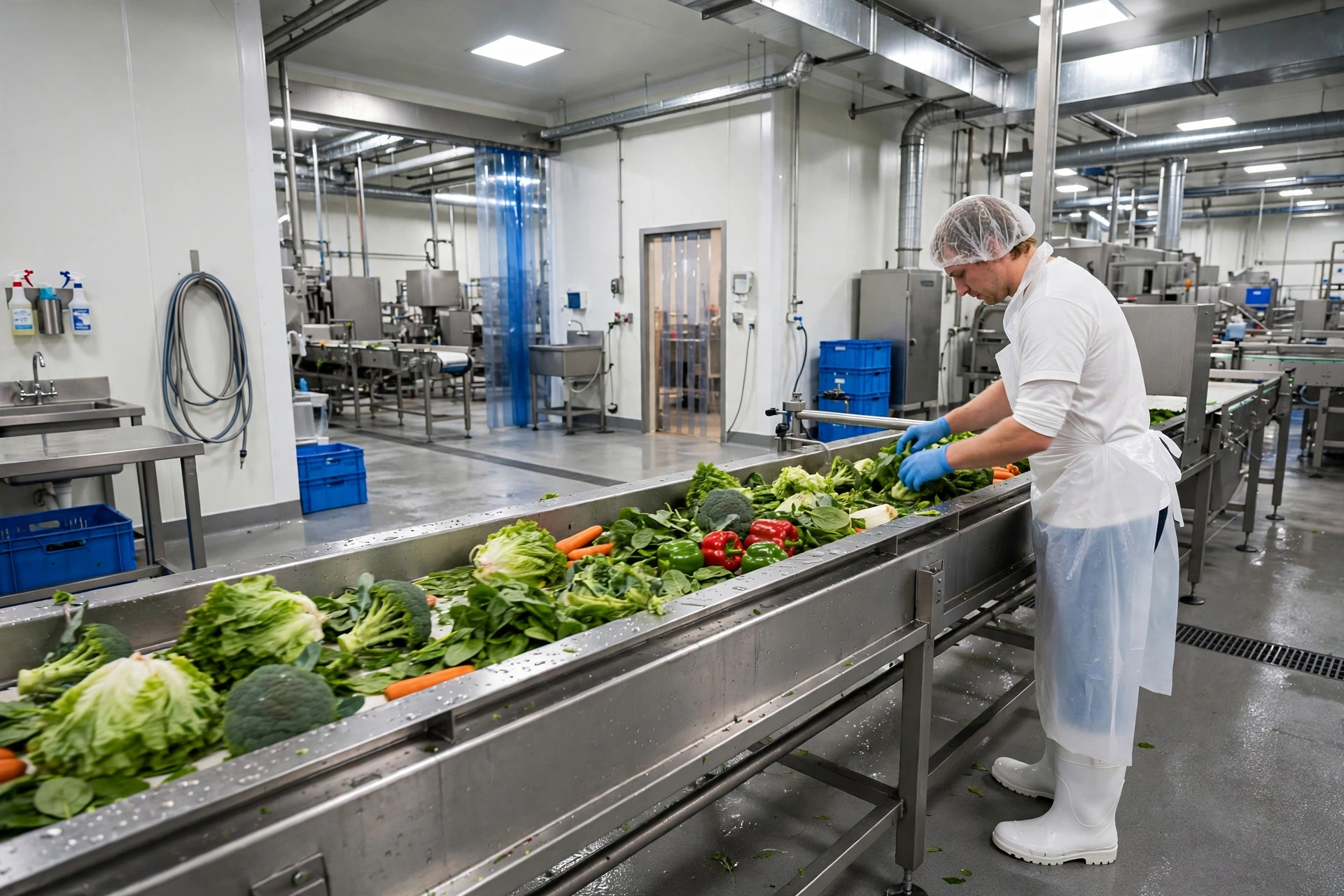
A food processing plant asks personal protective equipment to do two jobs at once. The gear must protect the worker from knives, hot surfaces, chemicals, and slippery floors — and it must protect the product from the worker: hair, skin, sweat, and anything a torn glove can shed into food. That double duty is what makes PPE for food processing workers different from general factory PPE. This guide explains what to specify for each area of the plant, which standards to ask for, and how to buy in bulk without creating a food-safety problem of your own.
Why Food Processing PPE Is Different
In most factories, PPE failure hurts the wearer. In a food plant, it can also hurt the consumer and the business: a single contamination incident can trigger a recall, a lost customer, and an audit finding that closes a line. That is why food-safety rules sit alongside safety rules in every PPE decision. In the United States, the FDA Food Code — the model code most states adopt for food establishments — sets out how food must be protected from contamination, and its provisions on employee hygiene, clean outer clothing, and hair restraints shape what workers wear on the line; see the FDA Food Code 2022 for the current model text. On the worker-safety side, OSHA’s general PPE standard requires employers to assess the hazards of each task and provide the matching protection. A hazard assessment that covers both sides — the cut risk and the food-contact risk — is the starting point, and our guide to how to conduct a PPE hazard assessment shows how to run one.
The second difference is the environment. Food plants are wet, cold, and washed down daily with detergents and sanitisers. Equipment that survives a dry warehouse can fail here: leather boots rot, cotton aprons soak through, gloves degrade in cleaning chemicals, and metal parts rust. The best food processing PPE is washable, quick-drying, and resistant to the cleaning chemicals the plant already uses. If workers are peeling off gloves, leaving aprons on hooks, or wearing street shoes onto the line, the specification is wrong — not the workers.
Hygiene First: Hairnets, Aprons, and Disposable Gloves
Every worker who handles food or works over exposed product needs a hair restraint — a hairnet, and a beard cover where facial hair is present. It is cheap, it is non-negotiable, and it is the item most often skipped when a shift gets busy. Disposable aprons keep outer clothing — and whatever it picked up outside the production area — away from product; in high-care zones, a full disposable coverall is the safer choice, and our guide to disposable coveralls covers how to choose between types. Sleeve protectors are worth adding wherever forearms work over open product, and they cost almost nothing per shift.
Disposable gloves are the most-used item in the plant, and the choice of material matters. Nitrile is the usual default: it resists oils and fats, fits tightly enough for knife work and packing, and is latex-free, which matters because latex proteins can trigger allergies in workers and can contaminate product. Latex is cheaper but carries the allergy risk, and vinyl is the weakest barrier of the three — acceptable for short, low-risk handling, but not where a torn glove means product contamination. Our comparison of nitrile vs latex vs vinyl gloves sets out the trade-offs in full. Whichever material you choose, buy the right thickness for the task — a thin glove tears on a bone edge, a thick one kills dexterity — and change gloves on a schedule, not when they fail: after handling raw product, after a break, and whenever a glove is torn or contaminated.
Cut Protection: Knives, Saws, and Slicers
Boning, trimming, slicing, and filleting put a sharp edge millimetres from fingers for hours at a time, and fatigue is the real hazard — the cut usually happens late in the shift, not in the first hour. Cut-resistant gloves are a core control here, and the holding hand is the one at risk: the hand that holds the product while the other hand holds the knife. Our guide to cut-resistant gloves in food processing explains how to match the cut level to the task — ANSI/ISEA 105 grades run from A1 to A9, EN 388 grades cut resistance from A to F, and most food processing sits in the middle of both scales. Metal-detectable gloves and liners are worth specifying where product passes a metal detector: a torn glove that cannot be detected is a food-safety failure, not just a PPE failure.
Two details decide whether cut gloves actually get worn. The first is fit: a glove that is too stiff slows the line, and workers will take it off; a glove that is too slick is worse, because the worker drops product and reaches for it with a knife in hand. Measure hands properly before ordering — see our safety glove size chart — and run a trial with the actual crew before committing to a bulk order. The second is maintenance: cut-resistant liners must survive repeated laundering without losing their cut rating, and they must be inspected for thinning and holes. A glove with a hole in the liner protects nobody and contaminates product.
Footwear, Cold, and Slips
Food plant floors are wet by design — washdowns, melting ice, spilled product — so slip resistance is the first footwear requirement, before toe protection. White, washable safety boots are the standard: they show contamination, they can be hosed down, and they keep the dirt of the yard out of the production area. Steel or composite toe caps to EN ISO 20345 are needed wherever pallets, crates, and trolleys move, and our guide to safety footwear standards explains the S1–S7 ratings. In chill rooms and cold stores, insulated boots and thermal socks are part of the kit, not an optional extra — cold hands and feet slow work and cause mistakes, and our guide to heat stress and PPE covers the other end of the temperature problem for hot kitchens and bakeries.
Cleaning crews face a different chemical load from production staff: concentrated detergents, sanitisers, and caustic cleaners. Those jobs need a chemical glove chosen from permeation data for the specific chemical, not a general-purpose disposable — our explainer on chemical glove breakthrough time shows how to read it. Eye protection and aprons go with the chemical glove wherever splashing is possible; see EN 166 eye protection markings for what the lens ratings mean. Hearing protection belongs in the kit too: slicers, grinders, and packaging lines run loud enough to damage hearing over a career, and our comparison of SNR vs NRR hearing protection ratings helps match protectors to the measured noise level.
Buying in Bulk: What to Check Before You Order
Food processing PPE is bought in volume — boxes of disposable gloves, aprons, and hairnets every week, plus seasonal runs of boots and cut gloves. That makes the supplier check more important, not less. Before placing a bulk order, verify the certificates behind the products: EN 388 for cut gloves, EN ISO 374 for chemical gloves, EN 455 for medical-grade disposable gloves where the plant requires them, EN ISO 20345 for footwear. Ask for the EU declaration of conformity and the test reports, and check them against the model you are actually buying — a certificate for one model does not cover another. Our guide on how to verify PPE certifications before a bulk order walks through the checks step by step.
Size mix is the detail most bulk orders get wrong. A crew is not one size, and gloves, boots, and aprons that do not fit are not worn — or are worn badly. Order a size range based on a real headcount, not a guess, and include a small trial quantity of any new product before committing to the season’s volume. Check the supplier’s lead time and re-order reliability too: running out of nitrile gloves mid-shift is not a problem you want to solve at retail prices. For the wider supplier questions — MOQ, sampling, audits — see how to choose a PPE manufacturer and what PPE distributors look for in a manufacturer partner.
Fit, Training, and Storage
Even the right equipment fails if it is not fitted and used correctly. Gloves need the right size so workers keep dexterity on knives and controls; boots need the right width for a full shift on wet floors; aprons need to stay tied and in place. A short fitting session at the start of a season — with the actual products, on the actual workers — pays for itself in compliance. Training should be practical: how to put on and take off gloves without contaminating hands, when to change gloves, how to spot a torn liner, and why a hairnet stays on for the whole shift. Storage matters as well: keep PPE away from sunlight, chemicals, and damp, and keep clean kit separate from used kit. See our guide to PPE inspection and replacement schedules for the routine that keeps the kit honest.
Related Guides
For the standards behind the choices in this guide, read Cut-Resistant Gloves in Food Processing, Nitrile vs Latex vs Vinyl Gloves: How to Choose, and How to Conduct a PPE Hazard Assessment.
Get a Quote for Your Plant
Aceppe supplies food processing PPE in bulk — cut-resistant and disposable gloves, aprons and coveralls, hairnets and beard covers, washable safety boots, and eye and hearing protection — built to the standards above and shipped worldwide. Tell us the zones in your plant, the tasks your crew does, and your headcount, and we will put together a zone-matched kit with samples before you commit. Free samples are available — the buyer covers shipping. Contact us for a quote today.


