



Ask a safety buyer which respirator is cheaper — disposable or reusable — and the usual answer is the unit price: a disposable filtering facepiece costs a dollar or two, a reusable half-mask costs thirty. The comparison looks settled before it starts. It is not. The unit price is the smallest part of what a respirator costs over a year. A disposable vs reusable respirators cost analysis has to count everything around the respirator: fit testing, medical evaluation, training, filters, cleaning, storage, and replacement. This guide works through each cost, then runs a worked example for a 20-person crew.
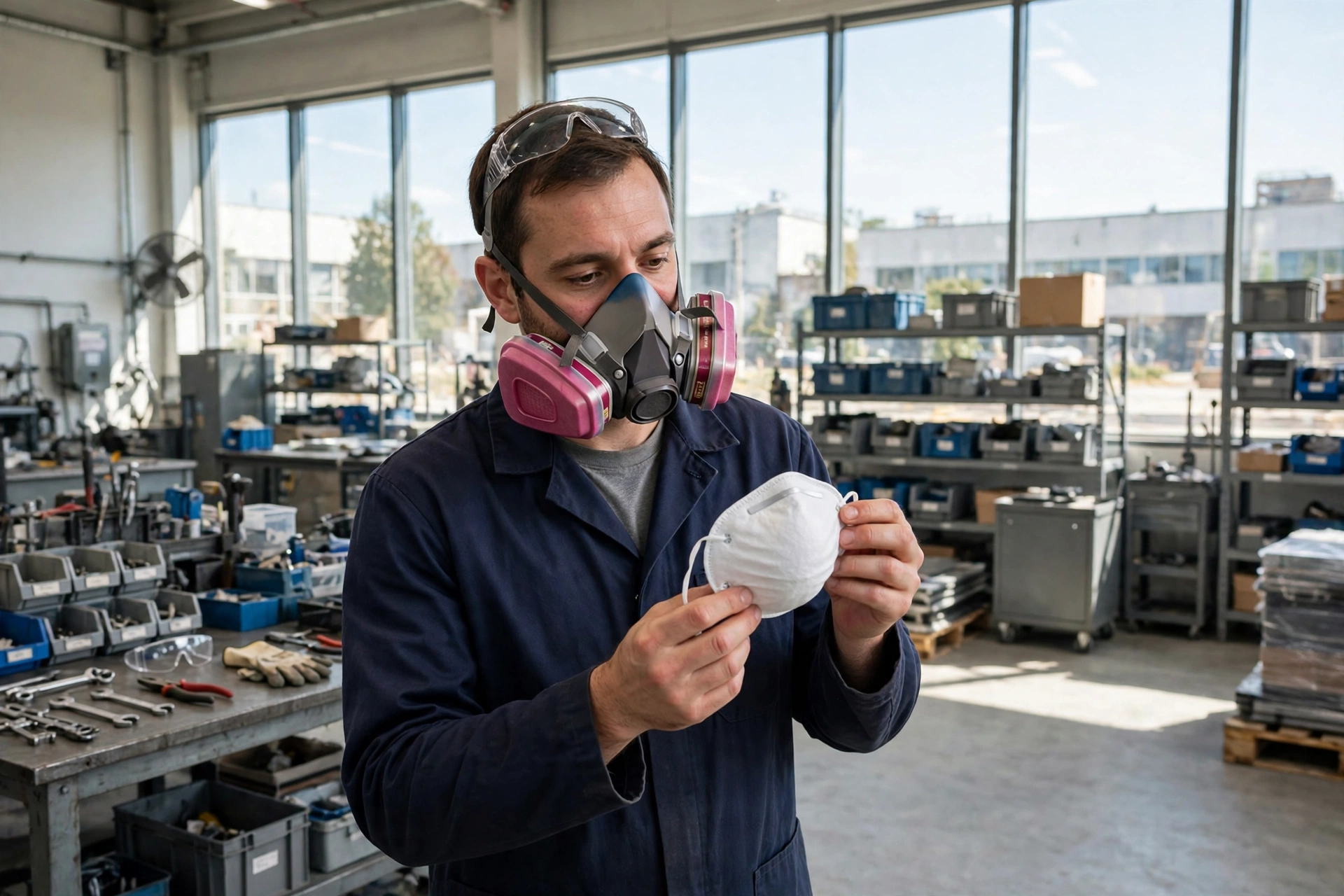
What a Disposable Respirator Really Is
A disposable respirator — usually called a filtering facepiece respirator, or FFR — is a single unit in which the filter material is the mask itself. The familiar N95 is the best-known example; FFP2 and FFP3 are the European equivalents under EN 149. The mask is worn for a shift or a task, then discarded. There are no parts to replace, no cleaning, and no maintenance log. NIOSH-approved filtering facepieces carry an approval marking on the mask itself, and that approval is the buyer’s first check: an unmarked or counterfeit mask can look identical and protect far less. Our guide to N95 vs FFP2 vs FFP3 ratings explains what the ratings mean and which one fits which hazard.
The economics of a disposable are simple: the cost is the unit price multiplied by the number of masks used. The complication is the number of masks used. A filtering facepiece is designed for one shift, and it should be replaced sooner if it is damaged, soiled, or hard to breathe through. In a dirty environment, a worker may go through two or three masks a day. The more masks a worker uses per day, the faster the disposable route becomes expensive.
What a Reusable Respirator Really Is
A reusable respirator — usually an elastomeric half-mask or full-face mask — is a durable facepiece with replaceable filters or cartridges. The facepiece itself lasts months to years; the filters are changed on a schedule or when breathing resistance rises. A half-mask covers nose and mouth; a full-face mask also covers the eyes and seals across a larger area. Both are tight-fitting respirators: they only protect when they seal against the wearer’s face.
The economics of a reusable are the mirror image: a higher upfront cost, then a low running cost per shift. A half-mask facepiece costs roughly what a box of disposables costs, and a pair of particulate filters costs a few dollars and typically lasts weeks of daily use in a dust environment. Gas and vapour cartridges have a defined service life and must be changed on a schedule, not when the wearer smells something.
The Cost Components Most Quotes Leave Out
Unit prices dominate every quotation, but a respiratory protection programme has five cost lines, and the unit price is only one of them. Under OSHA’s respiratory protection standard, 29 CFR 1910.134, employers using tight-fitting respirators must run a written programme that includes medical evaluation, fit testing, training, and maintenance — and every one of those has a price. Similar duties exist elsewhere, for example under the EU framework for respiratory protective equipment and the guidance in EN 529 on selection, use, and maintenance.
1. Medical evaluation
Before a worker is assigned a tight-fitting respirator, a physician or other licensed health care professional must determine that the worker is medically able to use one. This applies to disposables and reusables alike whenever respirator use is required rather than voluntary. The cost is per worker, typically once at hiring, so it does not change the comparison — but buyers who leave it out underestimate the programme either way.
2. Fit testing
Every tight-fitting respirator must be fit tested on each wearer, initially and annually, using the model and size that worker will actually wear. The procedure is the same for both routes, but churn is the difference: if your disposable model changes because a supplier is out of stock, every affected worker needs a new fit test on the new model. A stable reusable model, fitted once and kept in stock, avoids that repeated cost. See our guide to respirator fit testing for what the test involves and why the annual retest matters.
3. Training
Workers must be trained to put the respirator on, check the seal, recognise when it is damaged, and know its limits. Training cost is similar for both routes, but reusable respirators add two topics: cleaning and filter change. A workforce that wears a reusable until the filter clogs gets the worst of both worlds: the high upfront cost and the protection of a spent filter.
4. Cleaning, inspection, and storage
A reusable facepiece must be cleaned and inspected after each use and stored where it will not be crushed or contaminated — a few minutes of labour per worker per shift, plus cleaning materials. It is the line buyers most often forget. A disposable has no cleaning cost at all.
5. Filters and cartridges
For a reusable, the running consumable is the filter or cartridge. Particulate filters are cheap and long-lived in dust; gas and vapour cartridges cost more and must be replaced on a schedule set by the manufacturer or by a change schedule the employer develops. For a disposable, the running consumable is the mask itself. The comparison is between a few dollars of filters per month and a dollar or two of masks per day — and that arithmetic is the heart of the worked example below.
A Worked Example: 20 Workers, 200 Shifts a Year
The following example compares the two routes for a 20-person crew working 200 shifts a year in a dusty manufacturing environment — grinding and cutting, where a particulate filter is the right protection. Prices are illustrative ranges; use your own supplier quotes for the final numbers. Fit testing and medical evaluation apply to both routes and are excluded from the comparison total.
| Cost line (per worker, per year) | Disposable FFR | Reusable half-mask |
|---|---|---|
| Masks or facepiece | 200 masks × $1.50 = $300 | 1 facepiece $30 (amortised over 2 years = $15) |
| Filters / cartridges | — | 6 filter pairs × $8 = $48 |
| Cleaning and inspection labour | — | 10 min × 200 shifts ≈ $80 |
| Storage and spares | — | $10 |
| Disposal | 200 masks ≈ $10 | Negligible |
| Total per worker per year | ≈ $310 | ≈ $153 |
| Total, 20 workers | ≈ $6,200 | ≈ $3,060 |
In this example the reusable route costs roughly half as much per year, and the gap widens if workers use more than one disposable a day. But the example has a sensitive assumption: daily use. Run the same arithmetic for a crew that needs respirators only 20 days a year — intermittent maintenance work, for example — and the disposable route wins easily, because the reusable facepiece and its filters are paid for whether they are worn or not. The break-even point for a typical half-mask sits somewhere around 40 to 60 days of use a year: below that, disposables are cheaper; above it, reusables pull ahead and the gap grows with every extra day.
Two warnings about the table. First, the cleaning labour line is the most disputed number — some employers count five minutes, some fifteen, some none at all. Second, the table assumes the hazard is particulate only: a filtering facepiece does not protect against gases at all, so comparing the two routes only makes sense for the same hazard.
Protection Is Not a Price Difference
A common misunderstanding is that a reusable respirator protects better than a disposable because it costs more. Under OSHA’s assigned protection factors, a filtering facepiece and an elastomeric half-mask both carry an assigned protection factor (APF) of 10 — the same level of protection when both are properly fitted and worn. A full-face elastomeric mask carries an APF of 50, which is a genuine step up, because it seals over a larger area and protects the eyes. The protection difference is between half-mask and full-face, not between disposable and reusable.
What a reusable does offer is a more reliable seal for many faces: elastomeric facepieces come in multiple sizes, conform to the face, and can be fit checked every time they are put on. That is a fit argument, not a protection-factor argument, and it should be settled by a fit test, not by a catalogue.
When Disposable Wins — and When It Does Not
Disposable respirators are the right choice when use is intermittent, when the workforce turns over quickly, when the hazard is low and the exposure is short, and when the cost of managing a cleaning and filter-change programme would exceed the savings. Their weakness is volume: once a crew is wearing masks every day, the cost per shift of a disposable is simply higher than the cost per shift of a reusable.
Reusable respirators are the right choice for daily, long-term use in a stable workforce, for dusty environments where particulate filters last weeks, and for workplaces that already run a maintenance routine for other PPE. Their weakness is management: they need a cleaning station, a filter-change schedule, a spare-parts stock, and a supervisor who checks that the schedule is followed. A reusable programme that nobody manages costs more than a disposable programme and protects less. Before switching, audit honestly whether the management will happen — the cheapest respirator is the one worn correctly, and the most expensive is the one that is not.
The Break-Even Rule of Thumb
If you need a one-line rule for a purchasing decision, use days of use per year. Below about 40 days a year, buy disposables and spend the saving on fit testing and training. Above about 60 days a year, buy reusables and spend the saving on a proper cleaning and filter-change routine. Between 40 and 60 days, run the numbers with your own quotes. And whichever route you choose, standardise on one model: every model change triggers new fit tests, new training, and a new spares stock. Start with a PPE hazard assessment for the tasks involved — the hazard, the exposure time, and the daily headcount are the three inputs the comparison depends on.
Frequently Asked Questions
Can a disposable respirator be reused?
A filtering facepiece can be reused within a shift if it stays clean, undamaged, and easy to breathe through. It should never be shared, washed, or worn across multiple days as a routine.
How often should reusable filters be changed?
Particulate filters are changed when breathing resistance rises, when they are damaged or soiled, or on the schedule your programme sets. Gas and vapour cartridges follow a manufacturer change schedule based on the contaminant and concentration, not on smell.
Does a reusable respirator need a fit test too?
Yes. Every tight-fitting respirator — disposable or reusable — must be fit tested on each wearer, initially and annually, on the model and size that worker will wear. A fit test is a property of the wearer and the mask together, not of the mask type.
Sourcing Respirators for Your Workforce?
If you are standardising respiratory protection across a site, request a free sample kit — the samples are free, you only cover shipping. For bulk and OEM supply across our full PPE range, see our PPE manufacturer and wholesale supplier page, or send your task list, hazard, and headcount for a quote.


