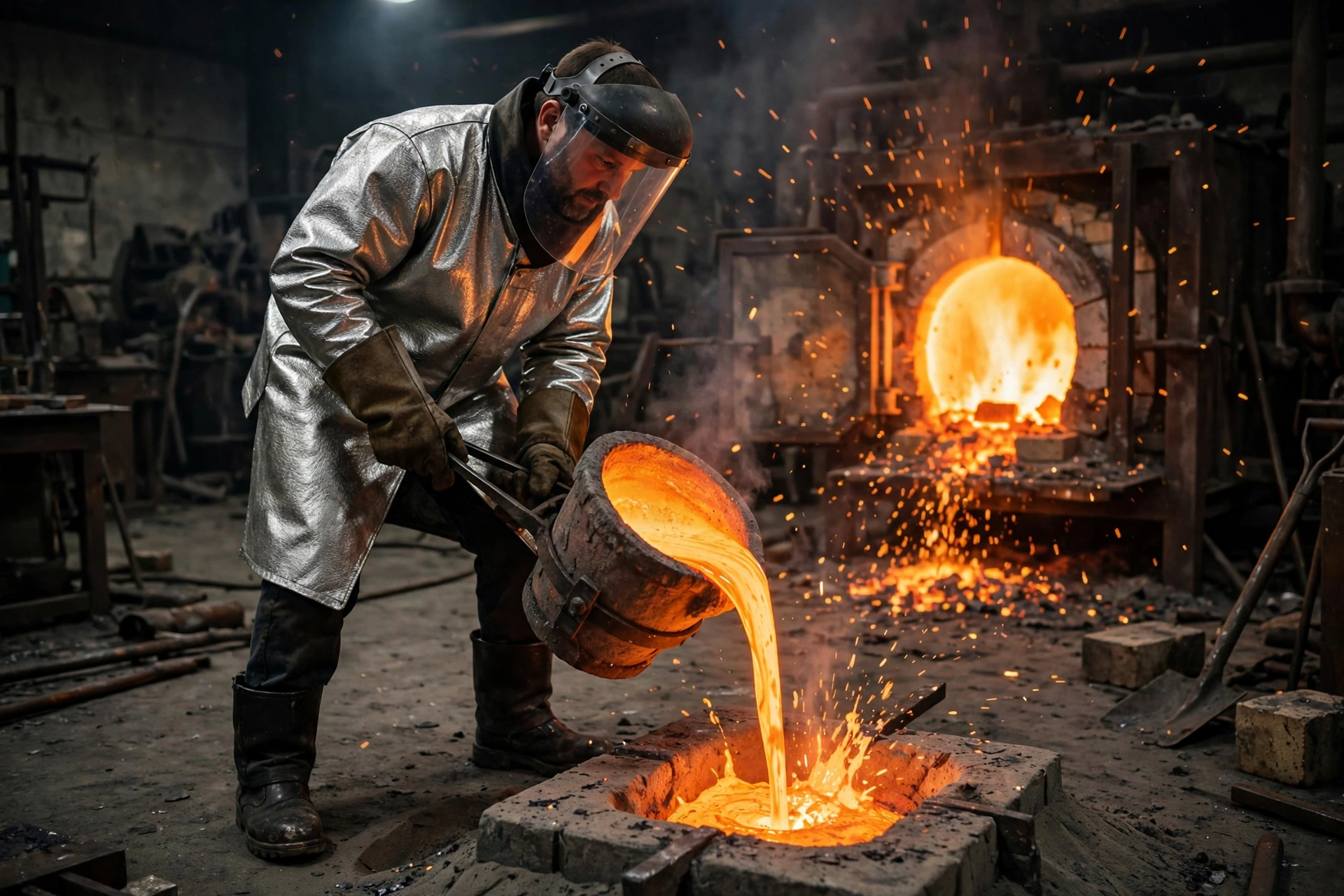
A foundry worker’s shift crosses several hazard zones before lunch: radiant heat from a furnace running well over a thousand degrees, molten metal that splashes on pouring, silica dust from moulding and shakeout, and the noise of grinding and shakeout tables. The kit that is right for a moulder working with sand can be wrong — or dangerous — for a pourer standing beside a crucible or a fettler grinding a casting. Buying PPE for foundry workers therefore starts with the task, not the catalogue.
This guide walks through the kit task by task, explains which standards govern each item, and closes with the buying checks that keep a whole crew consistent: sizing, inspection, replacement, and certification verification.
Start With the Hazard Assessment
Under OSHA’s general PPE rule, 29 CFR 1910.132, the employer must assess the hazards of each work area, select the PPE that controls them, and make sure it is used and maintained. In a foundry the assessment has to cover the heat, the metal, and the dust together: a furnace door opened for charging changes the radiant heat plan, a pour changes the splash plan, and a shakeout line changes the dust and noise plan. Our PPE hazard assessment guide explains the process step by step, from walking the site to writing the specification.
A practical way to run the assessment is to map the job into tasks and list the dominant hazard of each: radiant heat and burns at the furnace, melting, and pouring stations, molten metal splash on pouring and casting, cuts and abrasions from castings, gates, and hand tools in fettling, eye injuries from grinding and shot blasting, hearing damage from shakeout and grinding, silica dust from moulding, core making, and shakeout, and heat stress from long shifts beside hot metal. One worker may cross five of these in a single day, so the kit has to be layered — a base kit worn all day, plus task-specific items added at the station.
The Task-by-Task Kit
Heat and molten metal splash
Radiant heat is the defining hazard of foundry work, and the clothing must be specified for it, not just for general heat. Protective clothing against heat and flame is governed by EN ISO 11612, which rates garments for radiant heat, convective heat, and molten metal splash, and gloves for thermal risks fall under EN 407. For furnace and pouring work, aluminised jackets, aprons, and leggings reflect radiant heat away from the body, while the base layer underneath should be a flame-resistant fabric — ordinary workwear can melt onto skin in a splash, which turns a small burn into a serious one. Hand protection is covered by 29 CFR 1910.138: foundry gloves need a long gauntlet cuff that overlaps the sleeve, so molten splash cannot run down into the glove, and leather that is thick enough to resist heat transfer for the few seconds a pour takes. The common mistake is buying one heat glove for the whole foundry: a pourer’s glove, a fettler’s glove, and a moulding glove face different heat, cut, and dexterity demands, and one model cannot serve all three.
Face and eye protection must match the splash risk as well. A face shield to EN 166 with a chin guard and a heat-resistant visor protects the whole face from splash and radiant heat, and it should be worn over safety glasses, not instead of them — a splash that gets past the shield still needs the glasses behind it. Hard hats to EN 397 protect against falling castings and overhead crane loads, and on pouring stations a hard hat with a heat-resistant shell and a brim that shields the neck is worth specifying.
Hands, feet, and fettling
Most foundry work is hands-on: handling moulds and cores, guiding castings, grinding gates and risers, and moving hot parts with tongs. Cut-resistant gloves rated under ANSI/ISEA 105 are the everyday choice for fettling and handling, with the cut level matched to the task — a higher level usually means a thicker, stiffer glove, so the crew should test the shortlist on real castings before ordering for everyone. Measure hands and order across the size range — a glove that is too tight tears and fatigues the hand, one that is too loose catches on castings and loses grip on a tong. Our safety glove size chart shows how to measure correctly. Keep the heat gloves and the cut gloves separate and labelled: a cut glove used at the furnace is a burn, and a heat glove used for grinding wears out fast and grips poorly.
Footwear should meet EN ISO 20345, with a heat-resistant sole for floors near furnaces and pouring bays, a metatarsal guard where castings are handled overhead, and a puncture-resistant sole for yards with scrap and debris. The foot protection rule is 29 CFR 1910.136. Foundry boots should also be quick to remove — laces that melt or seize in heat are a real problem, so slip-on or quick-release fastenings are worth specifying for pouring stations.
Dust, noise, and heat stress
Moulding, core making, and shakeout release respirable crystalline silica, which is governed by 29 CFR 1910.1053 with a permissible exposure limit of 50 micrograms per cubic metre as an 8-hour time-weighted average, and the general air contaminants rule is 29 CFR 1910.1000. The first controls are engineering ones — local exhaust ventilation at shakeout and enclosed sand handling — and respiratory protection under 29 CFR 1910.134 is the layer that covers what engineering controls cannot. That rule requires a written programme, medical evaluation, and fit testing: a respirator that leaks at the seal protects no one. Our respirator ratings guide explains what N95, FFP2, and FFP3 actually filter, and our fit testing guide explains why the seal matters more than the filter class.
Hearing protection is governed by 29 CFR 1910.95, which sets the action level at 85 dBA as an 8-hour time-weighted average: shakeout tables, shot blasters, and grinders all add up over a long shift, so earplugs or earmuffs should be part of the base kit, not something fetched when the noise starts. Our hearing protection guide explains SNR and NRR ratings. Heat stress is the other daily factor: radiant heat, hot metal, and heavy aluminised clothing together make foundry work one of the hottest jobs in manufacturing. Our heat stress and PPE guide covers the work-rest schedules, hydration, and cooling breaks that keep a crew working safely in the heat. Maintenance work on furnaces and mould lines also needs lockout: the control of hazardous energy rule, 29 CFR 1910.147, requires energy sources to be isolated before servicing, and the PPE for that job is specified against the locked-out state, not the running state.
Buying for a Whole Crew
Size it properly. A glove that is too tight tears and fatigues the hand; one that is too loose catches on castings and loses grip on a tong. Measure hands and order across the size range, and do the same for aluminised jackets and face shields, where a poor fit leaves gaps that radiant heat and splash exploit. A crew that shares one size of everything ends up with kit that protects no one properly.
Plan inspection and replacement from day one. Foundry gloves wear out in weeks on a busy crew, aluminised coatings degrade with heat and washing, face shield visors craze and scratch, hard hats retire after any impact, respirators run on their filter and seal schedule, and boots fail when the sole or the metatarsal guard cracks. A written inspection and replacement schedule keeps the fleet protective instead of decorative — see our PPE inspection and replacement guide. Ask the supplier for the manufacturer’s retirement instructions in writing before the first order, and confirm that identical models will still be available in a year: a fleet of mixed, incompatible models is far harder to inspect than a standardised one.
Verify the certificates before the bulk order. A glove claim is only as good as its test report, and a wrong claim is invisible until it fails. Ask for the certificate and the test report behind it, check the model number matches the product you are buying, and confirm the expiry date — our PPE certification verification guide walks through the checks. Judge the supplier, not just the price: consistent sizing across batches, a stable model range, honest lead times, and a willingness to supply samples are worth more than a small unit-price saving. Our guide to choosing a PPE manufacturer and our protective clothing suppliers checklist set out the questions that separate a reliable partner from a one-off shipment. For crews that also handle steel, our steel fabrication workers’ guide covers the shared kit, and our mining workers’ guide covers dusty, heavy work in more depth.
Related Guides
For the details behind this guide, see our PPE hazard assessment guide, our PPE for steel fabrication workers guide, and our PPE for chemical manufacturing workers guide.
Foundry work rewards buyers who specify per task and test before they commit. If you are putting together a kit for your crew — aluminised jackets, face shields, heat-resistant gloves, respirators, and safety boots in bulk — contact us with your crew size and job types. We supply free samples so your crew can wear-test the shortlist on your site before you order, and you cover only the shipping.