



A forest is several workplaces spread over rough ground. The felling crew, the delimbing team, the skidder operators, and the landing crew each face a different hazard profile, and the kit that is right for running a chainsaw can be wrong — or dangerous — on a steep slope or beside moving machinery. Buying PPE for forestry and logging workers therefore starts with the task and the location, not the catalogue.
This guide walks through the kit task by task, explains which standards govern each item, and closes with the buying checks that keep a workforce consistent: sizing, inspection, replacement, and certification verification.
Start With the Hazard Assessment, Not the Catalogue
Under OSHA’s general PPE rule, 29 CFR 1910.132, the employer must assess the hazards of each work area, select the PPE that controls them, and make sure it is used and maintained. Logging has its own standard on top of that: OSHA’s logging operations rule, 29 CFR 1910.266, which covers chainsaw operation, felling, and the PPE required for logging work. That assessment is the document a buyer should ask for before ordering anything: it names the hazards per task and per location, and the kit follows from it. Our PPE hazard assessment guide explains the process step by step, from walking the site to writing the specification.
A practical way to run the assessment is to map the operation into tasks and list the dominant hazard of each: a running chainsaw and falling timber during felling, flying chips and kickback during delimbing and bucking, crush and struck-by hazards around skidders and loaders at the landing, slips and trips on steep, wet, and uneven ground, and noise from saws and machines all day long. One worker may cross several of these in a shift, so the kit has to be layered — a base kit worn all day, plus task-specific items added at the location.
The Task-by-Task Kit
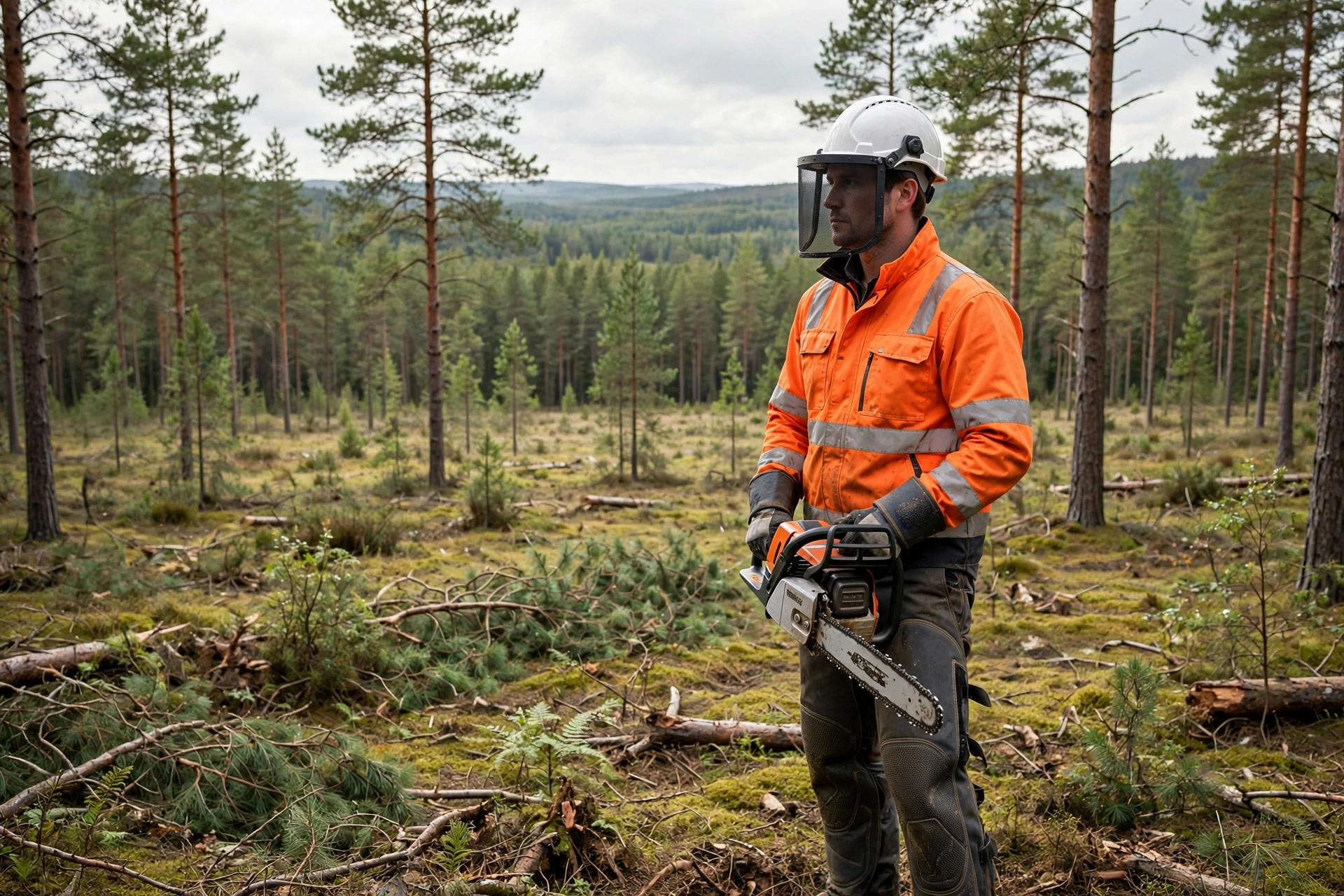
Felling and chainsaw work. The chainsaw is the defining hazard of logging, and the leg protection is the item that decides whether a slip becomes a serious injury. Chainsaw protective trousers or chaps are built with layers of cut-resistant fibres that clog and stop the chain on contact; they are rated by chain speed, with Class 1 (20 m/s) the usual baseline for ground work. The trousers must be worn for every cut, not only for the big trees, and they must be retired after any contact with a running chain — even a glancing one — because the protective layers are spent. Check the care label before washing: heat and aggressive detergents can degrade the fibres, and a pair that has been dried on a radiator may no longer stop a chain. Pair the trousers with a helmet system that combines head, face, and hearing protection in one unit, as the logging standard requires.
Delimbing and bucking. Once the tree is down, the work is fast and repetitive, and the hazards are flying chips, kickback, and a saw that bites into a tensioned limb. Eye and face protection is the priority here: a mesh visor keeps chips out while staying clear in humid air, and safety glasses underneath cover the gap when the visor is lifted. Gloves need grip in wet and sappy conditions and a cut-resistant palm for handling stems and limbs — see our cut resistant gloves selection guide for how cut levels are graded, and our safety glove size chart for the measuring method. Keep the chain brake working and the chain sharp: a dull chain forces the operator to push, and pushing is what causes kickback.
Skidding and landing work. At the landing, the hazards change from the saw to the machine: skidders and loaders moving timber, logs rolling and shifting, and workers on foot among them. Hi-vis clothing is the item that keeps a ground worker visible to the machine operator — specify garments to EN ISO 20471, and choose fluorescent orange, the colour that stands out against green and brown forest. Foot protection is equally important: OSHA’s foot protection rule, 29 CFR 1910.136, requires protective footwear wherever falling or rolling objects threaten the foot, and a landing meets that test all day. Our EN ISO 20345 safety footwear standards guide explains toe protection, penetration-resistant soles, and slip ratings — all three matter on a landing, where the ground is uneven, wet, and littered with bark and offcuts.
Steep ground and bad weather. Much logging happens on slopes, in rain, and in cold, where the footing is the hazard before any machine or saw is involved. Boots need a deep, self-cleaning tread that holds on mud and wet timber, and ankle support high enough to steady a step on a slope. Where the operation works on ground steep enough that a fall could carry a worker into a hazard, fall protection enters the kit — see our fall protection harness inspection guide. Cold and wet change glove choice too: a glove that is warm enough to keep on is safer than a better-rated glove that gets taken off, and waterproof outer layers that breathe are worth more than a cheap shell that soaks through by mid-morning.
Noise, all day, every day. A chainsaw at full throttle and the machines at the landing are loud enough to damage hearing over a season, not a career. OSHA’s noise rule, 29 CFR 1910.95, sets the framework, and the practical step is hearing protection rated for the task and worn for the whole exposure. The usual logging answer is ear muffs mounted on the helmet, so the hearing protection is on whenever the helmet is on — there is no separate item to forget. Our hearing protection ratings guide explains SNR and NRR so the buyer can compare products on the same basis. The rule for the crew is simple: if you have to raise your voice to be heard at arm’s length, the protection goes on.
Head, Eye, and Hearing Protection
A helmet to EN 397 is the baseline for felling, delimbing, and landing work — falling limbs, rolling logs, and low branches all argue for it. Under OSHA’s head protection rule, 29 CFR 1910.135, head protection is required wherever falling objects can strike, and a logging site qualifies from the first tree. In forestry the helmet is usually worn as a system: helmet, mesh or clear visor, and ear muffs on one mount, so the three protections go on and come off together. The chin strap should be worn on slopes and in wind: a helmet that falls off at the first bend is decoration. Eye protection to EN 166 should be matched to the task — a mesh visor for chips, sealed goggles for dusty dry cutting, and clear lenses for low light under the canopy.
Gloves deserve the same task-by-task thinking. Felling and delimbing need a cut-resistant palm and a grip that holds when wet with sap and rain; landing work needs the same palm plus durability against bark and cable; machine operation needs dexterity for controls and a snug fit that will not snag on levers. No single glove covers all three well, so the operation should stock the range and train workers to change gloves with the task. Order the full size range from the start and run a wear trial with the crew before committing: hands differ, and a size run ordered blind becomes a drawer of unworn gloves.
Heat, Fatigue, and the Kit That Stays On
Logging is heavy physical work, often far from shelter, and PPE that traps heat gets discarded. Our heat stress and PPE guide covers scheduling, hydration, and choosing lighter garments where the risk assessment allows it. Fatigue is the quieter hazard: a tired operator makes the mistakes that chainsaws punish, so work-rest patterns and a kit that does not add unnecessary weight are part of the safety picture. The kit that stays on the worker is the only kit that protects — and in forestry, that means kit the crew chose in a wear trial, not kit chosen from a catalogue photo.
Buying in Bulk: The Checks That Keep a Fleet Consistent
Verify certificates before you pay. Every item in the kit should arrive with a certificate or declaration that matches the standard claimed on the label — and the certificate must name the model you actually received, not a similar one. Our PPE certification verification guide explains what to ask for, how to read an EU type-examination certificate, and the red flags that mark a claim as untested. This matters most for chainsaw trousers, where the chain-speed class is the whole point of the garment.
Plan inspection and replacement from day one. Chainsaw trousers are retired after any chain contact, gloves wear out in weeks on bark and cable, boots in months on rough ground, helmets on a fixed schedule after any impact, and hi-vis when its fluorescence fades. A written inspection and replacement schedule keeps the fleet protective instead of decorative — see our PPE inspection and replacement guide. Ask the supplier for the manufacturer’s retirement instructions in writing before the first order, and confirm that identical models will still be available in a year: a fleet of mixed, incompatible models is far harder to inspect than a standardised one.
Judge the supplier, not just the price. Consistent sizing across batches, a stable model range, honest lead times, and a willingness to supply samples are worth more than a small unit-price saving. Our guide to choosing a PPE manufacturer and our protective clothing suppliers checklist set out the questions that separate a reliable partner from a one-off shipment.
Related Guides
For the details behind this guide, see our PPE hazard assessment guide, our EN 397 safety helmet standards guide, and our EN ISO 20345 safety footwear standards guide.
Forestry rewards buyers who specify per task and test before they commit. If you are putting together a kit for your crew — chainsaw trousers, helmet systems, hearing protection, gloves, and boots in bulk — contact us with your task list and headcount. We supply free samples so your crew can wear-test the shortlist on your site before you order, and you cover only the shipping.


