



A steel fabrication shop is several workplaces under one roof. The shearing station, the press brake, the grinding bay, the paint booth, and the loading dock each carry a different hazard profile, and the protective kit that works at one station can be wrong — or dangerous — at the next. Buying PPE for steel fabrication workers therefore starts with the station, not the catalogue.
This guide walks through the kit station by station, explains which standards govern each item, and closes with the buying checks that keep a fleet consistent: sizing, inspection, replacement, and certification verification.
Start With the Hazard Assessment, Not the Catalogue
Under OSHA’s general PPE rule, 29 CFR 1910.132, the employer must assess the hazards of each work area, select the PPE that controls them, and make sure it is used and maintained. That assessment is the document a buyer should ask for before ordering anything: it names the hazards per station, and the kit follows from it. Our PPE hazard assessment guide explains the process step by step, from walking the floor to writing the specification.
A practical way to run the assessment is to map the floor into zones and list the dominant hazard of each: sharp edges and heavy parts at shearing and handling, crush and pinch points at the press brake, sparks, noise, and airborne particles at grinding and cutting, and solvents and overspray at painting. One worker may cross four zones in a shift, so the kit has to be layered — a base kit worn all day, plus task-specific items added at the station.
The Station-by-Station Kit
Shearing and sawing. Freshly sheared edges are the classic hand injury in a steel shop: a burr or a razor edge under load cuts through a light glove in one slide. The core items are high-cut gloves, eye protection against flying chips, and steel-toe boots for dropped plate. Hearing protection is usually needed near power saws.
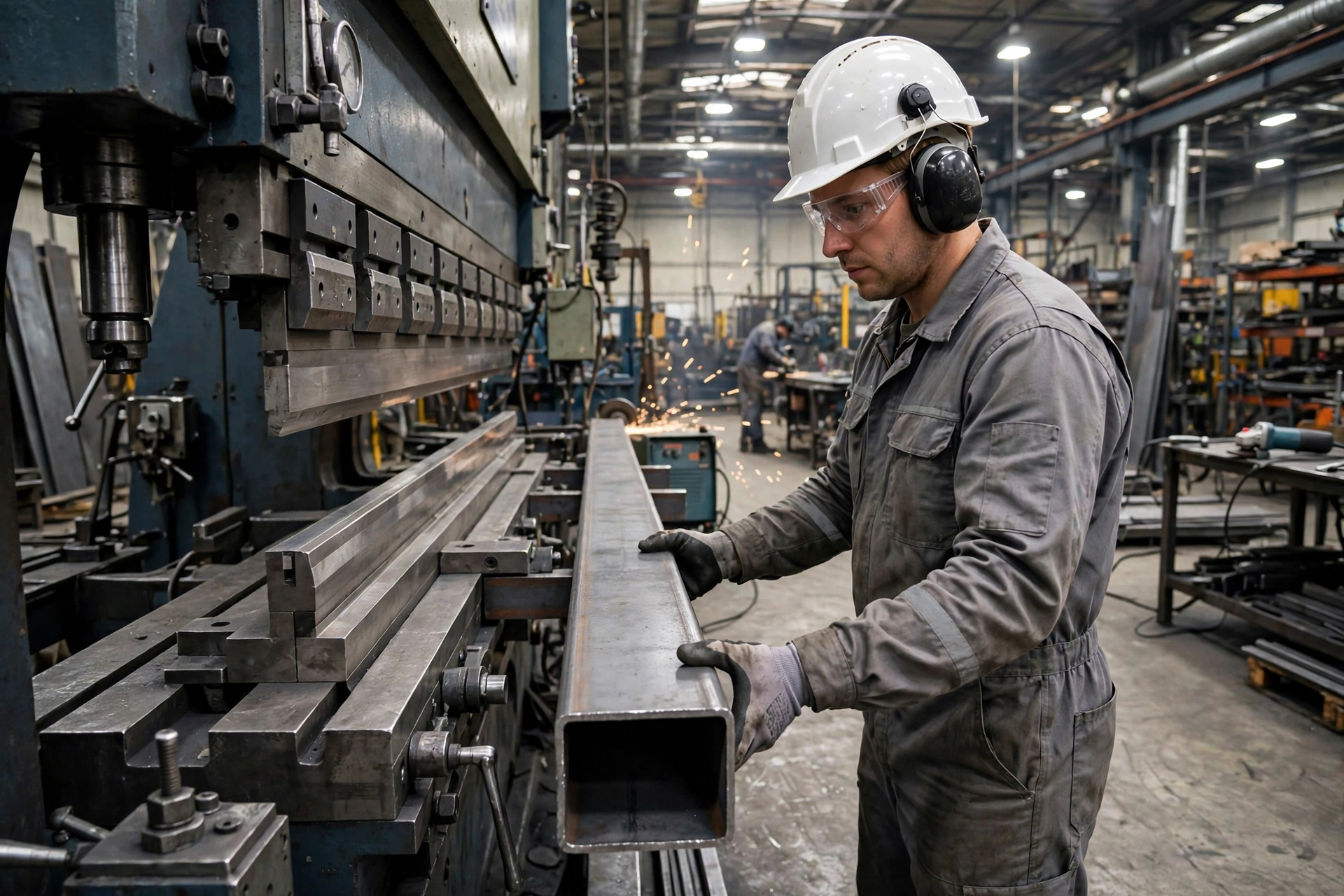
Press brake and forming. The press brake adds a crush and pinch hazard that no glove can solve — the control is guarding, two-hand controls, and procedure, not PPE. Gloves here are for handling the part before and after the bend, and they must be close-fitting so nothing snags. Loose cuffs and dangling sleeves have no place near a brake.
Grinding, deburring, and cutting. This is the highest-noise, highest-particle zone in most shops. Eye and face protection becomes a system — safety glasses plus a face shield — and respiratory protection enters the picture: grinding dust and metal fume need a rated respirator, not a nuisance dust mask. Hearing protection is mandatory in most grinding bays.
Assembly and fitting. Dexterity returns as the priority. Workers handle fasteners, check fits, and read drawings, so the glove must be thin enough to feel a bolt thread while still guarding against the edges of the part being assembled. This is where a single glove choice for the whole shop usually fails: the assembly glove and the shearing glove are different products.
Painting and coating. Solvents, overspray, and surface-preparation chemicals change the glove material entirely — a cut glove is not a chemical glove. Chemical-resistant gloves, eye protection against splash, and respiratory protection matched to the coating are the core items here. Our chemical glove breakthrough time guide explains how to read the permeation data that decides glove choice.
Hand Protection: Match the Cut Level to the Task
Hands are the most injured body part in metal fabrication, and the glove is the item buyers get wrong most often — usually by buying one glove for every task. Two rating systems frame the choice: the ANSI/ISEA 105 scale from A1 to A9, and the EN 388 TDM cut levels from A to F. Our cut resistant gloves for metal work guide maps typical shop tasks to levels: light assembly and inspection at A2–A3, sheet handling and duct fabrication at A4–A5, and stamping, heavy-gauge stock, and sharp scrap at A6–A7 and above.
Cut level is only half the decision. Palm coating decides grip: polyurethane for dry, precise work; sandy nitrile for oily or coolant-wet parts; leather palms where heat and rough abrasion dominate. And fit decides whether the glove is actually worn — a glove that is a size too big loses dexterity and snags; a size too small fatigues the hand. Measure hands properly before ordering a fleet: our safety glove size chart shows the measurement method to use, and a size run should always include the full spread of the workforce, not an average.
One hard rule belongs in every shop’s glove policy: gloves are for handling, never for contact with rotating machinery. Near lathes, drills, and powered saws, entanglement is the dominant hazard, and the correct assessment for that zone can be “no gloves.” OSHA’s machinery standard, 29 CFR 1910.212, requires machine guarding, and the PPE choice must follow the guarding assessment rather than override it.
Head, Eye, and Face Protection
A hard hat is required wherever there is a risk of falling objects or head impact — which in a fabrication shop means the dock, the crane bay, and anywhere work happens overhead. The choice is between Type I helmets, which protect against top impact, and Type II helmets, which also protect against lateral impact. Our EN 397 safety helmet guide explains the types, the markings to check on the shell, and when a chin strap is worth specifying.
Eye protection in a steel shop is rarely one item. Safety glasses with side shields cover general floor work; grinding and cutting add a face shield over the glasses; chemical splash at the paint booth calls for sealed goggles. The markings stamped on the lens and frame tell the buyer what the product is rated for — our EN 166 eye protection markings guide decodes them. Prescription wearers need over-glasses or prescription safety glasses, not a workaround that leaves the side shields off.
Hearing Protection: Measure the Bay, Then Choose
Grinders, power saws, and press brakes routinely push a bay above the level where hearing protection is required, and the right product depends on the measured level and the length of exposure. Ear muffs are easy to fit, easy to see, and easy to supervise; ear plugs fit under other headgear and suit hot bays. The two rating systems buyers meet are SNR in Europe and NRR in the United States — our SNR vs NRR guide explains how to compare them and why the labelled number is not the protection the worker actually gets.
Two buying mistakes recur: ordering one hearing protector for the whole shop when bays differ by 10 decibels or more, and ignoring communication. Workers who cannot hear a forklift horn or a shouted warning will take the muffs off — so test protectors on the floor before a bulk order.
Footwear: Toe Protection, Puncture Resistance, and Metatarsals
Safety boots in a steel shop do three jobs: protect the toes from dropped plate, protect the sole from nails, swarf, and sharp offcuts on the floor, and keep the wearer standing on oily or wet concrete. The European ladder is EN ISO 20345, from S1 to S7; our EN ISO 20345 safety footwear guide explains each level. For most fabrication floors, S3 is the sensible baseline: toe cap, puncture-resistant midsole, and a cleated, slip-resistant outsole.
Where heavy plate is handled at waist height or dropped from a bench, add metatarsal protection — an external or internal guard over the instep, which a plain toe cap does not cover. A wear trial with a small group, on the real floor, is worth more than any datasheet claim.
Respiratory Protection: Grinding Dust and Metal Fume
Grinding dust, cutting fume, and the fine particles from deburring are the respiratory hazard most steel shops underestimate, because the exposure is invisible and the symptoms arrive years later. The first question is always the rating: FFP2 and FFP3 in the European system, N95 and above in the US system, each with a defined assigned protection factor. Our N95 vs FFP2 vs FFP3 guide compares the ratings side by side.
The second question is fit. A respirator that leaks at the seal protects no one, whatever its rating, which is why fit testing matters before a fleet is rolled out — see our respirator fit testing guide. Disposable respirators suit intermittent grinding; reusable half-face respirators with replaceable filters suit daily, all-shift exposure and work out cheaper over a year. Either way, the programme needs a written schedule for filter changes and facepiece inspection.
Hi-Vis, Clothing, and Heat
Hi-vis is a dock and yard item first and a floor item second: wherever forklifts and trucks move, workers need to be seen. EN ISO 20471 classes run from 1 to 3, with Class 2 as the usual floor standard and Class 3 for roadside or high-speed vehicle areas — our EN ISO 20471 hi-vis guide sets out when each class applies. Specify the class per zone rather than buying one vest for everyone.
Clothing matters more than buyers expect in a steel shop. Loose sleeves snag at the brake and near rotating equipment; synthetic fabrics melt onto skin near hot work; cotton coveralls are the safer default where heat is present. In summer, heat stress becomes a real hazard in a shop full of hot metal and poor airflow — our heat stress and PPE guide covers work-rest schedules and the clothing choices that keep workers cool without giving up protection.
Buying in Bulk: The Checks That Keep a Fleet Consistent
Specify per station, order per station. A single “shop glove” or “shop boot” is how fleets go wrong. Write the specification station by station, then consolidate sizes and quantities. The order will contain several glove models and possibly two boot models — that is normal, and cheaper than the injury a wrong glove causes.
Verify certificates before paying. Every claim on a datasheet — a cut level, a boot rating, a respirator class — should trace to a test certificate for that exact model. Our PPE certification verification guide explains what to ask for, how to read an EU type-examination certificate, and the red flags that mark a claim as untested.
Plan inspection and replacement from day one. Gloves wear out in weeks, boots in months, helmets on a fixed schedule after any impact. A written inspection and replacement schedule keeps the fleet protective instead of decorative — see our PPE inspection and replacement guide. Ask the supplier for the manufacturer’s retirement instructions in writing before the first order, and confirm that identical models will still be available in a year: a fleet of mixed, incompatible models is far harder to inspect than a standardised one.
Judge the supplier, not just the price. Consistent sizing across batches, a stable model range, honest lead times, and a willingness to supply samples are worth more than a small unit-price saving. Our guide to choosing a PPE manufacturer and our protective clothing suppliers checklist set out the questions that separate a reliable partner from a one-off shipment.
Related Guides
For the details behind this guide, see our cut resistant gloves for metal work selection guide, our PPE hazard assessment guide, and our EN ISO 20345 safety footwear standards guide.
Steel fabrication rewards buyers who specify per station and test before they commit. If you are putting together a kit for your shop — gloves, helmets, eye and hearing protection, boots, and respirators in bulk — contact us with your station list and headcount. We supply free samples so your crew can wear-test the shortlist on your floor before you order, and you cover only the shipping.


