



A mine is not one workplace. The driller at the face, the loader operator in the tunnel, the crusher attendant on the surface, and the maintenance crew in the workshop face different hazards — and the protective equipment that protects one of them can be useless for another. That is why PPE for mining workers should be chosen task by task, not from a single generic list. This guide explains what to specify for each mining task, which standards to ask for, and how to buy in bulk without ending up with the wrong kit at the shaft.
Why Mining PPE Needs Its Own Plan
Mining combines more hazards in one shift than most industries manage in a year: falling rock, respirable dust, diesel exhaust, noise, heat, slips on wet ground, and work at height on surface structures. In the United States, mine safety is regulated by the Mine Safety and Health Administration (MSHA) under the Federal Mine Safety and Health Act, and mine operators are required by law to report accidents within 15 minutes — see the MSHA home page for the reporting duty and current fatality data. The US National Institute for Occupational Safety and Health runs a dedicated mining research programme — see NIOSH Mining — covering dust control, hearing loss, and ground control. A hazard assessment that lists each task, the exposure it creates, and the protection that matches it is the starting point — it is also what OSHA’s general PPE standard expects before any equipment is selected, and MSHA’s own rules carry the same expectation for mine sites.
The second reason is the environment itself. Underground workings are dark, damp, dusty, and warm; surface operations add weather, sun, and heavy mobile plant. Equipment that works in a dry warehouse can fail underground: lamps fog, respirator filters clog, gloves wear through on rough rock, and boots lose grip on wet, muddy floors. The best mining PPE is rugged, simple to fit, and comfortable enough for a full shift in heat and humidity. If workers are modifying kit, leaving it in the lamp room, or wearing it only when the supervisor is watching, the specification is wrong — not the workers.
Respiratory Protection: Dust Is the Long-Term Risk
The most serious long-term health risk in mining is the dust workers breathe. Respirable crystalline silica from drilling, blasting, and crushing can cause silicosis, and diesel particulate matter adds a further burden underground. MSHA’s 2024 silica rule lowered the permissible exposure limit for respirable crystalline silica to 50 micrograms per cubic metre over an 8-hour shift, which makes dust control — ventilation, water suppression, and enclosed cabs — the first line of defence, with respiratory protection as the backstop for the residual exposure. A loose paper mask is not protection against silica dust. Workers who need respiratory protection should be issued a properly fitted respirator — FFP2 or FFP3 in Europe, N95 or higher in the US — and our guide to N95 vs FFP2 vs FFP3 respirator ratings explains what each class actually guarantees. Fit matters as much as the filter: a respirator that leaks around the seal protects nobody, so fit testing for every wearer is part of the programme, not an optional extra — see our guide to respirator fit testing.
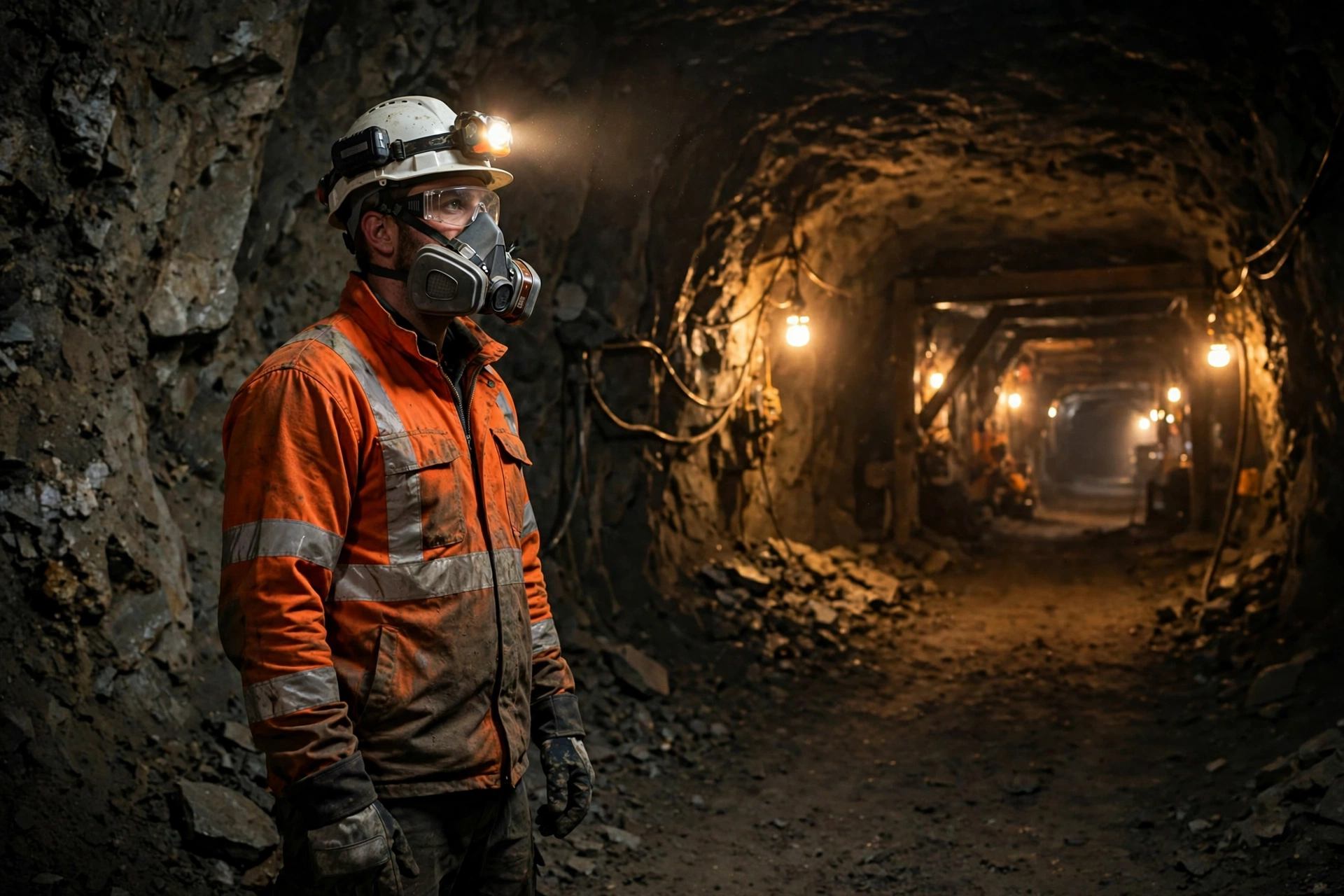
Underground, a half mask with replaceable filters is often the practical choice: it seals better than a disposable facepiece in dusty, humid air, and the filter can be changed when breathing resistance rises. For short, dusty jobs on the surface — cutting, grinding, or cleaning out a crusher — a disposable FFP3 or N95 is usually enough. Whatever the type, filters clog faster in a mine than in a clean factory, so build filter changes into the shift routine and keep spares at the face, not in a store a kilometre away. Beards break the seal on tight-fitting respirators: if a worker cannot shave, a loose-fitting powered respirator is the honest alternative, not a tight mask worn over stubble.
Head, Eyes, and Hearing
Head protection underground is about falling rock and low clearances, not just dropped tools. A hard hat to EN 397 is the baseline, and in a mine it is usually worn with a cap lamp bracket and a lamp — check that the lamp, its cable, and its battery are approved for use in the mine’s atmosphere before buying, and that the helmet’s suspension and shell are inspected on a schedule. Our guide to EN 397 safety helmet standards covers inspection and replacement signs, including the five-year shell rule. Chin straps are worth specifying underground: a helmet that falls off when a worker bends or climbs is not protecting anyone.
Eye protection should be sealed goggles rather than open safety glasses wherever dust, flying rock chips, or chemical splash can reach the face — and in a mine, that is most of the shift. EN 166 markings tell you whether a lens is rated for dust, liquid splash, and impact. Anti-fog coatings matter underground, where humidity is high and a fogged lens gets pushed up onto the helmet. Hearing protection is the slow injury: drills, crushers, fans, and diesel engines run loud enough to damage hearing over a career, so specify earplugs or earmuffs by the measured noise level of the actual equipment, not by habit. See our comparison of SNR vs NRR hearing protection ratings to match protectors to the job, and remember that earmuffs must fit over the helmet — test the combination, not each item alone.
Hands: Cuts, Chemicals, and Vibration
Hands take the most punishment in mining: sharp rock edges, wire rope, sheet metal, and heavy, rough loads. Cut-resistant gloves to EN 388 are worth specifying for handling rock, mesh, and steel — see our guide to cut-resistant gloves for metal work for how to match the cut level to the task — but loose gloves must never be worn near rotating machinery such as drills and conveyors, where entanglement is the dominant hazard and the correct assessment can be “no gloves”. Maintenance crews also handle fuels, oils, and reagents: those jobs need a chemical glove, not a cut glove, and the choice should follow permeation data for the specific chemical — our explainer on chemical glove breakthrough time sets out how to read it. A glove that resists diesel for 30 minutes is not the same as one that holds for a full shift.
Vibration deserves an honest note. Hand-held drills and breakers expose workers to hand-arm vibration, and the control is to reduce vibration at source and limit exposure time — anti-vibration gloves are not a substitute for that, and their measured benefit is limited. Do not buy gloves as the vibration control; buy them for grip, cut protection, and comfort, and manage vibration through tool selection, maintenance, and job rotation instead.
Footwear, Hi-Vis, and Work at Height
Safety footwear to EN ISO 20345 — usually S3 with toe protection, puncture-resistant soles, and water resistance — is the baseline for anyone in a mine, and our guide to EN ISO 20345 safety footwear explains the S1–S7 ratings. Underground, the sole matters as much as the toe cap: wet, muddy, and uneven ground demands deep tread and good grip, and metatarsal protection is worth adding for workers handling heavy loads where dropped objects can strike the top of the foot. Boots should be tried on the actual ground, on a full shift, before a bulk order — a boot that blisters in a week will be left in the locker.
High-visibility clothing to EN ISO 20471 is essential wherever workers are near mobile plant, on surface roads, or around the yard; EN ISO 20471 hi-vis classes explain which class fits which speed and setting. Underground, hi-vis works with the cap lamp — reflective bands that catch a lamp beam are what make a worker visible in a tunnel. For surface work at height — crusher platforms, conveyor gantries, and stockpile structures — a fall protection harness with a proper anchor point is required, and our fall protection harness inspection guide covers the pre-use and formal inspection routine. Heat is the last piece of the kit: deep workings are hot, and the PPE plan should include breathable clothing, water, and rest breaks — our guide to heat stress and PPE covers how to keep workers protected without overheating them.
Buying in Bulk: What to Check Before You Order
Mining PPE is usually bought in volume — a season’s worth of gloves, respirators, filters, and boots for a whole crew. That makes the supplier check more important, not less. Before placing a bulk order, verify the certificates behind the products: EN 397 for helmets, EN 166 for eyewear, EN 388 for gloves, EN ISO 20345 for footwear, EN 149 for respirators. Ask for the EU declaration of conformity and the test reports, and check them against the model you are actually buying — a certificate for one model does not cover another. Our guide on how to verify PPE certifications before a bulk order walks through the checks step by step.
Size mix is the detail most bulk orders get wrong. A crew is not one size, and gloves, respirators, and boots that do not fit are not worn — or are worn badly. Order a size range based on a real headcount, not a guess, and include a small trial quantity of any new product before committing to the season’s volume. Check the supplier’s lead time and re-order reliability too: running out of respirator filters mid-shift is not a problem you want to solve at retail prices. For the wider supplier questions — MOQ, sampling, audits — see how to choose a PPE manufacturer and what PPE distributors look for in a manufacturer partner.
Fit, Training, and Storage
Even the right equipment fails if it is not fitted and used correctly. Respirators need fit testing; gloves need the right size so workers keep dexterity on drills and controls; helmets need the suspension adjusted so the lamp sits level. A short fitting session at the start of a rotation — with the actual products, on the actual workers — pays for itself in compliance. Training should be practical: how to put on and take off dusty PPE without contaminating skin, how to check a respirator seal, when to change a filter, and when to retire a glove. Storage matters as well: keep PPE away from sunlight, fuels, and damp, and keep dusty kit separate from clean kit. A helmet that has been baking in a surface store all summer is not the helmet you tested in spring, and a respirator filter left open in a dusty lamp room is already spent. See our guide to PPE inspection and replacement schedules for the routine that keeps the kit honest, and how to measure your hand for safety gloves before ordering the size run.
Related Guides
For the standards behind the choices in this guide, read N95 vs FFP2 vs FFP3: Respirator Ratings Explained, Safety Footwear Standards: EN ISO 20345 S1–S7 Explained, and How to Conduct a PPE Hazard Assessment.
Get a Quote for Your Mine
Aceppe supplies mining PPE in bulk — hard hats, respirators and filters, hearing protection, cut-resistant and chemical gloves, safety footwear, and hi-vis workwear — built to the standards above and shipped worldwide. Tell us the tasks your crew does, the dust and noise levels you are managing, and your headcount, and we will put together a task-matched kit with samples before you commit. Free samples are available — the buyer covers shipping. Contact us for a quote today.


