


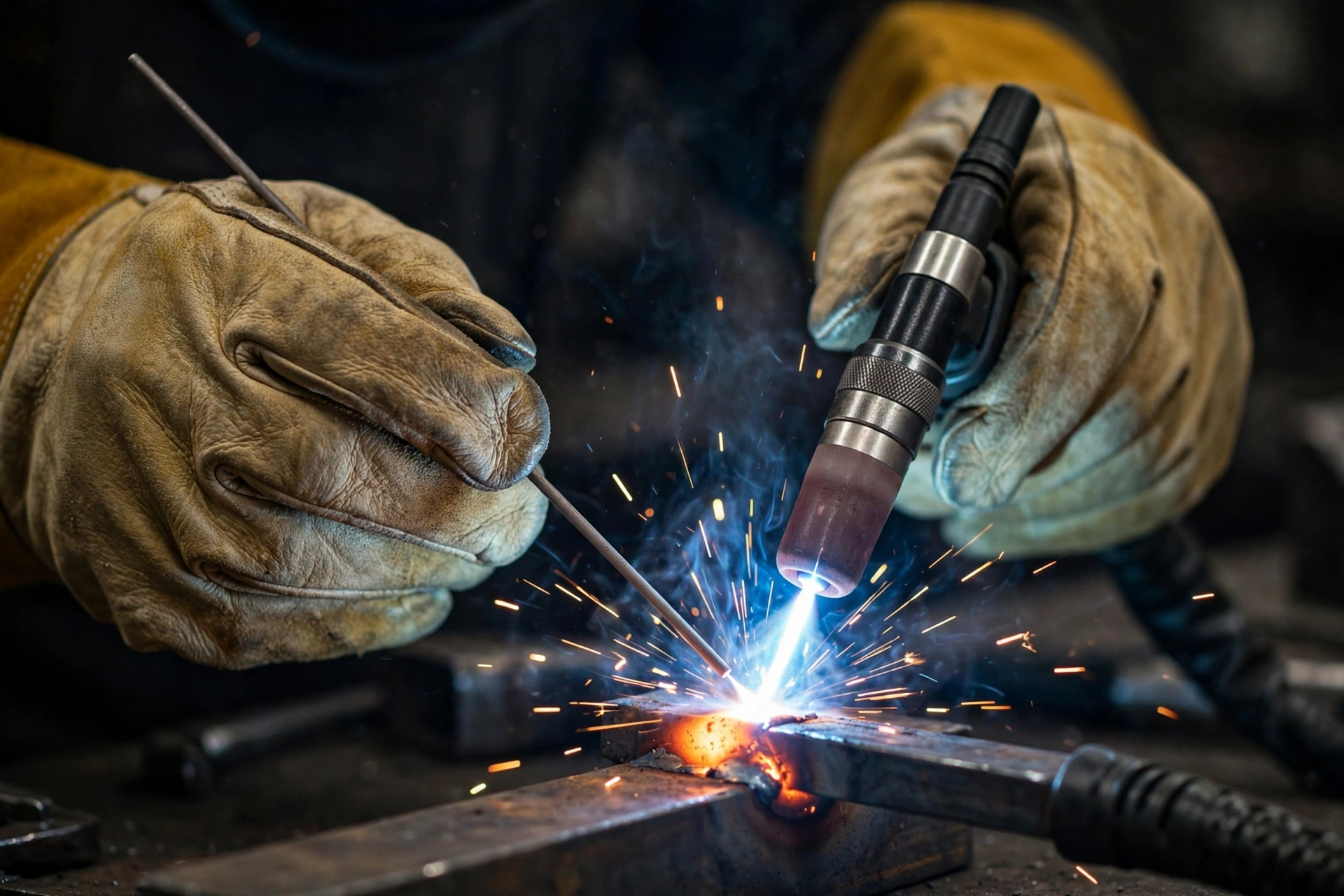
TIG welding is a two-handed skill. One hand holds the torch and keeps a precise arc gap measured in millimetres; the other feeds filler rod in a steady pinch-and-dab rhythm. Now imagine doing all of that in thick, bulky gloves — it would be like threading a needle with mittens.
That is why dexterity is the single most important quality of a TIG welding glove. Heat resistance, durability, and fit all matter, but without fingertip control a welder cannot keep the arc gap, feed the wire, or produce a clean weld. This guide explains why dexterity is decisive in TIG welding, how it is measured, what designs maximise it, and how to evaluate it before you buy.
Why TIG Welding Is Uniquely Dexterity-Dependent
Most welding processes reward hand control to some degree, but TIG (gas tungsten arc welding, GTAW) takes it further than any other. Three demands converge at once:
- Arc gap control. The electrode sits 2–4 mm from the workpiece. A twitch of the torch hand changes arc length, voltage, and heat input — and a slip that touches tungsten to the puddle contaminates the electrode and ruins the weld start.
- Filler rod feeding. The filler hand feeds 1.6 or 2.4 mm wire with thumb and forefinger in a continuous pinch-and-push rhythm, retracting the rod between dabs without letting the hot tip leave the gas shield. Fine fingertip friction matters enormously here.
- Extended torch posture. Welders often “walk the cup” (rocking the torch nozzle across the joint) or use a lay-wire technique, both of which demand wrist flexibility and a secure but relaxed grip — something a stiff glove destroys.
MIG and stick welding, by contrast, are single-handed operations with the gun or electrode holder doing most of the work; the other hand is free. That is why TIG gloves are cut, sized, and built differently from their MIG and stick counterparts — and why a glove that feels “good enough” for MIG often feels unusable for TIG.
What Dexterity Actually Means in a Glove
Dexterity in a glove is the hand’s retained ability to feel, grip, and manipulate small objects. It breaks down into three practical components:
- Tactile feedback. How much of what the fingers touch actually reaches the wearer’s sense of touch. A thin, supple palm transmits the shape of the filler rod; a thick one transmits pressure only.
- Finger independence. Whether each finger can bend and move on its own. Stiff or oversized gloves make fingers move as a block, killing the pinch grip TIG feeding depends on.
- Resistance-free motion. How much force the glove itself demands. A glove that fights every bend fatigues the hand in an hour; a supple one lets a welder keep a steady rhythm all shift.
Here is the uncomfortable truth about protection: every millimetre of material between hand and work trades some dexterity for protection. Good TIG glove design manages the trade-off — protecting where protection is needed (back of hand, cuff, seams) while keeping the working surface — palm and fingertips — thin, soft, and responsive.
How Dexterity Is Measured: Standards and Tests
Dexterity is not just a subjective impression — European standards quantify it. The classic test (defined in EN 420, now superseded by ISO 21420) asks a gloved operator to pick up metal pins of decreasing diameter — typically 11, 9.5, 8, 6.5, and 5 mm — against a time limit. The thinnest pin the operator can reliably pick up determines the dexterity level, from 1 (coarsest) to 5 (finest).
For welding gloves specifically, EN 12477 — the dedicated European standard for welders’ gloves — builds dexterity directly into its two-type system:
- Type A: higher mechanical and thermal protection, moderate dexterity requirements — the class for heavy MIG and stick work.
- Type B: higher dexterity, slightly reduced protection requirements — the class designed for TIG welding and precision work.
A Type B glove must demonstrate a higher dexterity level than a Type A glove before it can claim the marking. This is the standard’s way of recognising what every TIG welder knows: for this process, fingertip control is not a luxury, it is a safety and quality factor in itself. Our EN 12477 guide explains both types in detail, including the protection levels each one must achieve.
What Good Dexterity Looks Like in Real TIG Work
Abstract ratings are useful, but welders judge dexterity by feel. In practice, a dextrous TIG glove lets you:
- Pinch the filler rod firmly without slipping. You can hold a 1.6 mm wire between thumb and forefinger and feel it move — not just sense it vaguely through padding.
- Make micro-corrections mid-weld. Adjusting torch angle by a degree or two while the arc is lit, without breaking your stance or losing puddle control.
- Start the arc precisely. Positioning the tungsten exactly at the tack or joint start, then lifting off cleanly — a task where millimetres decide whether the arc initiates or the tungsten dips.
- Walk the cup smoothly. The rocking motion across a pipe joint requires wrist roll with a light, even grip; a stiff glove turns it into a jerky push.
- Handle hot tacks and small parts. Repositioning a clamped coupon or picking up a dropped filler tip without removing the glove.
Notice what is absent from this list: brute strength. TIG gloves are not asked to be armored — they are asked to be transparent, disappearing between the welder’s hands and the work.
The Trade-Off: Dexterity vs. Protection
Because TIG produces very little spatter and moderate radiant heat at the hands, the process tolerates thinner gloves than MIG or stick. A thick glove “just to be safe” harms TIG work: it raises the chance of a bad weld start, a contaminated tungsten, and an unsteady arc — each of which wastes material and time.
The right balance, in general terms:
- Palm and fingers: thin, single-layer, supple leather for maximum feel and filler-rod control.
- Back of hand and cuff: where radiant heat and accidental arc flash land — modest extra protection pays off without costing dexterity.
- Seams: the hidden failure point. A glove with thin leather but weak thread fails at the seams first, so seam construction matters as much as material thickness.
- Cuff length: a long cuff guards the forearm against arc flash without interfering with finger movement — protection where it is cheap, dexterity where it is dear.
This is exactly the philosophy behind the Type A / Type B split: protection where the process demands it, dexterity where the process depends on it.
Materials and Design That Maximise Dexterity
Not all leather — and not all glove patterns — are equal when fingertip control is the goal. The features that consistently separate dextrous TIG gloves from stiff ones:
Thin, supple hides
Goatskin and sheepskin are the traditional TIG leathers: a soft, flexible grain with surprising abrasion resistance at low thickness. A thin single-layer palm of supple hide transmits touch far better than thicker split hide, and the hide must stay flexible after heat exposure.
Unlined or lightly lined construction
Lining adds insulation but also friction and bulk between skin and leather. For precision TIG gloves, unlined or very lightly lined palms keep the hand closest to the work. Heavily lined gloves belong to cold-weather and high-heat work, not fine TIG.
Pre-curved fingers and wing-thumb design
A glove cut with fingers already slightly curved matches the natural grip posture and eliminates the “fight the glove” feeling. A wing thumb (sewn at an angle rather than straight) improves the pinch grip that filler feeding relies on.
Strong stitching at stress points
Thin gloves flex more at the seams, so seam thread must be up to the task. Kevlar stitching resists heat degradation and keeps the glove’s shape through repeated flexing — a glove that holds its shape keeps its dexterity; one whose seams stretch out loses it.
Proper sizing
Size is the single biggest dexterity killer in the field, and the most avoidable. A glove half a size too large bunches at the fingertips — adding an invisible layer of dead material right where touch matters. A glove too tight restricts circulation and finger movement. The correct size leaves the fingertips just reaching the glove’s fingertips with no bunching and no stretch across the knuckles.
How to Test Dexterity Before You Buy
Do not rely on specifications alone — run your own tests with the torch and filler you actually use. Five minutes of real handling tells you more than any datasheet:
- The coin test. Put the gloves on and try to pick a coin off a flat table. If you can pinch it on the first try, fingertip control is good; if you have to scoop or slide it, the glove is too thick or too loose.
- The filler feed drill. Hold your torch in one hand and a length of filler rod in the other. Feed the rod through your fingers in the dab rhythm you use on a joint. The motion should feel fluid, not sticky.
- The torch angle test. Grip the torch and make the small wrist adjustments you use for walking the cup or freehanding a fillet. Stiffness shows up immediately as jerky corrections.
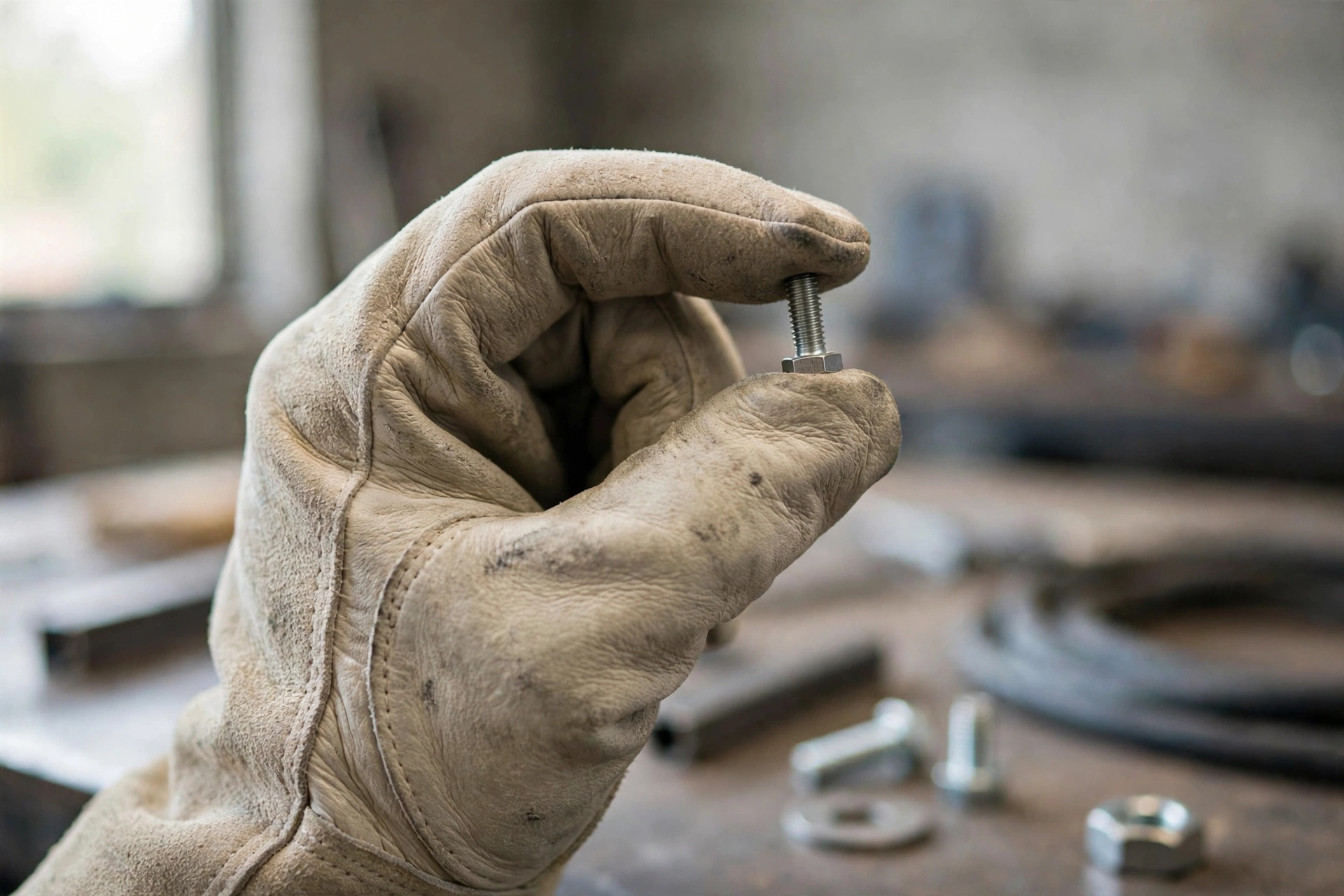
- The small-parts pickup. Try picking up a tack, a filler tip, or a small bolt. This mirrors real shop handling and exposes finger-independence problems.
- Run these tests with the exact size you intend to order, and have more than one welder try the same pair — hand shapes vary, and a glove that fits one welder perfectly may bunch on another’s.
Common Mistakes Welders and Buyers Make
- Buying MIG gloves for TIG work. The most common error: a thick, lined MIG/stick glove gets issued “because it is tougher.” It is — and it will also produce worse TIG welds. Match the glove to the process, not to a generic idea of toughness. See our TIG vs MIG gloves comparison for the full breakdown.
- Sizing up “for comfort.” A slightly loose glove feels comfortable at the desk and terrible at the bench. In TIG work, snug wins.
- Equating thickness with safety. Protection is a system: process-matched heat ratings (EN 407), correct glove type (EN 12477 Type B), plus technique and equipment. Thickness alone is a poor proxy.
- Ignoring the break-in period. Some gloves stiffen before they soften. Give a quality pair a fair evaluation after a few sessions — but walk away from any glove that stays stiff.
- Skipping a complete hazard assessment. Glove choice is one control among many — OSHA’s welding, cutting and brazing page covers the process hazards, and OSHA’s PPE guidance covers employer-side selection.
Quick Buying Checklist
- Confirm the process match. TIG welding calls for a Type B style glove — dexterity-first, not maximum-bulk.
- Check the dexterity marking. Look for the EN 12477 Type B marking and a dexterity level of 4 or 5.
- Inspect the palm. Thin, supple, single-layer leather; no thick lining on the working surface.
- Check the stitching. Heat-resistant thread (e.g. Kevlar) at seams and stress points.
- Size precisely. Fingertips should reach the glove’s fingertips with no bunching.
- Test with real tools. Run the coin, filler-feed, and torch-angle tests before committing to a bulk order.
- Match protection to your actual hazards. Review the complete welding PPE checklist so the glove is one part of a complete program.
Try Them Yourself
Dexterity is something you feel, not something you read about. AceppePro’s TIG welding gloves are designed to meet EN 12477 Type B requirements — the welding-glove classification built for higher dexterity — with a soft premium-leather palm for fingertip control and Kevlar stitching for seam durability. Try a pair on Amazon and run the tests above yourself — and for bulk orders or OEM inquiries, reach out via aceppe.com.