


If you’ve ever shopped for welding gloves, you’ve seen the small flame pictogram printed inside the cuff with a row of numbers underneath — something like 433X42. Most buyers glance past it. But that string of digits is one of the most informative markings on the glove: it is the glove’s EN 407 rating, and it tells you exactly which thermal risks the glove was tested against — and how well it performed.
Thermal hazards cause a large share of welding hand injuries: burns from hot workpieces, spatter, and radiant heat from the arc. Understanding what the EN 407 numbers mean is the fastest way to match a glove to the real heat risks of your welding process. This guide walks through all six EN 407 tests, how to read the markings, and which levels matter for TIG, MIG, and stick welding.
What Is EN 407?
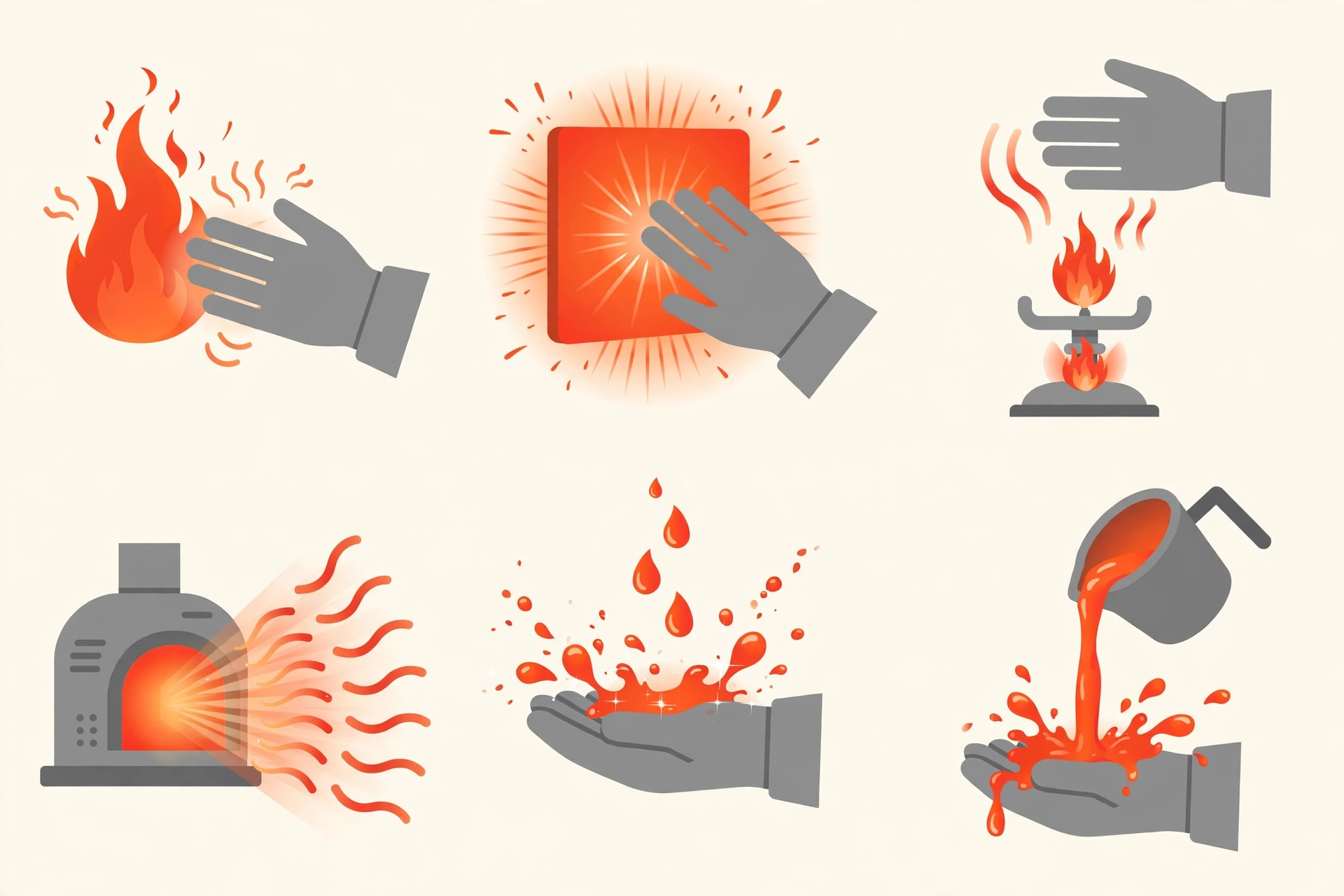
EN 407 is the European standard for protective gloves against thermal risks — heat and fire. Like EN 388 for mechanical risks, it defines a set of laboratory tests and a four-point rating scale (1–4, higher is better) for each one. The standard covers six specific thermal hazards:
- Burning behaviour — how the glove material reacts to a direct flame
- Contact heat — handling hot objects
- Convective heat — heat carried by hot gases, e.g. from a gas flame
- Radiant heat — infrared heat from a glowing arc, furnace, or hot metal
- Small splashes of molten metal — welding spatter
- Large quantities of molten metal — pours and ladle splash
The glove’s performance is shown under the flame pictogram as a series of six digits, one per test, in the order listed above. A digit of X means that test was not carried out — not necessarily that the glove would fail it, just that it wasn’t assessed. So 433X42 reads: burning behaviour 3, contact heat 3, convective heat 3, radiant heat not tested, small splashes 4, large splashes 2.
The Six Tests, One by One
Each test simulates a different way heat reaches your hands. Here is what the four levels mean for every test:
| Test | Level 1 | Level 2 | Level 3 | Level 4 |
|---|---|---|---|---|
| Burning behaviour (afterflame / afterglow) | ≤15 s / — | ≤10 s / ≤120 s | ≤3 s / ≤25 s | ≤2 s / ≤5 s |
| Contact heat (°C, ≥15 s threshold) | 100 | 250 | 350 | 500 |
| Convective heat (HTI, seconds) | ≥4 | ≥7 | ≥10 | ≥18 |
| Radiant heat (t24, seconds) | ≥7 | ≥20 | ≥50 | ≥95 |
| Small molten-metal splashes (droplets for 40 K rise) | ≥10 | ≥15 | ≥25 | ≥35 |
| Large molten-metal quantities (molten iron, grams) | 30 | 60 | 120 | 200 |
1. Burning Behaviour
The material is exposed to a flame for 10 seconds, and the tester measures how long it keeps burning after the flame is removed (afterflame) and how long it keeps glowing (afterglow). Level 4 material stops burning within 2 seconds and stops glowing within 5 — leather does this naturally, which is why leather dominates welding gloves. At level 1, the afterflame must still self-extinguish within 15 seconds, and there is no afterglow requirement. This test matters more than it looks: it is the gateway test for the other thermal ratings (more on that below).
2. Contact Heat
A hot plate at 100, 250, 350, or 500 °C is pressed against the glove material, and the tester measures the time for the inner surface to rise 10 °C — the threshold is at least 15 seconds. A level 1 glove lets you handle a 100 °C workpiece for 15 seconds before the inside gets uncomfortably hot; level 4 extends that to 500 °C. For welders, this is the test that governs repositioning hot workpieces and handling freshly welded parts. Note there is no level 5 in EN 407 (that exists in some other standards) — 500 °C is the top contact-heat rating here.
3. Convective Heat
A gas flame is held under the glove material and the tester records the heat transfer index (HTI) — the time for the temperature inside to rise by 24 °C. Level 1 requires at least 4 seconds of protection; level 4 requires 18 seconds. Convective heat matters most where flames or hot gases wash over the hands: oxy-fuel cutting, preheating, and furnace-adjacent work.
4. Radiant Heat
The material is exposed to a calibrated radiant heat source, and the tester measures how long it takes for the inner surface to reach a set temperature rise. Level 1 gives at least 7 seconds; level 4 gives at least 95 seconds of protection. The welding arc is an intense radiant source, so radiant-heat performance directly affects comfort during long arc-on periods — especially in MIG and stick welding where the arc is close to the hands for extended runs.
5. Small Splashes of Molten Metal
Droplets of molten metal are dropped onto the material one by one until the temperature inside rises by 40 K. Level 1 withstands at least 10 droplets; level 4 at least 35. This is the spatter test — the most welding-specific of the six. TIG welding produces very little spatter, so TIG gloves often show modest ratings here; MIG and stick gloves, facing heavy spatter, typically target level 3 or 4.
6. Large Quantities of Molten Metal
Molten iron (30–200 g) is poured over the material above a simulated-skin foil. The test fails if droplets stick to the specimen, if it ignites, or if it is punctured. At 200 g (level 4), this is a foundry-scale test — far beyond what a welding glove normally faces, and it applies to molten iron specifically. You will often see X in this position on welding gloves, and that is perfectly normal: the test was designed for foundry and smelting PPE.
How to Read the Markings
A certified glove shows the flame pictogram followed by its six digits — for example, EN 407: 434X43. Read the digits left to right against the test order: burning behaviour 4, contact heat 3, convective heat 4, radiant heat not tested, small splashes 4, large splashes 3.
Three rules of thumb when reading them:
- Compare digit by digit, not by total. A “434X43” and a “44444X” protect very differently — the first shields better against small spatter, the second against contact and convective heat. Add up nothing; match the digits to your hazards.
- X is not a failure. It means the manufacturer chose not to run that test. For welding gloves, X commonly appears in the large-splash position — the foundry test is irrelevant to most welding tasks, and skipping it keeps the glove cheaper.
- Low digits are still information. A level 1 is a measured, certified minimum — it tells you the glove was tested and held a real threshold, which is far more useful than a glove with no EN 407 marking at all.
Why Burning Behaviour Gates the Other Levels
EN 407 contains an important dependency: a glove can only claim level 3 or 4 in convective heat, radiant heat, or small molten-metal splashes if it has already achieved level 3 or 4 in burning behaviour. Otherwise those ratings are capped at level 2 — even if the material technically survived the longer exposure.
The logic is sound: a glove that keeps burning after the flame is gone is a hazard of its own, no matter how long it delayed heat transfer. Similarly, if burning behaviour only reaches level 1, the maximum contact-heat rating that can be reported is level 2. When you see a welding glove with strong heat digits, check the first digit — a burning-behaviour level of 3 or 4 is what makes the rest of the rating trustworthy.
Which Levels Matter for Your Welding Process?
Not every thermal risk is equal in every welding process. Use this as a starting point when reading glove ratings:
- TIG welding → prioritize dexterity-compatible heat protection. TIG is a low-spatter process with less ambient heat, but the torch sits close to the fingers and the arc is a strong radiant source. Look for solid burning-behaviour and radiant-heat digits; a modest splash rating is normal and acceptable. Our TIG welding gloves buying guide covers the full selection logic.
- MIG welding → prioritize splash and convective ratings. Heavy spatter and significant radiant heat mean the small-splash and convective digits do the real work. This is where level 3+ splash ratings earn their keep.
- Stick (SMAW) and oxy-fuel cutting → prioritize contact heat and splash. High heat, heavy spatter, and frequent handling of hot electrodes or cut parts favor strong contact-heat and large-splash numbers.
Thermal protection is only one dimension of a welding glove. The EN 12477 welding glove standard wraps EN 407 together with EN 388 mechanical ratings and dexterity requirements, splitting gloves into Type A (higher protection) and Type B (higher dexterity) — and for the full hand-protection picture, see our complete welding PPE checklist.
What EN 407 Does Not Cover
- Mechanical risks. Abrasion, cuts, and punctures belong to EN 388 — a glove with excellent heat ratings can still have poor cut resistance.
- Dexterity and sizing. Heat ratings say nothing about how well you can feel the filler rod; check the EN 12477 dexterity requirements for that.
- Chemical risks. Leather welding gloves offer no meaningful protection against solvents or welding-fume chemistry.
- Electrical hazards. Welding gloves are not insulating gloves — never use them as protection against electric shock.
- Other metals in the large-splash test. The large-quantity test uses molten iron; results do not automatically transfer to aluminium or other metals.
For the employer side of welding safety — fume exposure, ventilation, and facility-level controls — OSHA’s welding, cutting and brazing page is a solid starting point, and OX-ON’s EN 407 reference table is a handy one-page summary of every level.
Quick Buying Checklist
- Confirm the pictogram. Look for the flame symbol with EN 407 and six digits printed on the glove itself, not just the datasheet.
- Match digits to process. TIG → radiant and burning-behaviour digits; MIG/stick → splash and contact-heat digits.
- Check the first digit. Burning behaviour at 3 or 4 is what unlocks trustworthy level 3–4 ratings elsewhere.
- Don’t chase X positions you don’t need. A foundry splash test you will never use adds cost, not safety.
- Fit-test before bulk orders. Heat ratings are measured on flat material; have actual welders try the gloves in their working posture with their torch.
Try Them Yourself
Reading about heat protection is no substitute for feeling it. AceppePro’s TIG welding gloves pair a soft, thin sheepskin palm for fingertip control with a 13 cm extended cuff and Kevlar stitching for durability under radiant heat. Try them on Amazon — and for bulk orders or OEM inquiries, reach out via aceppe.com.