



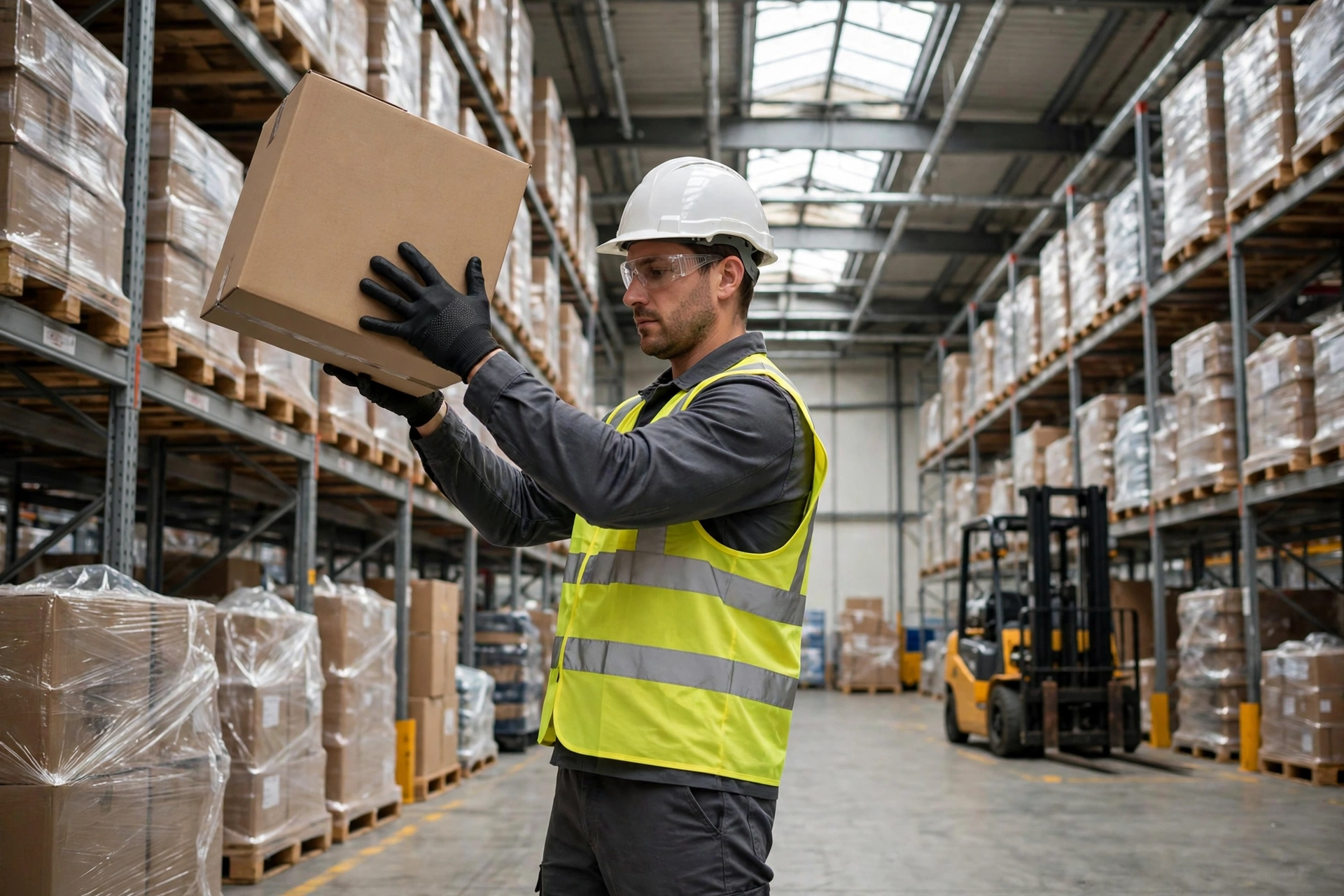
A warehouse is a workplace where people and machines share the same floor. Forklifts move pallets at height, racking holds tonnes of stock overhead, and workers lift, cut, stack, and sort in a constant flow. Most of the hazards are familiar, but familiarity is exactly what makes them easy to underestimate. Personal protective equipment is the last line of defence in a warehouse — it comes after layout, traffic management, and training — but it is the line that decides whether a routine incident becomes an injury. This guide explains which PPE warehouse and logistics workers actually need, how to match each item to the task, and what to check when buying in bulk.
Start With the Hazard Assessment, Not the Catalogue
The most common mistake in warehouse PPE buying is starting with a product list. The right order is the other way round: walk the site, list the hazards by zone and task, and only then choose the equipment. A picking aisle under high racking has a different risk profile from a goods-in dock where forklifts reverse all day, and a cold store has different needs again. OSHA’s warehousing guidance lists the same pattern across the industry: powered industrial trucks, ergonomics and manual handling, hazardous chemicals, and slips, trips, and falls are the recurring hazards, and the most common injuries are musculoskeletal disorders from lifting and being struck by forklifts or materials handling equipment. That is why a proper PPE hazard assessment comes before any order — it tells you which items are genuinely needed in each area, and which are just habit. For the method, see our guide to conducting a PPE hazard assessment.
Head Protection: When a Helmet Belongs in the Warehouse
Safety helmets are not needed everywhere in a warehouse, which is precisely why the decision should be deliberate. The case for them is strongest wherever people work beneath racking, loading bays, or mezzanines — anywhere an item can fall from height or a worker can strike their head on a beam, a low rack, or a vehicle. Falling stock is not a rare event: pallets shift, shrink wrap fails, and a misjudged forklift placement can dislodge goods from the level above. Our guide to EN 397 safety helmet standards explains what the standard actually tests, including shock absorption and penetration resistance, and how to tell a compliant helmet from a hard hat that only looks the part.
Where helmets are required, fit and wearability decide whether they are worn. A helmet that slides, pinches, or traps heat gets left on a shelf. Adjustable harnesses, ventilation, and compatibility with glasses and hearing protection matter more than a marginal difference in shell material. And a helmet is a consumable: inspect it regularly and replace it after any significant impact.
High-Visibility Clothing: Being Seen by Forklift Drivers
In a warehouse, the most dangerous machine is often the one the worker cannot hear coming and the driver cannot see. High-visibility clothing exists to solve the second half of that problem. The European standard EN ISO 20471 grades garments by how much fluorescent and reflective material they carry, and for most warehouse and yard work, Class 2 is the usual minimum, with Class 3 for high-speed or low-light yard work. Our guide to EN ISO 20471 hi-vis classes explains the classes, the difference between fluorescent and reflective material, and why a faded vest can quietly fall below its rated class after repeated washing.
Hi-vis only works if it is actually visible from the angles that matter. A vest covered by a jacket, a backpack, or a harness strap is a vest that is not doing its job. In forklift-heavy zones, wear hi-vis as the outermost layer, and check it against the real sightlines of the site — around racking ends, at crossings, and in the yard at dusk. Laundering matters too: fluorescent dyes fade and reflective tape cracks, so replace on condition rather than waiting for the garment to fall apart.
Safety Footwear: The Item Worn Every Hour
Safety shoes are the one PPE item a warehouse worker wears for the whole shift, which makes them the item where comfort and protection trade off most directly. The baseline for most warehouse roles is a shoe to EN ISO 20345 with a protective toe cap and a puncture-resistant midsole — S1P or S3 in the usual shorthand — plus slip-resistant soles for polished concrete, ramps, and wet dock areas. Our guide to EN ISO 20345 safety footwear standards breaks down the S1 to S7 categories so you can match the rating to the floor rather than guessing.
Two practical points decide whether safety footwear actually protects. First, fit: a shoe that pinches causes blisters, and a worker with blisters finds reasons not to wear it. Offer a proper size range, including wide fits, and let workers try before a bulk order is placed. Second, condition: worn-out soles, crushed toe caps, and split uppers are common on warehouse floors. Build a simple inspection routine into the same schedule as racking checks, and replace footwear on condition, not on a fixed calendar.
Hand Protection: Gloves Matched to the Task
Warehouse glove needs change by the hour. Cutting straps and opening cartons calls for cut resistance and a good grip on a blade handle. Handling rough timber pallets calls for abrasion resistance. Picking small items calls for dexterity, which a thick general-purpose glove destroys. There is no single warehouse glove, and buying one is how you end up with gloves workers take off to do the job properly. The right approach is two or three task-specific gloves: a cut-resistant glove for cutting and strapping, a general handling glove with a grippy palm for lifting and stacking, and a lighter glove for picking and scanning. Our safety gloves manufacturer guide explains how to specify gloves by task and what to ask a supplier about sizing and bulk supply.
Two details are easy to miss. Glove sizing is not one-size-fits-all: hands vary far more than most buyers assume, and a glove that is too large is a snag hazard around conveyors and strapping machines, while one that is too small tears and gets discarded. And gloves are consumables with a short life on a warehouse floor — budget for replacement by condition, and treat a torn glove as a signal to replace it immediately rather than a reason to keep working bare-handed.
Eye Protection and Hearing Protection
Eye protection in a warehouse is about specific moments rather than the whole shift: cutting banding and strapping, which can snap back; opening dusty cartons; working near shrink-wrap heat guns; and cleaning with compressed air. Safety glasses with side protection cover most of these, and they need to be comfortable enough to keep on — if they fog or pinch, workers will take them off at exactly the wrong moment. For more on markings and lens types, see our guide to EN 166 eye protection markings.
Hearing protection follows the same logic. Most warehouse floors are not continuously loud, but dock doors, conveyors, alarms, and reversing vehicles create noisy pockets, and a worker who spends hours near them needs protection matched to the actual exposure. The practical rule is simple: if you have to raise your voice to be heard at arm’s length, hearing protection is worth considering. See our comparison of SNR vs NRR hearing protection ratings for how to read the numbers on the packet.
Forklift Zones: Where PPE Meets Traffic Management
Forklifts deserve their own section because they are involved in a large share of serious warehouse incidents, and PPE alone cannot fix a traffic problem. OSHA’s guidance on powered industrial trucks stresses that operators must be trained and evaluated, and that pedestrian safety depends on the worksite layout as much as on any item of clothing. PPE is the last layer: hi-vis so drivers can see pedestrians, safety shoes so a foot survives a glancing contact, and helmets where overhead work happens. The layers in front of it matter more — marked pedestrian walkways, mirrors at blind corners, speed limits, and physical separation where possible. For the official overview, see OSHA’s page on powered industrial trucks, and the broader warehousing overview for the full hazard picture.
Cold Stores, Outdoor Yards, and Heat
Warehouses are rarely one climate. A cold store at sub-zero temperatures needs insulated gloves, thermal footwear, and layered clothing that still allows movement — and the PPE must be specified for the cold, because ordinary gloves stiffen and ordinary footwear loses grip. Our guide to PPE for cold storage and freezer work covers the layering. At the other extreme, summer work in an unconditioned warehouse or an outdoor yard brings heat stress, and PPE that adds heat load needs to be weighed against the heat risk. See our heat stress and PPE guide for the water, rest, shade, and acclimatisation controls that should sit alongside any PPE choice.
Sizing, Comfort, and Why Workers Actually Wear It
The best-specified PPE in the world protects nobody if it stays in a locker. Across every category, the same pattern holds: comfort and fit decide compliance more than any policy does. That has three practical consequences for buyers. First, always trial before a bulk order — a small sample set across the real size range, worn for a full shift, tells you more than any datasheet. Second, stock a real size range, including small and large sizes. Third, ask workers which items they actually wear and which they leave behind, and treat the answer as purchasing data, not as a discipline problem.
Buying in Bulk: What to Ask a Supplier
Warehouse PPE is usually bought in volume, and volume buying rewards a short checklist. Ask for the standard and the test basis for each item, not just a claim that it is compliant. Ask for the size breakdown of the last similar order so your split matches real workforces. Ask for samples before committing, and confirm lead times and restocking, because a warehouse that runs out of gloves will improvise. And check that the supplier can keep supplying the same model: a changed model means re-trialling and re-fitting, which costs more than any unit-price saving. For the full picture of how to evaluate a supplier, see our guide to how to choose a PPE manufacturer.
Frequently Asked Questions
Does every warehouse worker need a safety helmet?
No. Helmets are needed where there is a risk of falling objects or head strikes — beneath racking, loading bays, and mezzanines. A hazard assessment should decide zone by zone, rather than a blanket rule that gets ignored.
What hi-vis class is right for a warehouse?
Class 2 is the usual minimum for warehouse and yard work, with Class 3 for high-speed traffic or low-light conditions. The class is only meaningful if the garment is worn as the outermost layer and replaced when faded or damaged.
How often should warehouse PPE be replaced?
On condition, not on a calendar. Inspect footwear, helmets, hi-vis, and gloves regularly and replace items when they are damaged, worn out, or fail a check. Gloves and hi-vis are consumables with short lives on a warehouse floor; helmets last longer but must be replaced after a significant impact.
Sourcing PPE for Warehouse and Logistics Teams?
If you are kitting out a warehouse or a logistics team, request a free sample kit — the samples are free, you only cover shipping. For bulk and OEM supply across our full PPE range, see our PPE manufacturer and wholesale supplier page, or send your headcount, zones, and task list for a quote.


