


Working at height introduces serious risks, and the right fall protection equipment can make a major difference in worker safety.
A full-body safety harness is one of the most important pieces of personal protective equipment for workers exposed to fall hazards. It is commonly used in construction, roofing, maintenance, tower work, scaffolding, utilities, warehouses, and other environments where employees may work above ground level.
Choosing the right harness means looking at more than just price. Buyers should consider the work environment, attachment points, fit, comfort, lanyard compatibility, applicable standards, and the complete fall protection system.
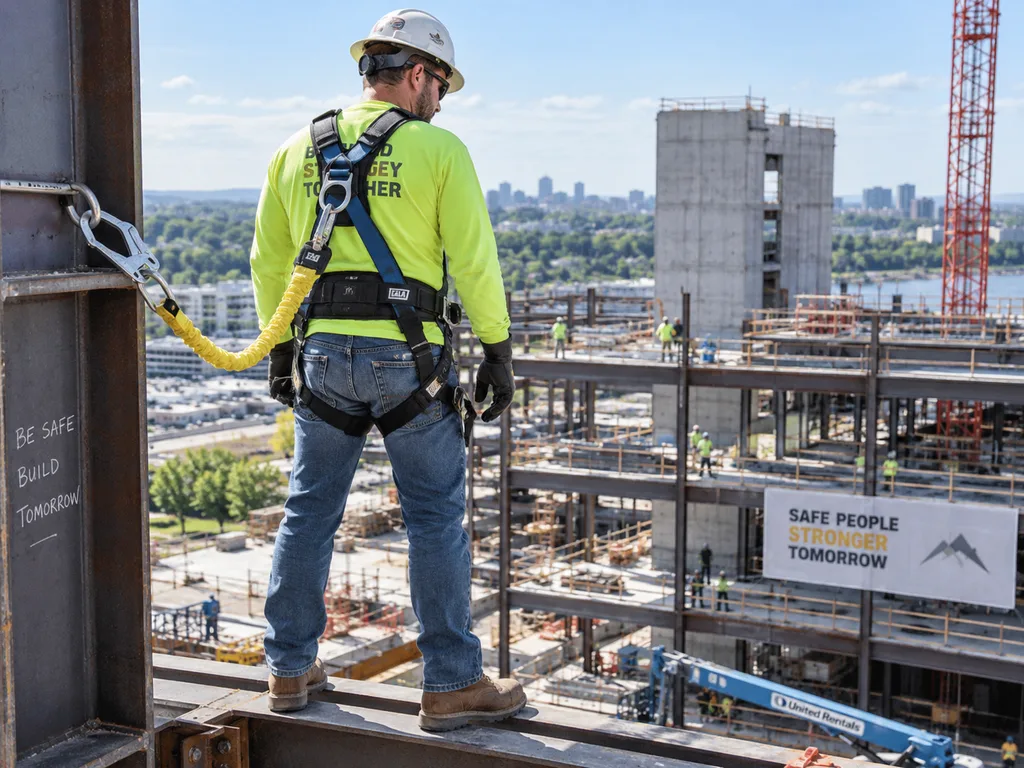
What Is a Full-Body Safety Harness?
A full-body harness is wearable fall protection equipment designed to distribute forces across the body if a worker falls.
It normally includes straps around the:
- Shoulders
- Chest
- Waist
- Thighs
The harness connects the worker to a fall protection system through designated attachment points, usually D-rings.
A harness should not be treated as a complete fall protection solution on its own. It must be used together with compatible connecting equipment and a suitable anchorage system.
For a broader overview of workplace PPE selection, see our PPE Hazard Assessment Checklist.
Where Are Safety Harnesses Commonly Used?
Full-body harnesses are widely used in jobs such as:
- Construction
- Roofing
- Scaffolding
- Tower maintenance
- Electrical utility work
- Warehouse maintenance
- Industrial plant maintenance
- Telecommunications
- Wind energy
- Bridge work
- Rescue operations
Any workplace where a worker may be exposed to a fall from height should assess whether fall protection is required.
OSHA provides detailed guidance on fall protection requirements in construction and other workplaces. More information is available from OSHA Fall Protection.
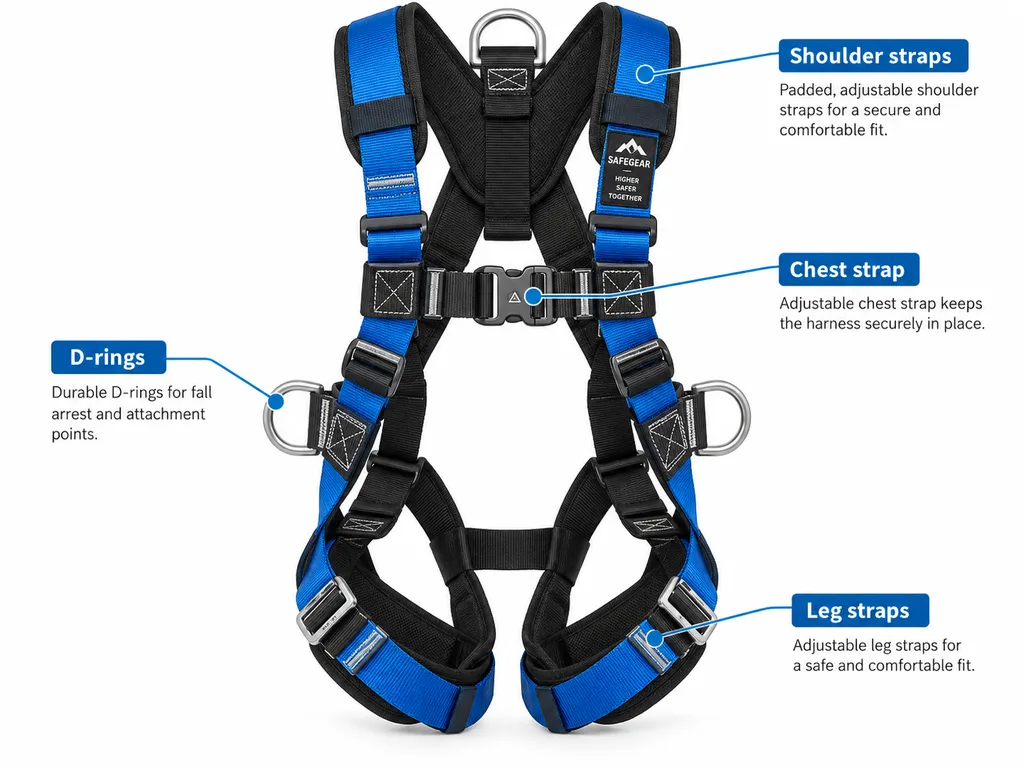
Main Parts of a Safety Harness
A safety harness contains several important components.
Shoulder Straps
Shoulder straps help keep the harness positioned correctly on the upper body.
Chest Strap
The chest strap helps prevent the shoulder straps from separating during a fall.
Leg Straps
Leg straps secure the lower body and help distribute forces during fall arrest.
D-Rings
D-rings are attachment points used to connect the harness to lanyards, lifelines, or positioning systems.
The rear dorsal D-ring is commonly used for fall arrest.
Some harnesses may also include:
- Side D-rings
- Front D-rings
- Shoulder attachment points
The correct configuration depends on the intended task.
Fall Arrest vs Work Positioning
Not every harness setup is designed for the same purpose.
Fall Arrest
A fall arrest system is designed to stop a worker after a fall has already started.
It typically includes:
- Full-body harness
- Energy-absorbing lanyard or self-retracting lifeline
- Anchorage point
Work Positioning
Work positioning systems support the worker in a specific position while allowing hands-free work.
They are commonly used in:
- Tower work
- Utility poles
- Structural maintenance
Positioning equipment should not automatically be treated as a substitute for fall arrest protection where a fall hazard exists.
Why Fit Matters
A harness must fit properly to function as intended.
A harness that is too loose may not keep the worker correctly positioned during a fall.
A harness that is too tight can restrict movement and become uncomfortable during long shifts.
Buyers should check:
- Chest adjustment
- Leg adjustment
- Shoulder adjustment
- Available size range
- Worker body dimensions
- Compatibility with work clothing
Large projects should avoid relying only on generic labels such as M, L, or XL. Actual size charts and measurements should be reviewed.
Important Safety Harness Standards
Buyers should always confirm which standard is required for the target market or project.
ANSI/ASSP Z359
The ANSI/ASSP Z359 series covers fall protection and fall restraint systems in the United States.
It includes requirements related to:
- Full-body harnesses
- Lanyards
- Self-retracting devices
- Connectors
- Anchorage systems
- Rescue systems
More information is available from the American Society of Safety Professionals.
EN 361
EN 361 is a European standard covering full-body harnesses for fall arrest systems.
Buyers supplying European projects should confirm that the harness is certified for the intended use and supplied with the required documentation.
Harness Attachment Points Explained
Different D-rings serve different purposes.
Dorsal D-Ring
Located on the back, usually between the shoulder blades.
Commonly used for fall arrest.
Side D-Rings
Usually positioned at the waist.
Commonly used for work positioning.
Front D-Ring
Used in certain climbing, rescue, or access applications depending on the harness design.
Buyers should never assume that every attachment point is suitable for fall arrest.
The manufacturer’s instructions should always be followed.
Lanyards and Lifelines
A harness usually connects to one of several fall protection devices.
Energy-Absorbing Lanyard
Designed to reduce the force transferred to the worker during a fall.
Twin-Leg Lanyard
Allows workers to maintain continuous connection while moving between anchor points.
Self-Retracting Lifeline
Automatically extends and retracts as the worker moves while limiting fall distance.
The correct system depends on:
- Working height
- Fall clearance
- Anchor location
- Worker movement
- Work environment
What Is Fall Clearance?
Fall clearance is the vertical distance needed for a fall arrest system to stop a worker before they hit a lower surface or obstacle.
This can depend on:
- Lanyard length
- Energy absorber extension
- Harness stretch
- Worker height
- Anchorage position
- Safety margin
This is why buyers and safety managers should not choose fall protection equipment based only on appearance or price.
The full system must be evaluated.
Comfort Features to Look For
Workers may wear harnesses for many hours, so comfort matters.
Useful features can include:
- Padded shoulder straps
- Padded waist belt
- Breathable back support
- Quick-connect buckles
- Adjustable leg straps
- Lightweight webbing
- Tool loops
Comfort can improve worker acceptance and make it easier to wear the harness correctly throughout the shift.
Safety Harness Inspection
Harnesses should be inspected before use.
Workers should check for:
- Cuts
- Fraying
- Torn stitching
- Chemical damage
- Heat damage
- Damaged buckles
- Bent D-rings
- Corrosion
- Missing labels
- Unauthorized repairs
Any damaged harness should be removed from service.
Equipment that has arrested a fall should also be handled according to the manufacturer’s instructions and the company’s safety procedures.
Common Mistakes Buyers Should Avoid
Choosing by Price Alone
Low-cost equipment may not provide the certification, durability, or documentation required for the project.
Ignoring the Full System
A harness is only one part of fall protection.
The lanyard, lifeline, connector, and anchorage must all be compatible.
Using the Wrong D-Ring
Different attachment points are intended for different functions.
Ignoring Worker Size
Poor fit can reduce comfort and affect performance.
Not Checking Certificates
Buyers should verify test reports, certificates, markings, and product documentation where certification is required.
For more information on checking PPE documentation, see our article on PPE Certificates Buyers Should Check Before Placing an Order.
Safety Harness Buyer Checklist
Before placing an order, confirm:
- Intended application
- Required standard
- Harness size range
- Attachment point configuration
- Webbing material
- Buckle type
- Padding requirements
- Lanyard compatibility
- Lifeline compatibility
- Anchorage requirements
- Product markings
- Test reports
- Certificates
- User instructions
- Packaging
- Production lead time
- Sample approval
Frequently Asked Questions
Can a safety harness be used without a lanyard?
No. A harness is part of a complete fall protection system and must be connected to compatible equipment and a suitable anchorage.
What is the most common fall arrest attachment point?
The rear dorsal D-ring is commonly used for fall arrest, but the correct connection should always follow the manufacturer’s instructions.
Are all harnesses the same size?
No. Harnesses are available in different size ranges, and proper adjustment is important.
Can a harness be reused after a fall?
Equipment that has arrested a fall should be removed from service and handled according to the manufacturer’s instructions and applicable safety procedures.
What is the difference between fall arrest and positioning?
Fall arrest stops a worker after a fall begins, while positioning equipment supports a worker in a stable work position. They are not the same system.
Conclusion
A full-body safety harness is one of the most important pieces of fall protection equipment for workers operating at height.
The right harness should provide:
Correct Fit + Reliable Attachment Points + Comfort + Compatibility + Certification
Buyers should always evaluate the complete fall protection system rather than purchasing the harness alone.
ACEPPE PRO supplies PPE and industrial safety equipment for construction companies, contractors, distributors, maintenance teams, and industrial projects worldwide.
Available options can include:
- Full-body safety harnesses
- Energy-absorbing lanyards
- Twin-leg lanyards
- Fall arrest equipment
- Customized packaging
- Bulk production
- Project-based PPE supply
Contact ACEPPE PRO for specifications, samples, certifications, pricing, and fall protection solutions.