



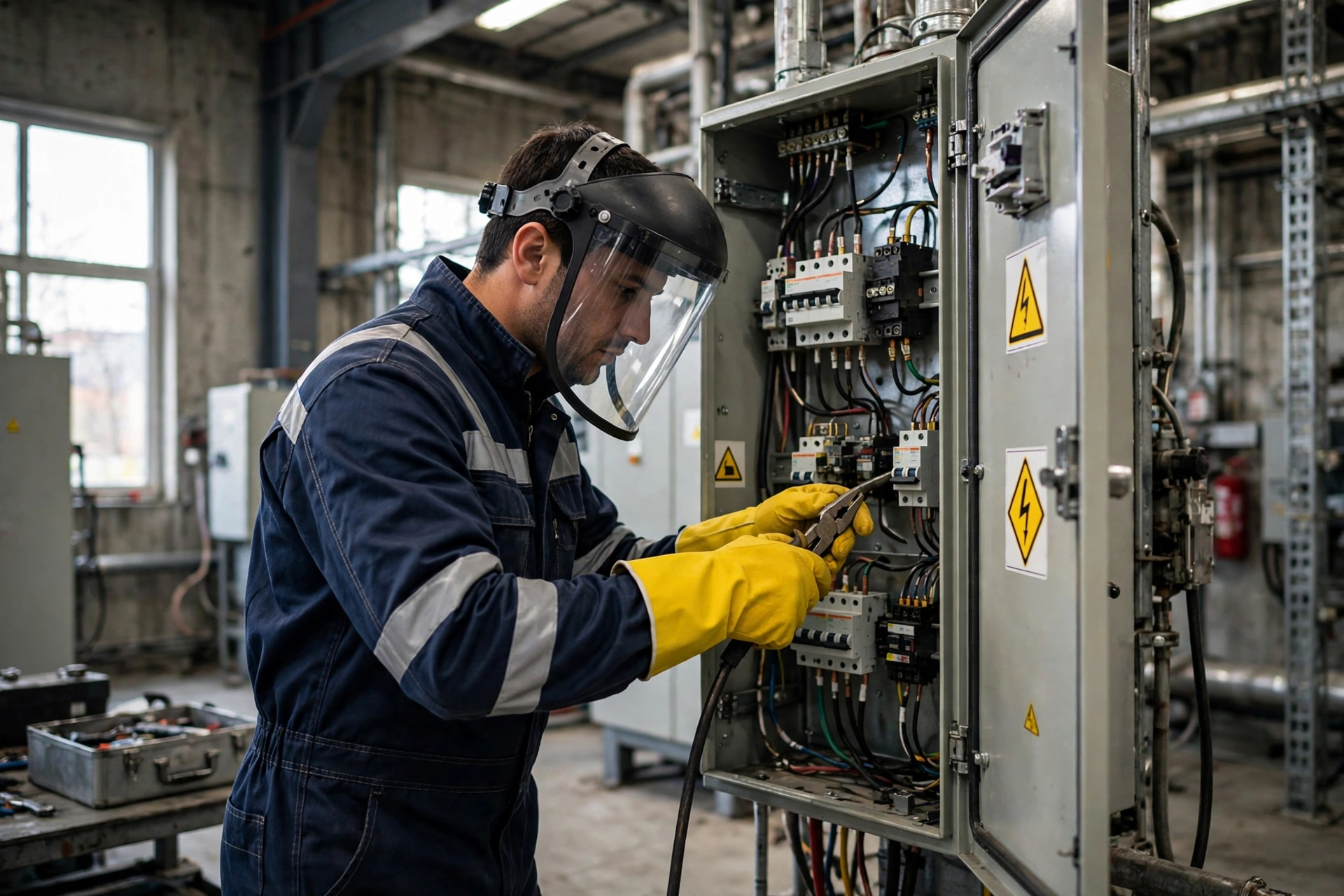
An arc flash releases more energy in a fraction of a second than most workers will ever see in any other incident: temperatures hotter than the surface of the sun, a pressure wave, molten metal, and an intense burst of light. The clothing standing between that energy and the worker is the last barrier, and choosing it wrong is not a comfort issue — it is the difference between a survivable incident and a fatal one. That is what the arc flash PPE categories are for. Under NFPA 70E, the US standard for electrical safety in the workplace, every task on or near energised equipment is assigned a PPE category from 1 to 4, and each category prescribes exactly what the worker must wear. This guide explains the four categories, the two methods for selecting them, and the mistakes that leave workers under-protected.
What an Arc Flash Actually Is
An arc flash is an explosive release of energy caused by an electrical fault — a short circuit through air between conductors, or between a conductor and earth. The arc ionises the air, and the fault current sustains it for as long as the protective device takes to clear it. The energy radiated as heat is measured as incident energy, in calories per square centimetre (cal/cm²), at a specified working distance from the arc. That number is the basis for everything that follows: clothing is rated by how much incident energy it can withstand before the wearer would receive a second-degree burn, and the PPE category is a shortcut that maps common tasks to the clothing that covers their incident energy.
Two points matter before any selection. First, an arc flash is not an electric shock, and the protection against each is different: arc-rated clothing protects against the thermal energy of the flash; insulated gloves and tools protect against shock. A worker needs both, and one does not substitute for the other. Second, ordinary work clothing — even heavy cotton — is not arc protection. Untreated cotton can ignite and continue burning after the flash ends, which is why NFPA 70E requires arc-rated clothing for work within the arc flash boundary, not merely flame-resistant clothing.
The Two Ways to Select Arc Flash PPE
NFPA 70E offers two selection methods. A facility uses one or the other for a given task, and mixing them up is a common audit finding.
Incident energy analysis
An engineering study calculates the incident energy at each piece of equipment, and the result is printed on the equipment label — typically as an incident energy value and an arc flash boundary distance. The worker then selects clothing whose arc rating exceeds the labelled incident energy. This is the precise method, and it is the only option for equipment whose parameters fall outside the tables. The label is the authority: if the label says 12 cal/cm², the clothing must be rated above 12 cal/cm², whatever the task table would suggest.
PPE category method
Where no incident energy study exists, NFPA 70E provides tables that assign a PPE category to common tasks on common equipment. The tables apply only when the equipment parameters are within the stated limits — maximum short-circuit current and maximum fault-clearing time for the equipment type. If the available fault current or the clearing time exceeds the table limits, the category method cannot be used, and an incident energy analysis is required. The four categories below are the output of this method.
The Four PPE Categories
Each category is defined by a minimum arc rating, and each prescribes a complete clothing system — not just a jacket. The rating of the system is the rating of its lowest-rated component, so a Category 2 task cannot be done in a Category 2 jacket with Category 1 trousers.
Category 1 — minimum arc rating 4 cal/cm²
Arc-rated long-sleeve shirt and trousers, or an arc-rated coverall, with a minimum rating of 4 cal/cm²; an arc-rated face shield with a wrap-around guard, or safety glasses with side shields and a balaclava; a hard hat; hearing protection; leather gloves; and leather footwear. Category 1 covers lower-energy tasks such as operating a circuit breaker with covers on, or working on low-voltage control circuits within the table limits.
Category 2 — minimum arc rating 8 cal/cm²
Everything in Category 1, but with clothing rated to at least 8 cal/cm², plus an arc-rated balaclava or an arc-rated hood. Category 2 is the most commonly specified category in commercial and light industrial work, covering tasks such as voltage testing on 600 V class equipment and removing bolted covers from panelboards within the table limits.
Category 3 — minimum arc rating 25 cal/cm²
Arc-rated jacket and trousers or a coverall rated to at least 25 cal/cm², an arc-rated hood with a face shield, and the same head, hearing, hand, and foot protection as the lower categories. At this level, the clothing system is substantially heavier, and the hood replaces the separate face shield and balaclava. Category 3 covers work on medium-voltage equipment and higher-energy low-voltage switchgear within the table limits.
Category 4 — minimum arc rating 40 cal/cm²
Arc-rated jacket and trousers or a coverall rated to at least 40 cal/cm², with an arc-rated hood, plus the standard head, hearing, hand, and foot protection. Category 4 is the highest table category and applies to the highest-energy tasks within the table limits, such as work on certain medium-voltage switchgear. Above 40 cal/cm², the category method stops: the equipment needs an incident energy analysis, and the clothing is selected to the calculated value.
Arc-Rated vs Flame-Resistant: Not the Same Thing
The most persistent confusion in this field is between flame-resistant (FR) and arc-rated (AR) clothing. Flame-resistant means the fabric self-extinguishes when the ignition source is removed. Arc-rated means the fabric has been tested to a specific arc thermal performance value (ATPV) or energy breakopen threshold (EBT), measured in cal/cm² under the ASTM F1959 test. All arc-rated clothing is flame-resistant, but not all flame-resistant clothing is arc-rated — and a garment that is only flame-resistant has no cal/cm² rating and cannot be selected against an incident energy or a PPE category. Buyers should ask for the arc rating on the garment label and in the test data, not just the words “flame-resistant”. In Europe, the equivalent product standard is EN 61482-2, which certifies arc-rated clothing under the EU PPE Regulation.
A second confusion is layering. Wearing two arc-rated layers increases the system’s rating, but the combined rating is not the sum of the two labels — it must be determined by testing the combination. The safe way to specify a layered system is to buy it as a tested combination from the supplier, with the combined rating documented. Guessing at layered ratings is how workers end up wearing a system rated below the incident energy they face.
Shock Protection Is a Separate Layer
Arc flash PPE does not protect against electric shock. Within the restricted approach boundary, workers need rubber insulating gloves with leather protectors, rated by voltage class — from Class 00 (500 V) to Class 4 (36,000 V) — and the gloves must be tested at the intervals their standard requires. Insulated hand tools, voltage-rated mats, and other shock protection are selected separately. The US regulation behind this is OSHA’s electric power standard, 29 CFR 1910.269, which requires employers to assess the workplace for arc flash and other electrical hazards and to provide the protective equipment the assessment calls for. The NFPA 70E standard itself is the consensus document that defines the categories, the boundaries, and the selection tables most employers follow.
Boundaries: Arc Flash, Limited, and Restricted
PPE categories only make sense inside the boundary system. The arc flash boundary is the distance at which the incident energy falls to 1.2 cal/cm² — the threshold for a second-degree burn on bare skin. Inside it, arc-rated clothing is mandatory. The limited approach boundary is the distance within which only qualified persons, or unqualified persons under escort, may enter. The restricted approach boundary is closer still, and inside it, shock protection is required and the risk of shock is real. A worker standing outside the arc flash boundary needs no arc-rated clothing for that equipment — which is why accurate boundary distances, from the label or the study, matter as much as the clothing itself.
Care, Laundering, and Replacement
Arc-rated clothing loses its protection if it is cared for wrongly. Follow the manufacturer’s laundering instructions exactly: most arc-rated garments must not be treated with chlorine bleach or fabric softener, and must not be washed with flammable soils left in the fabric. Contaminated garments — soaked in oil, grease, or solvents — should be removed from service, because flammable contamination can ignite under arc exposure regardless of the fabric’s rating. Inspect garments before each use for holes, tears, and thinning, and retire any garment whose arc-rated layer is damaged, whose label is unreadable, or that has been exposed to an arc flash: a garment that has taken an arc has done its job once and should not be relied on a second time.
For buyers, the practical questions to ask a supplier are: the arc rating and test method for each garment, the combined rating of any layered system as tested, the care instructions in writing, and the availability of the full size range — arc-rated clothing that does not fit is clothing that does not protect, because gaps at the wrist, waist, and neck are where the energy gets in. The electrical trade view of the wider PPE picture is covered in our construction PPE requirements by trade guide, and the assessment that should come before any purchase is described in our PPE hazard assessment guide.
FAQ
Can I wear Category 2 clothing for a Category 4 task?
No. The category is a minimum: the clothing system must be rated at or above the category’s minimum arc rating. Wearing lower-rated clothing than the task requires is the single most common arc flash violation, and it is not cured by adding a jacket of the same lower rating.
Does the PPE category method work for any panel?
No. It applies only when the equipment’s short-circuit current and fault-clearing time are within the limits in the NFPA 70E tables. If either value exceeds the table limit, an incident energy analysis is required and the clothing is selected to the calculated energy.
Is flame-resistant clothing enough for arc flash work?
No. Flame-resistant clothing self-extinguishes, but only arc-rated clothing carries a tested cal/cm² rating. Without a rating, there is no way to match the clothing to the incident energy or the PPE category.
Do I need arc-rated underwear?
NFPA 70E does not require arc-rated underwear, but it does require that underlayers not be made of meltable fibres such as untreated polyester or nylon, which can melt into the skin under arc exposure. Natural fibres or arc-rated base layers are the safe choice, and some employers specify arc-rated underwear for Category 3 and 4 work.
Specifying Arc Flash PPE for Your Team?
If you are standardising electrical safety clothing across a site or a resale range, put the product in your hands before you commit: request a free sample kit — the samples are free, you only cover shipping. For bulk and OEM supply across our full PPE range, see our PPE manufacturer and wholesale supplier page, or send your target spec and quantity for a quote.


