



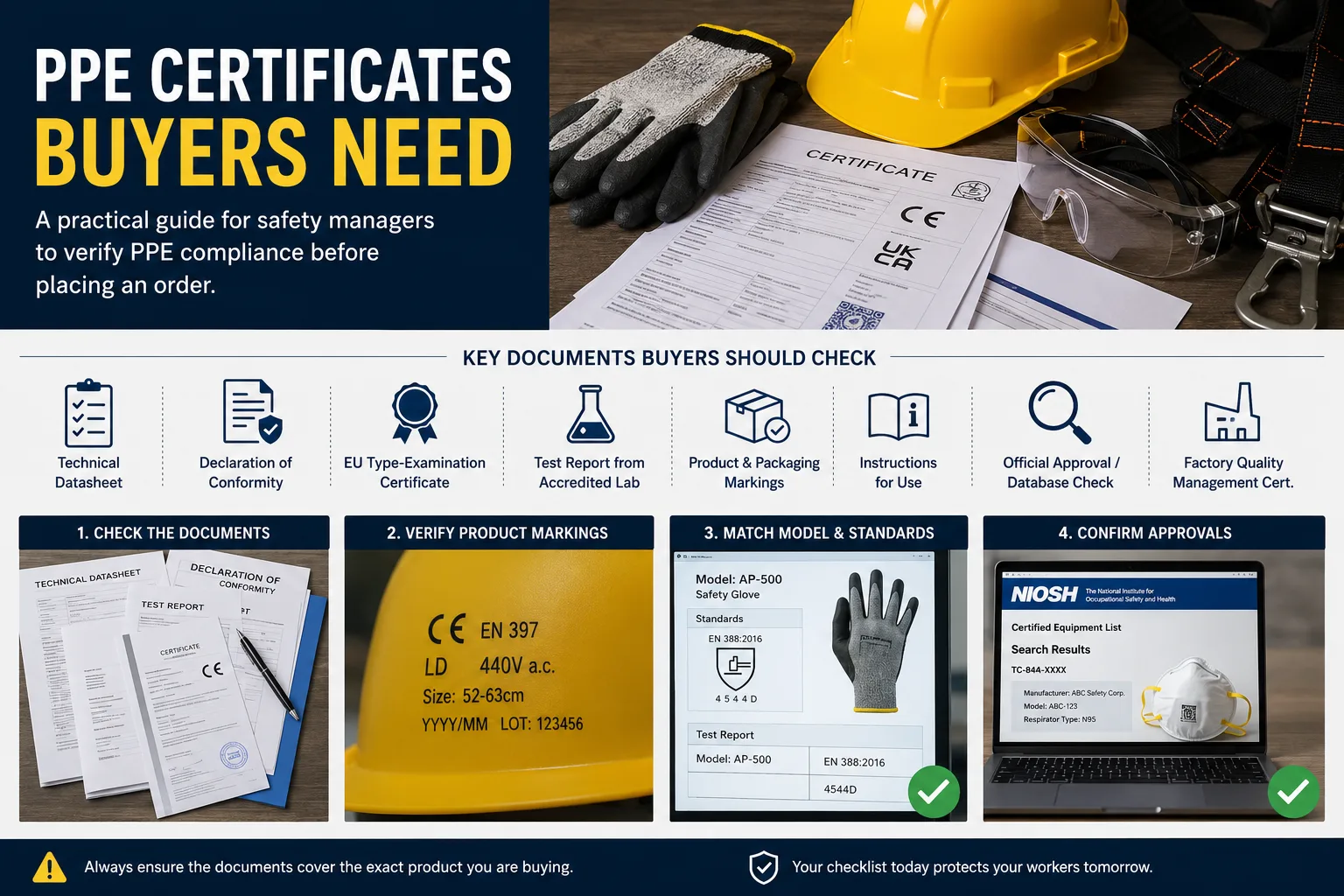
Buying personal protective equipment is not just about comparing prices, materials and delivery times.
Before approving an order, safety managers also need to confirm that the product offers the right level of protection and meets the requirements of the destination market.
This is where things often become confusing.
A supplier may send you a CE certificate, an ISO 9001 certificate, a laboratory test report or a declaration of conformity. These documents may all look official, but they do not prove the same thing.
In some cases, a supplier may even provide a valid document that does not actually cover the product being offered.
That is why buyers should not simply ask:
“Is this PPE certified?”
A better question is:
“Which standards apply to this product, and which documents prove that this exact model complies?”
This guide explains the main documents safety managers should check before placing a PPE order.
There Is No Universal PPE Certificate
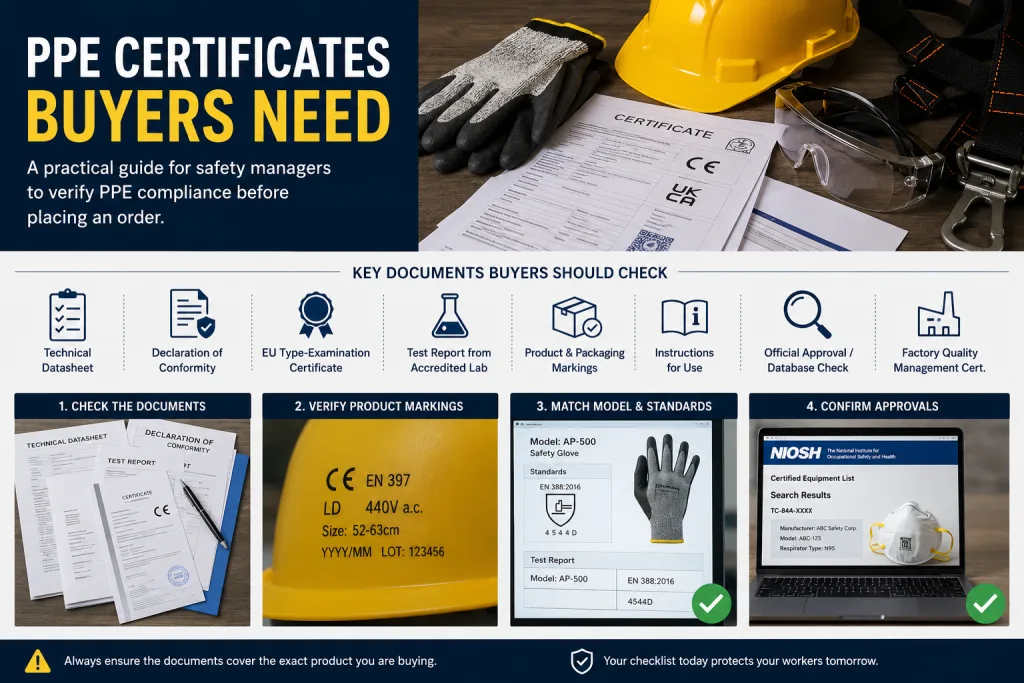
One of the biggest misunderstandings in PPE purchasing is the idea that one certificate can cover everything.
It cannot.
The documents required will depend on several factors:
- The type of PPE
- The workplace hazard
- The required protection level
- The country where the product will be used
- The relevant regulations and standards
- Whether third-party testing or certification is required
A safety helmet, respirator, protective glove and fall-arrest harness will not follow the same testing or approval process.
Even products within the same category may require different documentation.
For example, a basic work glove and a chemical-resistant glove may look similar, but they protect against completely different hazards. The test report for one should not be used to support the other.
Before reviewing certificates, the buyer must first understand what protection is actually needed.
Start with the Workplace Hazard
Certificates should support the buying decision, but they should not be the starting point.
The starting point should be the workplace hazard assessment.
Before contacting a supplier, identify:
- What hazard workers are exposed to
- Which parts of the body need protection
- How serious the risk is
- How often exposure occurs
- The working environment
- Whether the PPE will be worn with other equipment
- The required sizes and fit
- Any legal or customer requirements
For example, a glove with a high cut-resistance rating may still be the wrong choice if workers are mainly exposed to chemicals.
A safety shoe may have a protective toe cap but still be unsuitable for electrical, heat or chemical risks.
Once the hazard is clear, it becomes much easier to define the product specification and request the correct documents.
Documents PPE Buyers Should Request
1. Product Technical Datasheet
The technical datasheet gives you the basic information about the product.
It should include:
- Manufacturer or brand
- Product name
- Model number
- Materials
- Available sizes
- Intended use
- Protection level
- Applicable standards
- Product limitations
- Storage conditions
- Shelf life, when relevant
The most important thing to check is the model number.
The model shown on the datasheet should match the model on:
- The quotation
- The test report
- The certificate
- The declaration of conformity
- The product
- The packaging
If the numbers do not match, ask the supplier to explain why.
A certificate for a similar-looking product is not enough.
Small changes in material, thickness, coating, construction or components can affect product performance.
2. Declaration of Conformity
A declaration of conformity is a formal statement from the manufacturer confirming that the product meets the applicable legal requirements.
For products sold in the European Union, this is normally called an EU Declaration of Conformity.
It should identify:
- The manufacturer
- The manufacturer’s address
- The product and model
- The applicable regulation
- The standards used
- The conformity assessment process
- The notified body, when required
- The name and signature of the responsible person
- The date of issue
The declaration should cover the exact product being purchased.
A general statement saying that “all our products meet CE standards” is not enough.
The declaration should clearly identify the model.
3. EU Type-Examination Certificate
For PPE sold in the European Union, the required conformity process depends on the risk category.
PPE is generally divided into three categories:
- Category I: Protection against minimal risks
- Category II: Risks that do not fall under Category I or III
- Category III: Risks that may cause death or serious and irreversible harm
Category II and Category III products may require assessment by a notified body.
An EU type-examination certificate should normally show:
- The manufacturer
- The product model
- The certificate number
- The notified body
- The notified body identification number
- The standards applied
- Product photographs or descriptions
- Any conditions or limitations
Buyers should verify that the notified body is authorized to assess the relevant type of PPE.
A professional-looking logo on a PDF does not automatically mean the document is valid.
4. Full Laboratory Test Report
The certificate may give you the conclusion, but the test report shows what was actually tested.
A full test report should include:
- Laboratory name and address
- Report number
- Testing date
- Product model
- Sample description
- Test method
- Standard and edition
- Individual test results
- Pass or fail conclusion
- Product photographs
- Signature or verification information
Do not rely only on the first page.
The remaining pages may show important details, such as:
- Only one material was tested
- Some optional tests were not carried out
- The product passed one test but failed another
- The sample does not match the offered product
- Only a component was tested, not the finished product
For example, a glove may be tested for cut resistance but not for impact, chemicals or heat.
One successful test does not mean the glove protects against every hazard.
5. Product and Packaging Markings
Ask the supplier for clear photographs of the actual product and packaging before placing a bulk order.
Depending on the type of PPE, the markings may include:
- Brand or manufacturer
- Model number
- Size
- Standard number
- Protection level
- Pictograms
- Batch or lot number
- Manufacturing date
- Expiry date
- CE marking
- Notified body number
- Respirator approval number
These markings should match the supporting documents.
If the test report shows one model but the product carries another model number, the buyer should request clarification.
The same applies when a standard appears on the product but is not mentioned in the report.
6. Instructions for Use
PPE should come with clear instructions.
These instructions help workers understand how to use, inspect, clean, store and replace the product.
They should explain:
- Intended use
- Product limitations
- How to wear or adjust the product
- Inspection before use
- Cleaning and maintenance
- Storage conditions
- Replacement criteria
- Compatibility with other PPE
- Meaning of markings
- Disposal requirements, where relevant
The instructions should be available in a language understood by the users.
This is especially important for products such as:
- Respirators
- Chemical protective clothing
- Fall-protection equipment
- Hearing protection
- Reusable eye and face protection
- Electrical protective equipment
A product may pass laboratory testing and still fail to protect workers if it is used incorrectly.
7. Official Approval or Database Record
Some PPE products can be checked through official databases.
Respirators
For NIOSH-approved respirators, buyers should check the approval number and confirm that it matches the correct manufacturer and product.
The number is often shown in a format such as:
TC-84A-XXXX
The number should appear on the approval label and should be searchable in the official NIOSH database.
Do not accept claims such as “N95 quality” or “NIOSH standard” without a valid approval number.
European notified bodies
For EU certificates, buyers should confirm that the notified body is officially listed and authorized for the relevant product category.
Testing laboratories
Where possible, check whether the testing laboratory is accredited for the specific test method used.
A laboratory may be legitimate but not accredited to perform every type of PPE test.
8. Factory Quality-Management Certificate
Many suppliers provide an ISO 9001 certificate.
This can be useful because it shows that the factory operates a quality-management system.
However, ISO 9001 is not a product certificate.
It does not prove that:
- A glove passed a cut-resistance test
- A helmet passed an impact test
- A respirator is approved
- A vest meets a visibility class
- A safety shoe meets a specific standard
ISO 9001 helps buyers evaluate the factory’s management and production processes.
It should support product-specific documents, not replace them.
Common Documents by PPE Category
The exact requirements will depend on the market and the product, but the following table can be used as a starting point.
| PPE category | Documents commonly requested |
|---|---|
| Safety helmets | Technical datasheet, impact and penetration test report, markings, conformity documents and instructions |
| Safety glasses and goggles | Optical and impact test reports, lens and frame markings, declaration of conformity |
| Protective gloves | Test reports for the relevant hazard, material details, markings and conformity documents |
| Safety footwear | Test report, footwear classification, toe and sole results, product markings |
| High-visibility clothing | Reflective and background material reports, garment classification, wash-cycle information |
| Disposable respirators | Official approval information or applicable conformity documents, test reports and markings |
| Chemical protective clothing | Type classification, material tests, seam tests, chemical test results and instructions |
| Fall-protection equipment | Test reports, third-party conformity documents, serial or batch traceability and inspection instructions |
| Hearing protection | Attenuation test results, fitting information, markings and instructions |
| Welding PPE | Reports covering heat, flame, radiation, impact or electrical risks, depending on the product |
Do not assume every document in the table is required in every country.
The buyer should always confirm the legal, tender and project requirements before ordering.
How to Check Whether the Documents Are Genuine
Receiving a certificate by email is not the same as verifying it.
The documents should form one consistent chain.
Check the model number
The model number should be consistent across the quotation, datasheet, certificate, report, declaration, product and packaging.
A small difference may be acceptable in some cases, but the supplier should be able to explain it clearly.
Check the manufacturer
The supplier may be the manufacturer, exporter, distributor or trading company.
Ask:
- Who made the product?
- Whose name appears on the report?
- Who owns the brand?
- Who is responsible for compliance?
- Does private labeling affect the certificate?
A trading company can still supply compliant products, but the relationship between the supplier and manufacturer should be clear.
Check the standard year
Standards are updated over time.
The report should show the full standard reference and publication year.
Compare it with:
- The tender specification
- Local regulations
- Customer requirements
- The latest applicable version
An older report is not automatically invalid, but it should be reviewed carefully.
Check what was tested
Make sure the test covers the finished product.
A report for reflective tape does not automatically cover the completed safety vest.
A fabric test does not necessarily certify the completed chemical coverall.
A toe-cap test does not prove that the finished safety shoe meets all footwear requirements.
Check the issuing body
Confirm that the laboratory, certification body or notified body is authorized or accredited for the work it performed.
Do not rely only on logos, stamps or signatures.
Look for signs of editing
Warning signs include:
- Different fonts in the same document
- Misaligned model numbers
- Blurry logos
- Missing pages
- Removed report numbers
- Edited product photographs
- Unclear signatures
- Screenshots instead of complete PDFs
- Refusal to provide verification details
For large or safety-critical orders, buyers may also contact the issuing organization directly.
Common Red Flags
“CE certified” with no documents
A supplier should be able to provide more than a photograph of a CE mark.
Ask for the declaration of conformity, certificate where applicable, report and product markings.
Only ISO 9001 is provided
ISO 9001 is not proof that the PPE product passed the required tests.
The report belongs to another model
Similar design does not mean identical performance.
The offered product should be clearly covered.
Only the first page is available
Ask for the complete report.
The missing pages may contain the actual results, conditions or limitations.
The markings do not match
Differences in model, manufacturer, standard or approval number should be explained before ordering.
The supplier cannot explain the protection level
A reliable supplier should be able to explain:
- What hazard the product protects against
- Which standard was used
- Which level was achieved
- What the product does not protect against
The product is described as suitable for everything
Be careful with claims such as:
- 100% cut-proof
- Completely chemical-proof
- Fireproof
- Suitable for all industrial work
- Guaranteed protection in every condition
Professional PPE normally has specific limitations.
Checklist Before Approving a PPE Order
Before approving the order, confirm that you have reviewed:
- Workplace hazard assessment
- Product specification
- Destination-market requirements
- Technical datasheet
- Complete test report
- Declaration of conformity
- Certificate, where required
- Notified body or approval details
- Product markings
- Packaging markings
- Instructions for use
- Batch or lot traceability
- Factory quality-management certificate
- Approved sample
- Inspection requirements
- Agreed procedure for product changes
This is especially important for customized orders.
Changing the material, coating, construction, sole, filter, fabric or other component may affect the validity of an existing test report.
Even adding a private label may require documentation to be reviewed.
What to Include in Your PPE Inquiry
A detailed inquiry helps the supplier recommend the correct product and provide the right documents.
Include:
- Product name
- Intended use
- Main workplace hazard
- Required standard
- Required protection level
- Quantity
- Sizes
- Color
- Logo or branding requirements
- Destination country
- Required reports or certificates
- Tender deadline
- Sample requirements
- Inspection requirements
- Shipping method
Instead of writing:
“Please quote certified gloves.”
Provide a clearer request:
“Please quote 5,000 pairs of cut-resistant gloves for sheet-metal handling. We require sizes 8 to 11, nitrile-coated palms, the specified cut level, complete test reports, product markings and delivery to Dubai.”
The second inquiry gives the supplier enough information to select and quote the right product.
Frequently Asked Questions
Is a CE certificate enough?
Not always.
Depending on the product, buyers may also need to review the declaration of conformity, test report, product markings, instructions and notified body details.
Is ISO 9001 a PPE certificate?
No.
ISO 9001 covers the company’s quality-management system. It does not prove that an individual PPE product passed a performance test.
Should buyers request samples?
For bulk, customized or safety-critical orders, requesting a sample is strongly recommended.
The sample should be checked against the report, datasheet, certificate and product markings.
Can one report cover several models?
Sometimes, but only when the report or certification clearly identifies and covers those models.
Do not assume that every product in the same range is included.
How can buyers verify a respirator approval?
Check the approval number in the relevant official database and confirm that the manufacturer, model and protection class match the offered product.
Request PPE with the Required Documentation
PPE documentation should make the buying process clearer, not more complicated.
When requesting a quotation from ACEPPE, send us:
- The product list
- Required quantity
- Intended use
- Workplace hazard
- Required standard
- Destination country
- Branding requirements
- Required certificates and test reports
Our team can review the request, confirm which documents are available and prepare a quotation based on your project requirements.
Request a PPE Quotation
Send ACEPPE your RFQ, product list or technical specification. Please include the required standards, quantities and delivery destination so our team can recommend the most suitable options.