



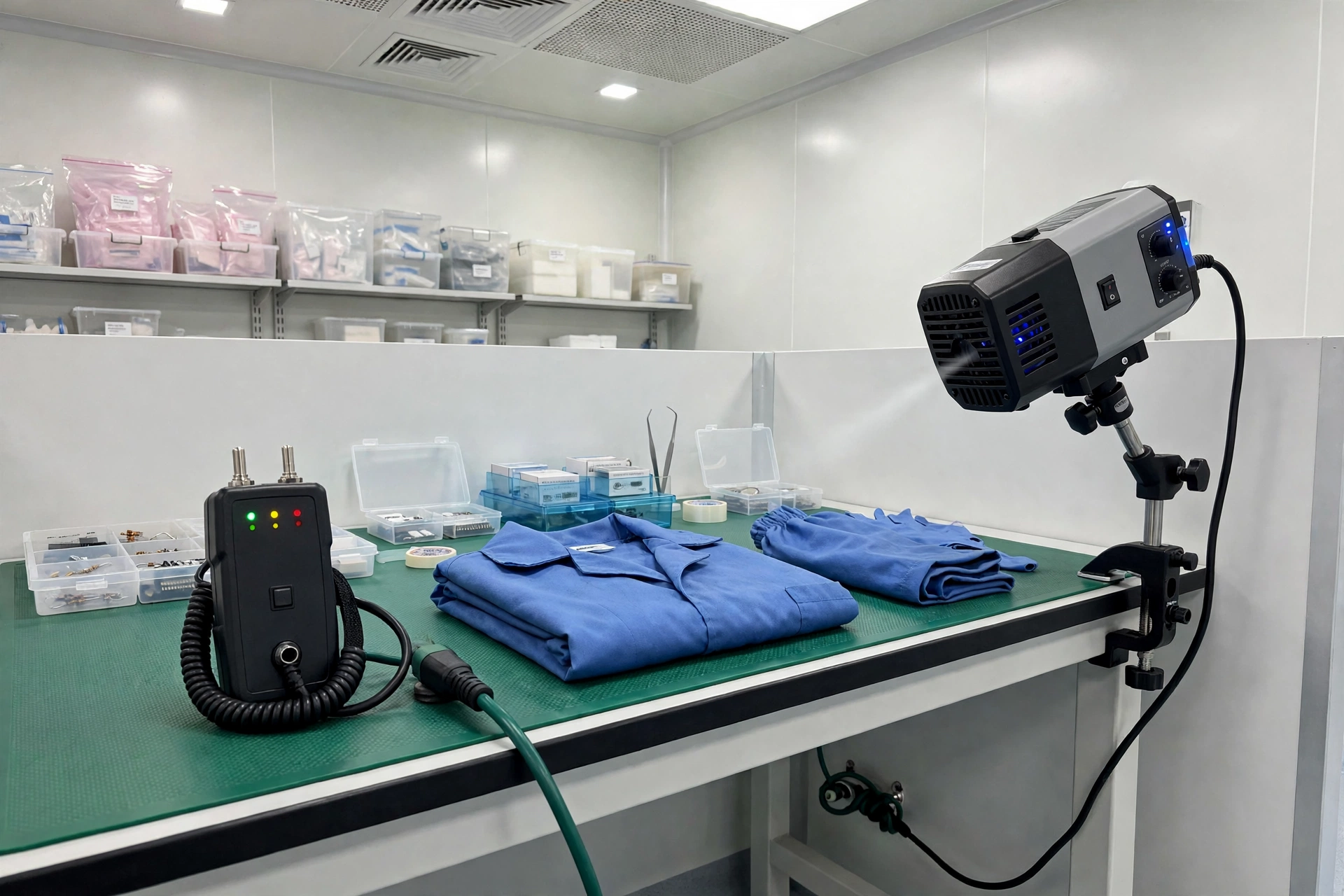
The short answer first
Yes, ESD signs are required. Under IEC 61340-5-1 and ANSI/ESD S20.20, every entrance to an ESD Protected Area has to be identified with an EPA sign, and the boundary itself should be marked — floor tape or painted lines are the usual way. An EPA that isn’t marked isn’t really an EPA: the controls only work if people know the exact moment they cross into the area, because that is when wrist straps, ESD footwear and garment rules start to apply. An unmarked area means visitors and new staff walk in uncontrolled without even knowing.
And checking an EPA is a layered job, from the floor up — not a single test. A wrist strap that passes does not rescue a floor that failed six months ago, and a perfect floor does not help an operator whose strap cord broke at the strain relief. The routine below is what a small or mid-size site can actually sustain, and it follows the same seven areas as our free 33-item EPA checklist.
1. Personnel grounding — the operator is the first thing to check
Everything in an EPA starts with the person, because people are the largest charge generators in the room — walking across a standard floor builds kilovolt-level body voltage in a few steps.
- Wrist straps worn snug on bare skin, by everyone inside the EPA. A loose strap, or one worn over a sleeve, makes only intermittent contact — the operator can carry charge all shift without knowing it.
- Wrist-strap cords tested daily. The typical pass range is 0.8–1.2 MΩ. Cords flex thousands of times a day and fail silently at the strain relief; a failed cord means a completely ungrounded operator who believes they are protected.
- ESD footwear on both feet, verified each shift. One standard shoe breaks the person-to-floor path. Soles wear and get dirty, and lose their dissipative path over time.
- ESD garments worn fastened, covering personal clothing. Ordinary clothing tribocharges heavily and radiates fields — charged personal clothing can induce voltages on nearby devices without any contact at all.
The check that most sites skip: test the person–footwear–flooring system in combination. Components that pass individually can still fail as a system. System resistance and body-voltage generation are what actually protect the device.
2. Worksurfaces — where the devices actually sit
- Dissipative mats on every EPA bench, bonded to a common point ground. A bare bench is either an insulator (charge stays) or a hard ground (fast discharge spike). An ungrounded mat is just a large floating conductor — it accumulates charge and becomes a discharge source itself.
- Mats cleaned with ESD-safe cleaner, no insulative residue. Silicone or wax residues form insulating films; isolated islands on the surface break the discharge path exactly where devices sit.
- No ungrounded insulators on worksurfaces. Plastic bags, foam and paper within 30 cm of ESD-sensitive items are a classic audit failure — field induction charges devices without any direct contact.
- Soldering stations and hand tools ESD-safe and grounded. A floating iron tip can hold hundreds of volts and discharge directly into the device on contact.
3. Flooring — the charge generator under your feet
Standard flooring plus walking is the largest charge generator in most EPAs, so the floor deserves its own checks:
- ESD flooring installed throughout the EPA, with resistance verified within program limits. Resistance drifts as floors wear and soil — a floor that passed at installation can silently go out of spec within months.
- Cleaned on schedule with approved, non-insulative products. Common waxes and finishes are insulators; a single wrong cleaning product can coat the whole EPA floor in an insulating film.
4. Equipment grounding and ionization — the parts that fail quietly
- All equipment chassis bonded to ground, with a common point ground established, labeled and accessible. Floating metal near ESD-sensitive work is a hidden capacitor. Ground integrity has to be checked periodically — corrosion and vibration loosen bonds, and protection that tested fine last year can be silently gone today.
- Ionizers where insulators cannot be grounded. Some process-essential insulators (certain films, carriers) cannot be removed or grounded, and ionization is the only accepted way to neutralize them. But an ionizer has to be verified, not just installed: balance (offset voltage) within limits, emitter points cleaned on schedule, and charge decay time verified against program requirements — balance alone does not prove the ionizer works fast enough. An imbalanced ionizer emits more of one polarity and charges the work area instead of neutralizing it.
5. Signage, garments and packaging — the visible half of compliance
This is where most EPAs quietly fail, because these items look like paperwork until an audit — or a field failure — exposes them:
- EPA entrance signs posted, with the area identified and handling precautions stated. Boundary tape alone does not tell a newcomer the rules; entrance signage is how IEC 61340-5-1 and ANSI/ESD S20.20 expect the area to be marked. It is a requirement, not decoration.
- EPA boundaries clearly marked (floor tape, signage). An unmarked boundary is not a boundary — untrained personnel and charged materials wander in.
- Visitors escorted and equipped before entry (foot grounders, garments). Training records cover your own staff; delivery drivers, customers and auditors are the usual gap. One unequipped visitor can carry kilovolt-level charge straight to a bench.
- ESD garments verified as true static-control garments — conductive fibre, resistance within program limits, fully covering personal clothing. A blue coat is not automatically an ESD garment; look-alike garments give a false sense of compliance while the clothing underneath radiates fields. Garments must be inspected and laundered on schedule, with no fabric softener or harsh detergents — softener residues coat the conductive fibres and quietly destroy garment performance.
- ESD-sensitive items kept in shielding or protective packaging outside the EPA, and packaging and EPA areas marked with the ESD susceptibility symbol. Outside the EPA there are no controls at all, and people cannot follow rules they cannot see.
- Only trained personnel enter the EPA, with training records kept — and failed areas or suspect product quarantined and identified, so potentially damaged devices never ship to customers.
6. Verification testing — record numbers, not ticks
This is the difference between an audit and a ritual:
- Record actual values, not just pass/fail. A tick in a box cannot show drift; recorded resistance values, taken per ESD TR53 methods, can. Worksurfaces and floors drift out of spec for months between audits without anyone noticing.
- Log readings with temperature and relative humidity, and re-test key surfaces in low-humidity conditions. Dry air is the worst case: a floor that passes on a humid morning can fail on a dry afternoon.
- Compliance verification (audits and measurements) performed on schedule. ESD programs drift — materials wear, habits slip — and nonconformances accumulate silently until field failures spike.
Run the whole check in minutes
The routine above is 33 items across seven areas. Our free EPA Compliance Checklist turns it into a scored, printable self-audit: check each item that is verified in place, get a score and a gap report you can hand to whoever owns the fix, and export or print it for the record.
Try it: EPA Compliance Checklist — free, no sign-up, runs in the browser.
If you are setting up or upgrading an EPA, the same tools site has a free Safety Starter Kit that walks through a small company’s whole PPE setup in six steps — and Aceppe supplies ESD workwear, ESD gloves and full-range PPE for electronics manufacturing, with bulk and OEM programs.
A short checklist before your next EPA audit
- Entrance signs posted and boundary marked — every entrance, not just the main one.
- Wrist straps and footwear verified today, not last quarter.
- Mats bonded, cleaned with ESD-safe products, insulators cleared from benches.
- Floor resistance verified recently, with the right cleaning products in use.
- Ionizer balance and decay time verified, not assumed.
- Garments verified as real ESD garments, laundered without softener.
- Readings recorded as values with temperature and humidity — and re-checked in dry conditions.
Most EPAs do not fail on one dramatic defect. They fail on drift: a cord that broke, a floor that wore, a garment that stopped dissipating, a sign that was never put up. A checklist run on schedule is what catches drift before field failures do.
This article is general guidance based on IEC 61340-5-1 and ANSI/ESD S20.20 concepts. It is not a substitute for the text of those standards, a formal third-party ESD audit, or product qualification testing. Threshold values vary by site program — always confirm against your ESD control program plan and on-site EHS judgment.


