



The code printed on the tongue or label of a safety boot is not marketing. It is a compact specification: it tells a buyer which impacts, punctures, water, and slip tests that footwear has passed, and which it has not. For anyone ordering safety footwear in bulk, learning to read that code is the fastest way to avoid two expensive mistakes: buying boots that look rugged but fail the site’s actual requirement, and over-specifying a class the job does not need. This guide explains the EN ISO 20345 system, class by class, so the code on the boot can be checked against the job before an order is placed.
Three Footwear Families: Safety, Protective, and Occupational
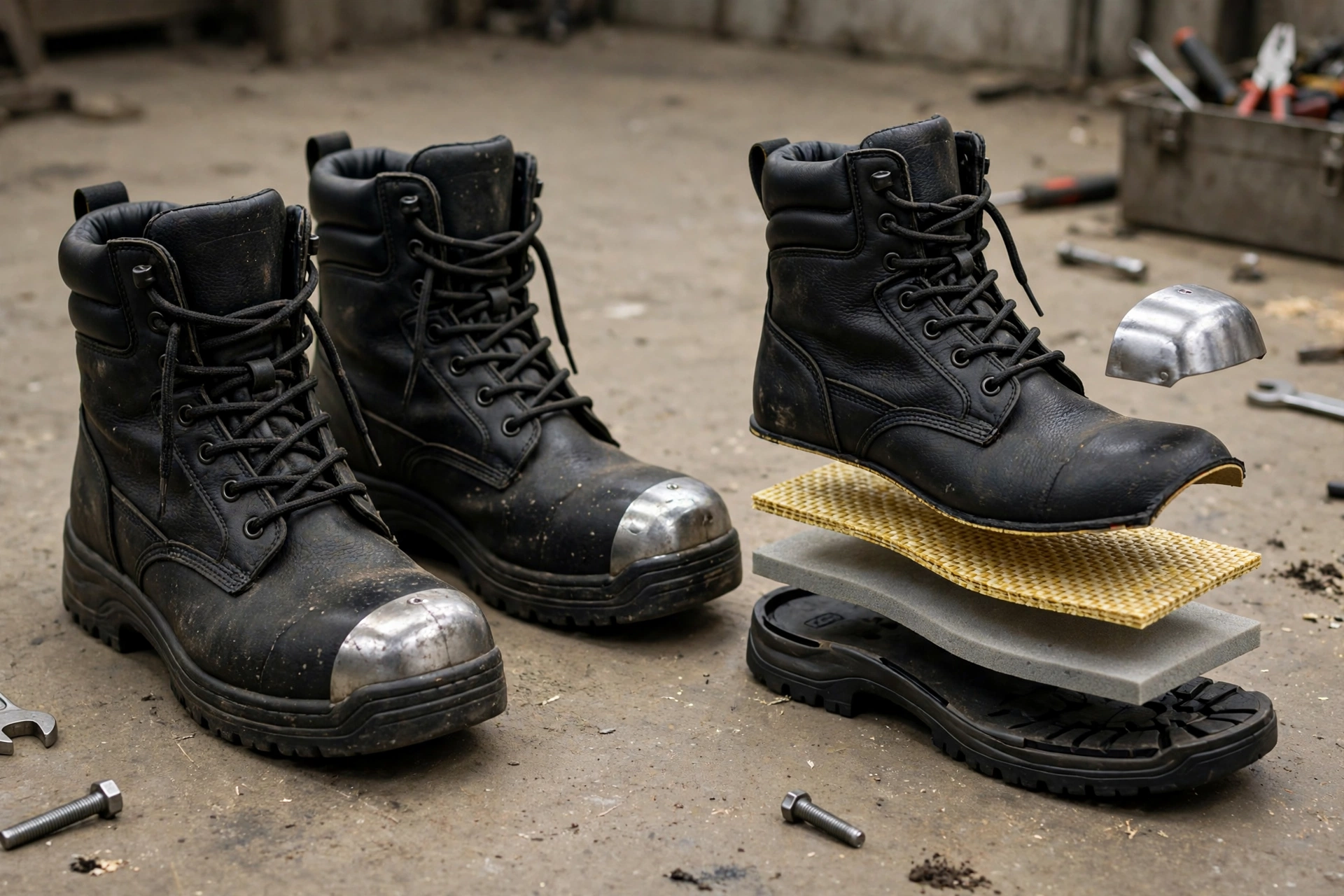
European footwear standards divide work footwear into three families, and the distinction is the toe cap. Safety footwear, under EN ISO 20345, has a toe cap tested to 200 joules of impact and 15,000 newtons of compression: roughly, a heavy object dropped from height, and a heavy load pressing down. Protective footwear, under EN ISO 20346, has a toe cap tested to 100 joules, for lower impact risk. Occupational footwear, under EN ISO 20347, has no protective toe cap at all and is for jobs where impact is not a hazard but slip resistance, antistatic properties, or water resistance still matter. A buyer who orders occupational footwear for a site with falling-object risk has not saved money; they have removed the protection the job requires.
This guide focuses on safety footwear, the EN ISO 20345 family, because that is where the S-class codes appear. Every pair in this family carries at least the basic SB requirements: the tested toe cap, plus requirements for the upper, outsole, and general construction. Each higher class adds tested properties on top of that base, and the additions follow a fixed pattern that is worth memorising.
Reading the Class Code: SB to S7
SB is the basic safety class: toe protection plus the general requirements, with no additional properties claimed. S1 adds three properties to SB: a closed, sealed seat region at the heel, antistatic properties, and energy absorption in the heel region, which reduces the shock transmitted to the wearer when walking and standing on hard surfaces. S1 is a common choice for dry indoor work such as warehousing and light assembly, where impact risk exists but water and sharp objects underfoot are not the main concern.
S1P adds penetration resistance to S1: a protective insert in the sole that resists sharp objects driven through from below. The insert may be steel or a composite material, and the difference matters for weight, flexibility, and metal detection. S1P is the default workhorse class for construction, maintenance, and waste handling, where nails, scrap, and debris underfoot are a daily risk. S2 keeps the S1 properties and adds resistance of the upper to water penetration and absorption, for work where the upper gets wet but the boot is not standing in water. S3 combines S2 with penetration resistance, making it the standard choice for outdoor construction and wet, rough ground.
S4 and S5 are the moulded or vulcanised counterparts of S1 and S3: instead of a leather or textile upper, the footwear is made from polymer or rubber, which makes the whole boot water resistant by construction. S4 is the polymer equivalent of S1, and S5 adds penetration resistance to S4. These classes suit food processing, chemical handling, and agriculture, where boots are hosed down or stand in liquid. S6 and S7, added in the 2022 revision of the standard, go further: they require water resistance of the complete footwear, tested as a whole boot rather than just the upper material, with S7 adding penetration resistance to S6. For a buyer, the practical reading is simple: the higher the number, the more tested properties are included, but only the properties the job actually needs should be paid for.
Additional Codes Buyers Actually Use
Beyond the class letter and number, additional markings describe individual tested properties, and these are where many specifications are won or lost. A stands for antistatic properties, E for energy absorption in the heel, and P for penetration resistance, which is why S1P and S3 carry the P in their class name. WRU means the upper resists water penetration and absorption, while WR means the complete footwear resists water. HRO means the outsole resists contact heat, which matters for foundry and asphalt work. FO means the outsole resists fuel oil, a common requirement where vehicles and machinery are refuelled. SR is the slip resistance marking under the current standard, replacing the older SRA, SRB, and SRC categories: a boot marked SR has passed the current slip test on the specified surfaces. ESD marking indicates electrostatic discharge properties for electronics and explosive-atmosphere work, and it is a different property from simple antistatic performance, so the two should not be confused in a specification.
The right way to use these codes in a purchase specification is to list them as requirements, not as wishes. Instead of writing “safety boots, waterproof, non-slip”, a specification that reads “EN ISO 20345 S3, SR, FO” tells every supplier exactly which tests the footwear must have passed, and it makes competing quotes comparable. Vague wording invites the cheapest boot that can plausibly be described as waterproof, which is rarely the boot that passes the test.
What Changed in the 2022 Revision
Buyers comparing old and new stock should know that EN ISO 20345 was revised in 2022, and the changes affect how codes are read. The slip resistance test was reworked and the marking simplified to SR, so older boots marked SRA, SRB, or SRC are not directly comparable to new SR-marked boots without checking the test behind the mark. The water-resistant whole-footwear classes S6 and S7 were introduced, giving buyers a tested option above S3 for genuinely wet work. Additional properties such as ladder grip were also added for specific jobs. None of this invalidates older certified stock, but a specification written from an old catalogue should be checked against the current standard before it is reordered, and suppliers should be asked which version of the standard their certification references.
Matching the Code to the Job
A dry warehouse with forklift traffic and pallet handling usually calls for S1P: toe protection, antistatic properties, and penetration resistance, without paying for water resistance the job does not need. Outdoor construction with mud, rain, and debris calls for S3, and standing-water work calls for S6 or S7. Food processing and chemical areas where boots are washed down call for S4 or S5, with chemical resistance of the sole checked separately against the substances actually used. Foundry, asphalt, and hot-surface work needs HRO in addition to the base class. Electronics assembly and explosive atmospheres need ESD properties checked as a specific requirement, not assumed from an antistatic marking. Where several hazards combine, the class is chosen for the combination, and the additional codes cover the rest.
Fit is the second half of the specification and the part most often skipped. Safety footwear that does not fit will not be worn for a full shift, and a toe cap that pinches or a heel that slips creates its own injury risk. A bulk order should be preceded by a fit trial across the workforce’s size range, including wide fittings where needed, and the size curve for the order should come from that trial rather than from last year’s quantities. Break-in time should also be planned: new safety boots are stiffest in the first week, and scheduling a trial before the old boots are retired avoids a week of complaints and non-compliance.
Checking Footwear Before a Bulk Order
Before committing, ask the supplier for the documents behind the code: the EU type-examination certificate or equivalent certification for the exact model, the test reports that support the claimed class and additional markings, and confirmation of which revision of EN ISO 20345 the certification references. Check that the model number on the certificate matches the model being quoted, because a certificate for one model does not cover another. Our guide to verifying PPE certifications before a bulk order explains that check in detail, and it applies to footwear exactly as it applies to gloves and clothing. Also confirm the replacement rule for the site: footwear should leave service when the toe cap is exposed, the sole is worn through, the penetration insert is damaged, or the upper is split, regardless of how new the boots look from a distance. OSHA’s PPE guidance and OSHA standard 1910.136 set out the employer’s duty to provide protective footwear where foot injury hazards exist, which is the framework behind any footwear programme.
A final practical point: order the class the hazard assessment requires, and record why. When an auditor, a client, or a new safety manager asks why the site wears S3 rather than S1P, the answer should be in the assessment, not in someone’s memory. That record is what turns a boot purchase into a defensible safety decision, and it is what makes the next reorder a routine task instead of a fresh argument. For a general method, see our guide to conducting a PPE hazard assessment.
Get Samples Matched to Your Footwear Specification
If you are specifying safety footwear, send us the class and additional codes your assessment requires, the size range, and the surfaces and substances the footwear will meet. We can recommend products against that specification and provide free samples for fit and wear trials; the buyer covers shipping. Start with the contact form and include your class code, quantities by size, and work environment, and we will respond with matched options rather than a generic catalogue.
Related Guides
ESD Safety Shoes: How to Choose the Right Pair for Your EPA | How to Conduct a PPE Hazard Assessment (OSHA Guide) | How to Verify PPE Certifications Before a Bulk Order


