



A chemical glove can “fail” in three completely different ways, and the datasheet words for them — permeation, degradation, penetration — are often used interchangeably even by people who buy gloves for a living. They shouldn’t be. Each term describes a different physical mechanism, is measured by a different test, and demands a different response from the buyer. Confuse them, and you can select a glove with superb test numbers that still lets your team down. This guide separates the three concepts cleanly.
Permeation: The Invisible Failure
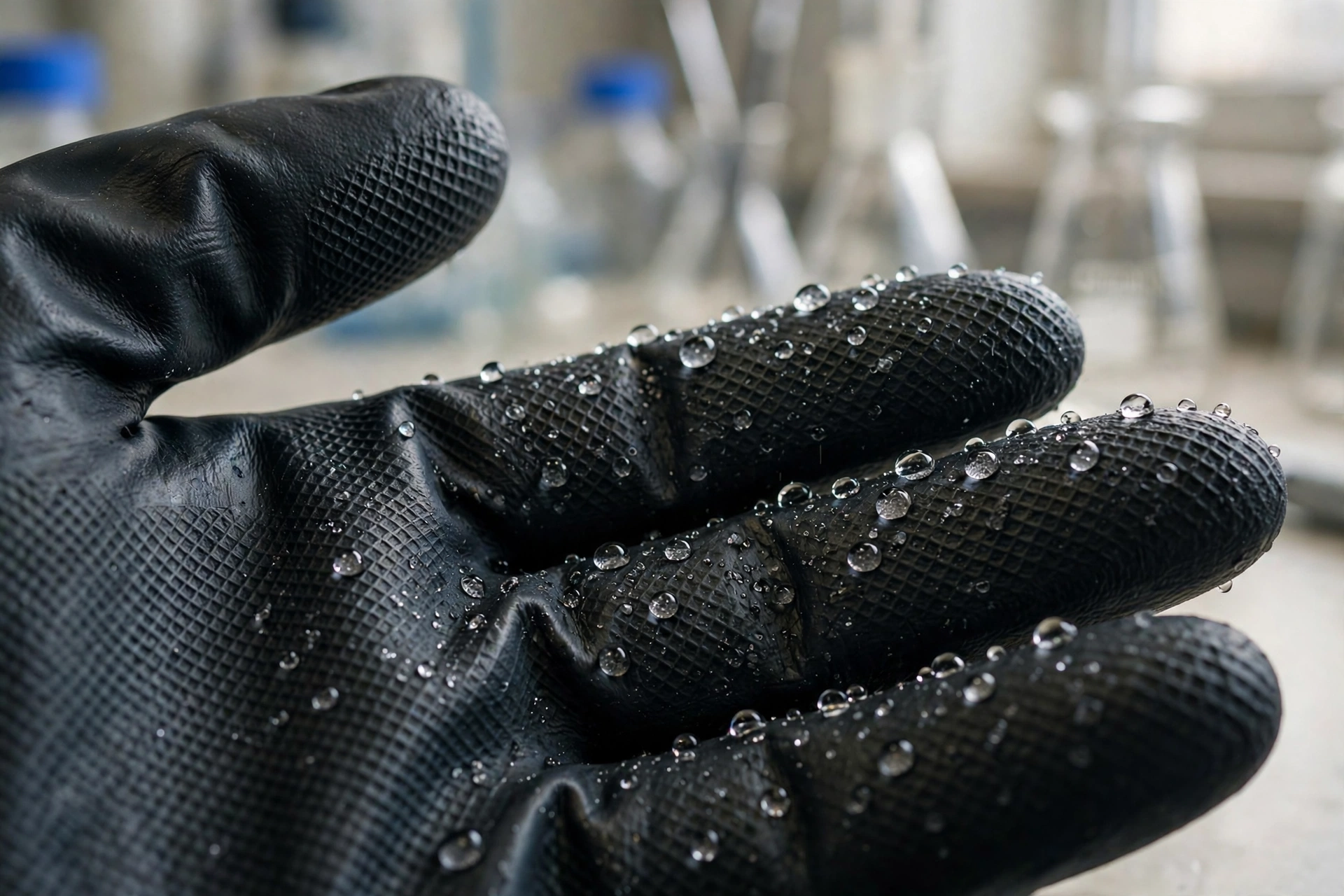
Permeation is molecular. The chemical absorbs into the glove’s outer surface, diffuses through the material molecule by molecule, and desorbs on the inside — while the glove looks, feels, and flexes exactly as it did when new. There is no hole, no tear, no visible change. Permeation is the failure mode you cannot inspect for, which is why it is governed by laboratory data rather than by looking at the glove.
Two numbers describe it. Breakthrough time is how long before the chemical is first detected inside the material; permeation rate is how fast it crosses thereafter. Our hub guide to chemical glove breakthrough time covers the concept in full, including how to apply it to change-out schedules. The test methods are EN 16523-1 (Europe) and ASTM F739 (US), and they contain a trap for the unwary: they define breakthrough at different detection thresholds.
- EN 16523-1 (used for EN ISO 374 ratings) reports breakthrough when the permeation rate reaches 1.0 µg/cm²/min.
- ASTM F739 reports a normalized breakthrough time at 0.1 µg/cm²/min — a threshold ten times more sensitive.
The consequence: the same glove, against the same chemical, can legitimately show a longer “breakthrough time” in European data than in American data, because the European test waits until ten times more chemical is crossing before it starts the clock’s endpoint. Neither is wrong; they are different rulers. When comparing datasheets across regions, check which standard — and therefore which threshold — produced the number, or you will compare a glove against itself and reach the wrong conclusion.
Degradation: The Visible Failure
Degradation is what the chemical does to the glove material itself: swelling, shrinking, hardening, softening, cracking, tackiness, or loss of strength after contact. Unlike permeation, degradation you can often see and feel — a nitrile glove that swells like a balloon in a solvent or goes stiff after acid contact is degrading in front of you. It is measured under EN 374-4 as the change in puncture force of the material after one hour of continuous contact with the chemical, reported as a percentage.
Degradation matters for two reasons. The obvious one is mechanical: a degraded glove tears, punctures, and loses grip, so its barrier fails physically. The subtler reason is that degradation accelerates permeation — a swollen, plasticized polymer lets molecules through faster than the intact material the lab tested. Permeation data is generated on undegraded specimens; a glove that degrades in your chemical may deliver a fraction of its published breakthrough time in service. This is why professional selection always reads the two datasets together.
Penetration: The Manufacturing Failure
Penetration is bulk flow: liquid or air passing through pinholes, thin spots, porous areas, or imperfect seams — defects in the glove as manufactured, not properties of the material. A glove can be chemically superb and still penetrate through a pinhole. Penetration is controlled by leak testing (EN 374-2 air-leak and water-leak tests) and expressed through AQL — the acceptable quality level of the production batch. An AQL of 1.5 is the common industrial benchmark; lower AQL means fewer defects survive inspection. Penetration is also why glove inspection before donning — inflating disposable gloves, checking reusable ones — remains a real control, not a ritual.
How the Three Interact on a Real Shift
In service, the three failure modes form a sequence. A chemical contacts the glove and begins degrading the outer surface (degradation). The compromised material permeates faster than its datasheet promises (permeation). Mechanical stress on the weakened film opens micro-defects (penetration). The worker experiences this as “the glove just fell apart” — the end of a chain that started at the molecular level. Meanwhile the clock on the chemical exposure started long before anything looked wrong. The standard test methods behind all three mechanisms are published by bodies such as ASTM International (F739) and the EN 374 series, and serious supplier datasheets cite them test by test.
The selection discipline that follows is simple to state: for each chemical in your process, require all three data points — breakthrough time and permeation behavior (EN 16523 / ASTM F739), degradation rating (EN 374-4), and a leak-test standard with a stated AQL (EN 374-2). A supplier who can only produce one of the three is showing you one-third of the glove.
The same glove illustrates how much breakthrough varies by chemical: one CE-certified chemical glove (EN ISO 374-1 Type A, certificate 0598/PPE/25/3427) reports over 480 minutes against methanol but only over 60 minutes against dichloromethane. Permeation data is therefore chemical-specific, not glove-general — and a degradation-prone pairing can shorten even the longer number in service.
One Chemical, Three Failure Modes: A Walk-Through
Make it concrete with a generic example: a mid-weight nitrile glove used to handle a ketone solvent during parts cleaning. The permeation data looks reassuring at first glance — until you notice the breakthrough time for this solvent class is measured in single-digit minutes for many nitrile formulations, because nitrile’s polymer network is chemically vulnerable to ketones. Simultaneously, the solvent plasticizes the film: within minutes the glove swells and softens (degradation), losing tear strength. The worker, feeling the glove go baggy, grips a part harder; the weakened film splits at the thumb — penetration through a defect that service created. Three mechanisms, one ruined glove, and a skin exposure that began long before the split.
The correct glove for that task might be a butyl rubber glove — unremarkable mechanically, but with ketone breakthrough measured in hours and minimal degradation. The lesson generalizes: the “best” glove is the one whose three datasets survive your chemical, and a failure-mode analysis beats a single headline number every time. Where no single material survives, professionals layer: a chemically near-impermeable laminate glove worn under a durable outer glove, accepting poor dexterity in exchange for a barrier that holds — or they re-engineer the task (closed transfer, tools instead of hands) so the glove stops being the only line of defense.
Reading a Datasheet Like a Professional
- Find the test standard next to every number. A breakthrough time without a standard is a rumor.
- Confirm the chemical tested is your chemical — same name, same concentration, ideally same CAS number — not a cousin.
- Note the test temperature. Standard tests run near 23 °C; hot processes invalidate the numbers proportionally.
- Check degradation before breakthrough. A high degradation percentage demotes an impressive breakthrough time to a theoretical one.
- Convert data into a rule. Maximum wear time, inspection habit, replacement trigger — written into the task procedure.
Want all three datasets for your chemical list? Aceppe supplies chemical resistant gloves with full manufacturer test documentation — permeation, degradation, and leak-test AQL — for industrial buyers. Send your chemical inventory through our contact page and we will return a documented shortlist.
🧪 Free Tool: Glove Chemical Compatibility Checker
Check 60 chemicals against 6 glove materials with four-tier ratings — the starting point for a permeation-led glove specification. Free, no signup.


