



When you pick up a box of chemical-resistant gloves, the label lists breakthrough times next to dozens of chemicals: “>480 min,” “67 min,” “8 min.” But what does breakthrough time actually mean, and how should you use these numbers when choosing gloves for your workers? Misreading this single number is one of the most common causes of chemical glove failure in the workplace. This guide explains what breakthrough time measures, how it is tested, how to read a chemical resistance chart, and the mistakes to avoid.
What Is Breakthrough Time?
Breakthrough time is the time it takes for a chemical to permeate through an intact glove material and reach the inner surface at a measurable rate. It is not the time it takes for the glove to dissolve, tear, or show visible damage — those are different failure modes (degradation and penetration, covered below).
Under EN ISO 374-1:2016+A1:2018 (the European standard for protective gloves against dangerous chemicals and micro-organisms), each tested chemical is assigned a performance level based on its normalized breakthrough time, measured per EN 16523-1:
| Performance level | Breakthrough time | Practical meaning |
|---|---|---|
| Level 1 | >10 minutes | Very limited protection — splash only |
| Level 2 | >30 minutes | Short contact only |
| Level 3 | >60 minutes | Moderate tasks |
| Level 4 | >120 minutes | Extended contact |
| Level 5 | >240 minutes | Long shifts with one chemical |
| Level 6 | >480 minutes | Best rating — a full 8-hour shift |
The higher the number, the longer the chemical takes to pass through the material. A Level 6 rating does not mean the glove is safe forever — it means permeation was not detected during an 8-hour laboratory test.
Breakthrough Time Is Not a Safe-Use Timer
This is the single most important point: breakthrough time is not a guarantee of safe wear time. Laboratory tests are run at room temperature (23 °C) with pure chemicals on flat, unflexed material samples. Real-world conditions are harsher:
- Heat accelerates permeation. A glove tested at 23 °C will break through faster at 35 °C on a warm shop floor — sometimes dramatically so.
- Flexing and abrasion thin the material. Test samples don’t bend, stretch, or rub against rough surfaces.
- Chemical mixtures behave unpredictably. A solvent blend can permeate faster than any of its individual components.
- The lab detection threshold is arbitrary. EN 16523-1 declares “breakthrough” at a permeation rate of 1.0 µg/cm²/min. For highly toxic substances, even a fraction of that rate may matter.
Best practice: treat the published breakthrough time as a relative comparison tool between gloves, and apply a safety factor — replace gloves well before the rated breakthrough time, especially for continuous immersion.
Breakthrough vs. Degradation vs. Penetration
Three different things can go wrong with a chemical glove, and the terminology matters:
- Permeation (breakthrough) — the chemical dissolves into and diffuses through the glove material at a molecular level. The glove looks fine. This is what breakthrough time measures. (See how permeation works.)
- Degradation — the chemical changes the material’s physical properties: swelling, stiffening, cracking, or dissolving. Visible and dangerous.
- Penetration — the chemical passes through pinholes, seams, or tears in the glove. A manufacturing defect or damage, not a material property.
A glove can pass a breakthrough test with flying colors yet fail on degradation — for example, a glove that holds up against permeation but swells and becomes unusable. Always check all three properties on the glove’s chemical resistance chart.
How to Read a Chemical Resistance Chart
Most glove manufacturers publish a chemical resistance chart listing common chemicals with ratings. Here’s how to read one properly:
1. Find your exact chemical (not a cousin)
Ratings are chemical-specific. Toluene and xylene look similar on paper but permeate differently. “Acetone, 99%” is not “acetone, 50% aqueous solution.” Always match the exact chemical name and concentration you use on site.
2. Note the performance level, not just the pass/fail
Under EN ISO 374, gloves are classified by type:
- Type A — at least Level 2 against 6 test chemicals
- Type B — at least Level 2 against 3 test chemicals
- Type C — at least Level 1 against 1 test chemical
The 12 test chemicals of EN ISO 374-1 (methanol, acetone, acetonitrile, dichloromethane, carbon disulfide, toluene, diethylamine, tetrahydrofuran, ethyl acetate, n-heptane, sodium hydroxide 40%, sulfuric acid 96%) give a standardized comparison baseline — but they are only a starting point for your specific workplace chemicals.
3. Check the thickness tested
Breakthrough time scales roughly with material thickness. A chart value measured on an 18-mil unsupported nitrile glove does not apply to a 5-mil disposable nitrile glove of the same material. Confirm the chart matches the actual product and thickness you are buying.
4. Look for the test standard and date
Charts should reference EN 16523-1 or ASTM F739 (the US permeation test). If a chart gives vague labels like “Excellent” with no test data behind them, treat it as marketing, not evidence.
Material Matters: How Glove Polymers Compare
No single material protects against everything. Here is a general guide:
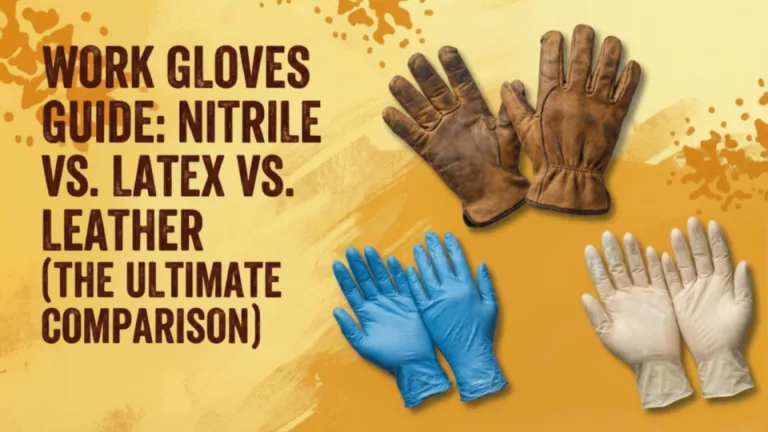
- Nitrile — the workhorse. Good against oils, greases, many solvents, and acids. The most common choice for industrial chemical handling. Learn more in our guide to glove standards.
- Latex (natural rubber) — excellent against water-based chemicals, acids, and bases, but poor against oils and organic solvents; allergy risk is a concern.
- Neoprene — good balance of chemical resistance and flexibility; decent against acids, bases, and many solvents.
- Butyl rubber — the specialist for ketones, esters, and highly corrosive chemicals; poor mechanical strength.
- PVC — good for acids and bases; stiff in cold weather and limited against solvents.
- Viton / fluoroelastomer — premium resistance to aromatic and chlorinated solvents; expensive and stiff.
When no single glove covers all the chemicals in a process, the practical answer is often double-gloving (e.g., a thin nitrile glove under a thicker chemical glove) or task-specific glove changes.
Common Mistakes When Using Breakthrough Time Data
- Treating breakthrough time as a wear schedule. As discussed — it is a lab comparison value, not a countdown timer. Build replacement schedules from risk assessment, not from the chart alone.
- Ignoring temperature. If the process runs hot, the chart number overstates protection. Ask the manufacturer for data at your operating temperature.
- Forgetting mechanical wear. Cut, abrasion, and puncture resistance still matter — a chemically perfect glove with a torn fingertip protects nothing. See our EN 388 cut levels guide for the mechanical side.
- Reusing disposable gloves. Thin disposable chemical gloves are single-use by design. Reuse means unknown contamination and degraded protection.
- Skipping user checks. Train workers to inspect gloves before each use and replace them at the first sign of swelling, discoloration, stiffness, or tackiness — regardless of elapsed time.
A Practical Selection Workflow
- List every chemical in the task, with exact concentrations and operating temperatures.
- Check the manufacturer’s chemical resistance chart for each chemical — performance level, material, and thickness.
- Prefer gloves rated Type A (EN ISO 374) or with Level 4+ breakthrough times for your key chemicals.
- Consider the mechanical demands of the task (grip, dexterity, cut risk) alongside chemical protection.
- Set a replacement schedule with a safety margin below the rated breakthrough time.
- Train users on inspection, donning/doffing without cross-contamination, and disposal. The UK Health and Safety Executive’s glove selection guidance is a useful reference for building your own program.
The Bottom Line
Breakthrough time is a powerful comparison tool — but only when read correctly. Match the exact chemical and concentration, respect the gap between lab conditions and your shop floor, and never use the number as a wear-time guarantee. Combined with degradation and penetration data, it lets you choose chemical gloves on evidence rather than guesswork.
AceppePro is an industrial PPE manufacturer supplying safety gloves, respiratory protection, and workwear. For bulk orders or OEM inquiries on chemical-resistant gloves, visit aceppe.com — we’re happy to help you match the right glove to your chemicals.