



An ESD safety shoe is not a normal safety shoe with a different label. It is one half of a system: the shoe and the flooring it stands on either control static together, or neither of them does. Buyers who treat ESD footwear as a catalogue line item — pick a style, tick the ESD box, move on — are the ones who discover at audit time that their shoes pass on paper and fail on the floor. This guide covers how to specify ESD safety shoes, including ESD steel toe shoes, so the pair you buy matches the protected area it will actually walk in.
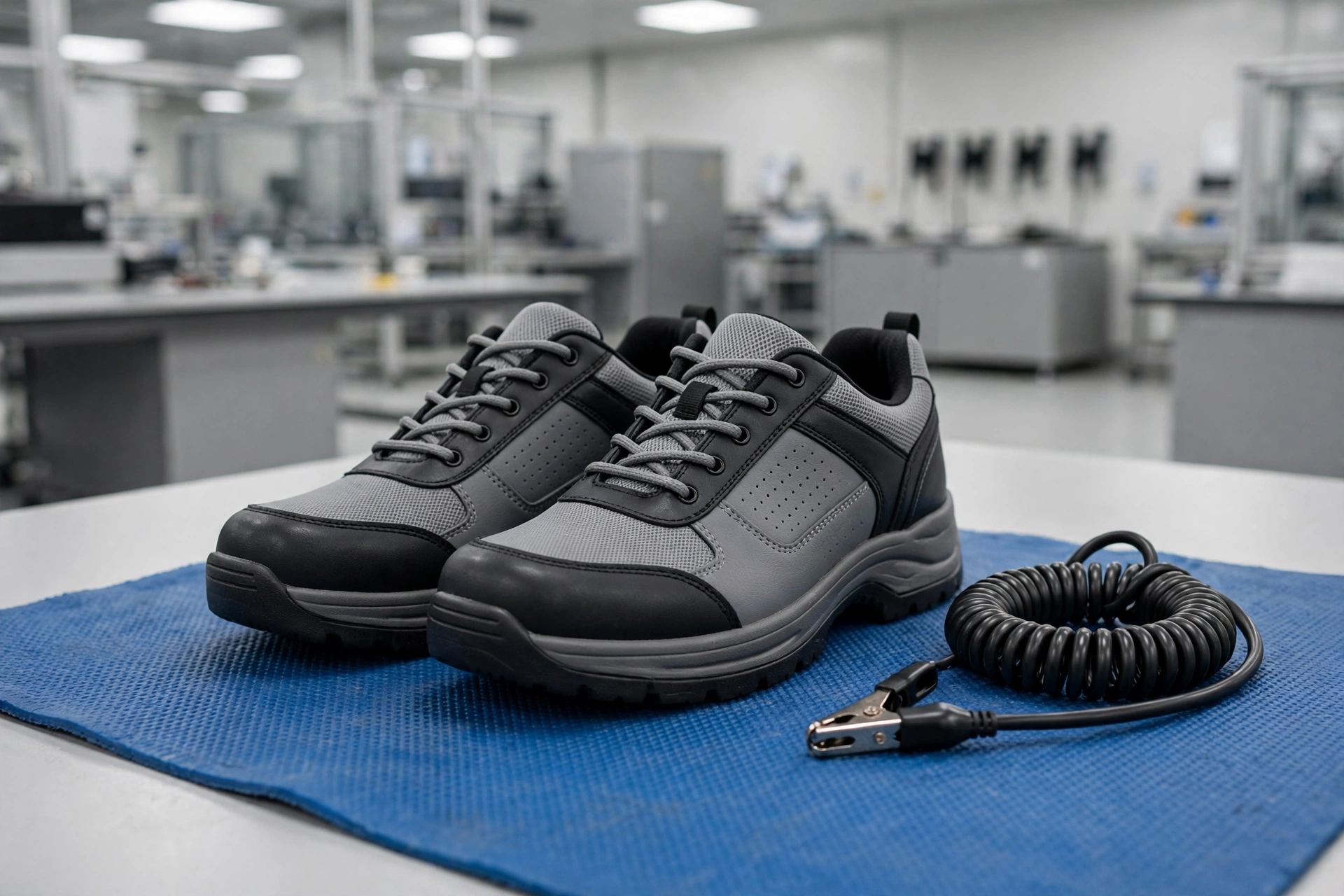
Footwear is one layer of a wider programme: our ESD workwear guide explains how garments, flooring, worksurfaces, and handling rules fit together in an electrostatic protected area, and this guide covers the footwear layer in detail.
Dissipative, Conductive, Antistatic: Three Words That Are Not Interchangeable
Start with the vocabulary, because suppliers use these words loosely and the difference decides whether your EPA is compliant. Dissipative footwear lets charge drain away in a controlled, gradual way — this is what most electronics EPAs require. Conductive footwear drains charge much faster and is specified only where a particular process demands it; it is not a stronger version of dissipative, it is a different behavior. Antistatic is the loosest term of the three: it describes a material that resists charge build-up, but on its own it does not guarantee the shoe will pass a system test in your facility. When a datasheet says only “antistatic,” ask for the test data behind the word before you buy.
The governing documents are ANSI/ESD S20.20 and IEC 61340-5-1, which treat ESD control as a system: the person, the footwear, and the flooring are tested together, not as separate products. Our guide to ESD footwear testing methods explains the tests themselves; this guide is about what to buy so those tests pass.
ESD Steel Toe Shoes: The Toe Cap Does Not Make the Shoe ESD
The most common specification error in ESD footwear is assuming a steel toe shoe is automatically ESD footwear, or the reverse — that an ESD shoe cannot have a steel toe. Neither is true. A steel toe cap protects against impact; ESD performance comes from the sole, the insole, and the materials path from foot to floor. A steel toe shoe with a standard insulating sole will fail an ESD system test, and an ESD shoe is available with either a steel or a composite toe cap. If your risk assessment calls for impact protection, specify both requirements explicitly: the toe cap rating your site needs, and ESD footwear performance verified as a complete shoe — not as separate claims on separate parts.
Composite toe caps are worth considering where metal-free footwear matters, for example in security-sensitive areas or where workers pass through metal detectors. They are lighter than steel, which matters on long shifts, but they do not change the ESD question: whatever the cap, the finished shoe still has to pass the footwear-and-flooring system test in your EPA.
The Shoe and the Floor Pass or Fail Together
This is the point buyers most often miss. Under ANSI/ESD S20.20, the person, footwear, and flooring combination is commonly tested to keep walking voltage below 100 volts — and that test is done on your floor, not in the supplier’s laboratory. A shoe that passed on the manufacturer’s test floor can fail on yours if your flooring has different resistance, if the floor is dirty or worn, or if workers wear the shoes outside the EPA and bring contamination back in. Before you commit to a large order, test the candidate shoe on your own flooring, with the people who will actually wear it. A sample pair tested on your floor is worth more than a page of datasheet numbers.
The same logic applies to heel grounders. A heel grounder straps conductivity onto a normal shoe, and it can be a reasonable stopgap, but it is not equivalent to ESD footwear: straps shift, wear, and depend on the wearer fitting them correctly every time. If your EPA is permanent, purpose-built ESD shoes are the lower-risk choice; reserve heel grounders for visitors and short-term access. The test method behind all of this is IEC 61340-5-1:2024, which sets out how the footwear and flooring system is evaluated.
Four Failures That Show Up at Audit
- No test records. The shoes were bought as ESD, but nobody can show a footwear test, a system test, or a periodic verification record. Auditors test the system, not the label.
- Wrong floor pairing. The shoe was qualified on one flooring type and deployed on another. Resistance is a property of the combination.
- Uncontrolled wear outside the EPA. Workers wear ESD shoes to the car park, the canteen, and the warehouse, then back into the EPA. Contamination and wear change resistance, and nobody re-tests.
- No replacement rule. Soles wear, insoles compress, and resistance drifts. Without a defined re-test interval and a retirement criterion, a shoe that passed in January can fail in June without anyone noticing.
A Buying Checklist for ESD Safety Shoes
- Specify the requirement as a system: footwear plus your flooring, tested together, with the walking voltage limit your program uses.
- Ask for system test data for the complete shoe, not just a material claim or an “antistatic” label.
- If impact protection is required, specify toe cap and ESD performance as two separate, explicit requirements.
- Test a sample pair on your own flooring before committing to volume.
- Define periodic verification, a re-test interval, and a retirement rule before the first pair is issued.
- Confirm sizing, width options, and comfort: a shoe workers refuse to wear protects nothing.
Sizing, Width, and Wear Trials
Size charts alone do not settle ESD footwear, because the shoe has to maintain floor contact through a full shift of real movement, not just stand still for a fitting. Width matters as much as length: a shoe that squeezes the foot changes how the wearer walks, and a shoe that is too loose lets the foot slide inside it, both of which affect contact and comfort. Trial the shoe with the socks and any insoles your site standardises on, on your own floors, over full shifts, and include the movements the job actually involves — walking between benches, standing at inspection stations, climbing steps, and kneeling where the work requires it. Ask the wearers afterwards, not just whether the shoe felt comfortable at first, but whether anything changed over the shift: hot spots, slipping, laces loosening, or a tendency to take the shoe off where it is most needed. A trial that only covers standing still has not trialled work footwear.
Test Records: What to Keep
A footwear programme that nobody records will drift, because the failures that matter are gradual: soles wearing, insoles being swapped, floors being recoated, and checks being skipped during busy weeks. Keep a simple record per person or per pair — the shoe issued, the date of each routine check, the result, and what was done when a check failed — and review it as a pattern rather than as isolated passes and fails. A cluster of failures on one floor area points at the floor, not the shoes; a cluster on one shoe size points at fit; failures that rise after a floor treatment point at the treatment. The record is also what an auditor will ask for, and it is far easier to produce a routine log than to reconstruct one after the fact. Agree the re-test interval and the retirement rule before the first pair is issued, so that replacement is driven by check results rather than by appearance or by calendar alone.
Related Guides
- ESD Workwear — the pillar guide for building an electrostatic-safe workwear programme.
- ESD Footwear Testing — methods, limits, and records for footwear and heel grounders.
- ESD Shoes vs Heel Grounders — two ways of grounding people, compared.


