



Choosing chemical resistant gloves is a process, not a purchase. The catalogue-first approach — pick a glove that looks tough, hand it out, hope — fails predictably, because chemical protection is specific: to the chemical, its concentration, the contact pattern, and the duration. This guide lays out the six-step selection process professionals use, from chemical inventory to in-use validation, with the material comparison table most buyers actually need. Follow the steps in order; each one eliminates a class of expensive mistakes.
Step 1: List Your Chemicals — Exactly
Start from the Safety Data Sheets, not from memory. For every chemical the glove will touch, record the full name, CAS number, concentration, and temperature in use, plus the contact pattern: full immersion, repeated handling of wet parts, splash only, or incidental contact. Mixtures get their own line — blends can permeate faster than any single component. This inventory is the input to every later step; a vague inventory (“some solvents”) guarantees a vague glove. Your reference point for exposure duties is OSHA’s hand protection rule, which requires selection based on the specific hazards of the task.
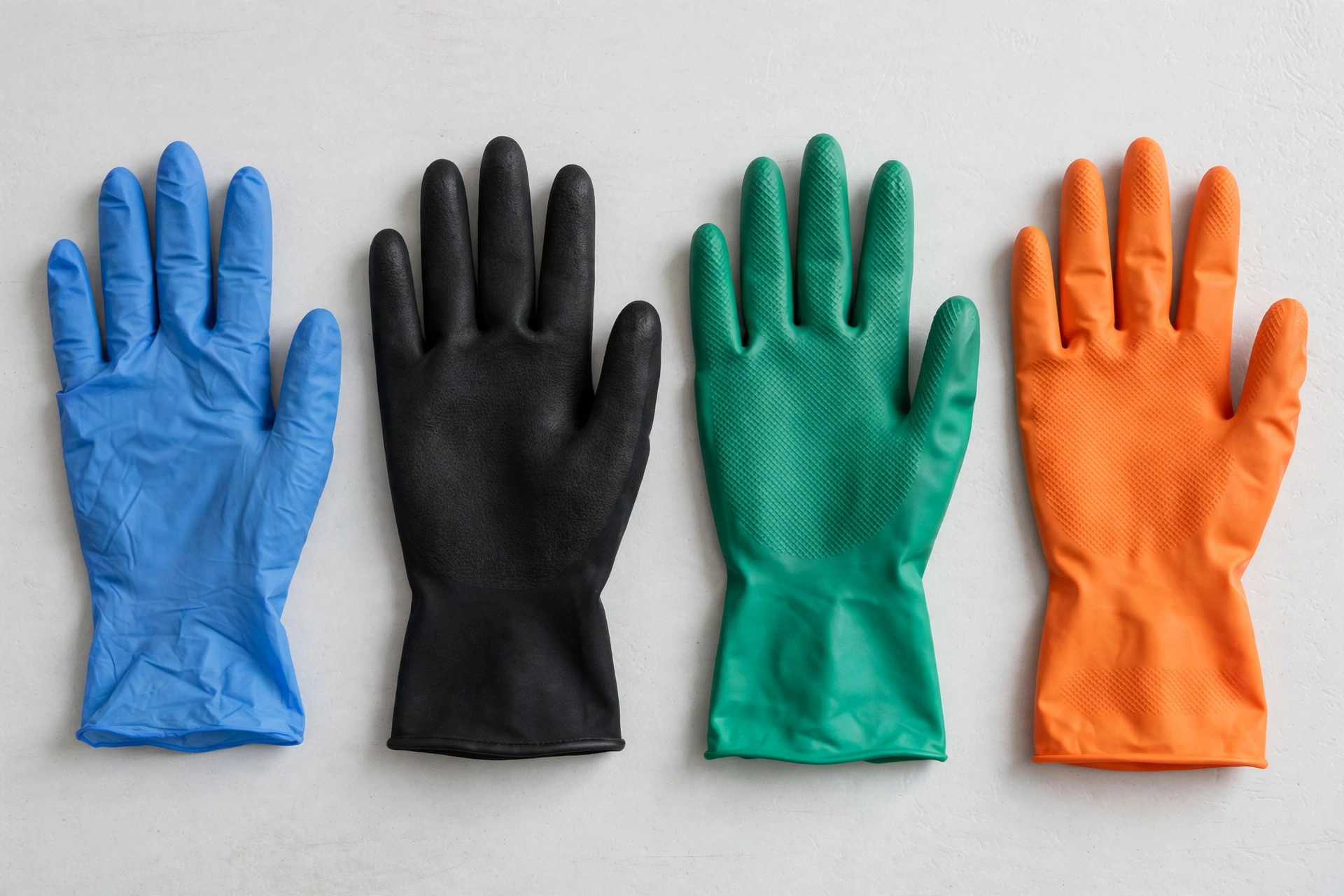
Step 2: Match the Material
No polymer resists everything. The four workhorse materials divide the chemical world between them:
- Nitrile (NBR): the industrial default. Excellent against oils, greases, fuels, and aliphatic solvents; good puncture and abrasion resistance. Weak against ketones (acetone, MEK), strong oxidizers, and some chlorinated solvents.
- Natural rubber latex: outstanding against water-based solutions, acids, and alkalis, with the best elasticity and comfort of the group. Poor against oils and organic solvents, and ruled out entirely where latex allergy is a concern.
- Neoprene (CR): the broad-spectrum compromise. Good resistance across acids, caustics, alcohols, and many solvents, with solid weathering and temperature behavior. Rarely the best at anything, seldom bad at anything.
- PVC: economical and strong against acids, caustics, and aqueous chemicals; common in janitorial and general chemical handling. Weak against many organic solvents, and it stiffens in the cold.
Beyond the big four sit the specialists — butyl rubber for ketones and esters, fluoroelastomers for aromatic and chlorinated solvents, and laminate films that resist nearly everything at the cost of dexterity. The NIOSH Pocket Guide to Chemical Hazards is a useful free reference when building your chemical inventory and checking hazard profiles. The matching rule is absolute: select against your Step 1 list, chemical by chemical — never against a material’s general reputation.
A specialist example shows why the material tier matters: one butyl/fluoro-rubber chemical glove, CE certified to EN ISO 374-1 Type A and EN ISO 374-5 (certificate 0598/PPE/25/3427, valid to 2030-05-22), reports breakthrough times over 480 minutes for methanol, acetone, acetonitrile and toluene — the butyl/fluoroelastomer tier that handles aromatic and chlorinated solvents other materials cannot.
Step 3: Check Breakthrough Against Task Duration
With a material shortlisted, verify it numerically. For each chemical on your list, find the manufacturer’s permeation data for the specific glove model and compare chemical glove breakthrough time against your longest continuous contact period — then apply a safety margin. A common professional rule caps wear time at half the measured breakthrough time, and less where degradation is significant. Also read the degradation data (EN 374-4): a material that swells or weakens in your chemical is disqualified no matter how good its breakthrough number looks on paper. If the data doesn’t exist for your chemical, that absence is itself an answer — choose a glove that has been tested.
Step 4: Set Thickness and Construction
Thickness buys mechanical durability and modestly extends breakthrough, but the decision that matters more is construction. Disposable nitrile (4–8 mil) suits splash protection and hygiene change-out. Reusable unsupported gloves (flock-lined or unlined nitrile, neoprene, or PVC, typically 11–22 mil) suit repeated handling and immersion. Supported gloves — coating bonded to a knitted liner — add cut and abrasion resistance for handling wet, rough parts. For immersion work, longer and thicker wins; for dexterity-critical splash work, the thinnest glove that passes Step 3 keeps hands willing to stay gloved.
Step 5: Length, Cuff, Size, and Grip
Chemicals run downhill: match cuff length to the splash and immersion geometry. Standard 12-inch cuffs cover the wrist; 14- to 18-inch gauntlets protect the forearm for reaching into tanks and drums; shoulder-length gloves exist for deep immersion. Size the glove to the hand — an oversized chemical glove folds, catches, and sheds grip on wet containers, while an undersized one strains and tears at the thumb crotch. Wet-grip textures (sandy or crinkled finishes) are a genuine safety feature wherever containers are handled wet. Stock the full size range; a glove that doesn’t fit is a glove hanging on the hook.
Between the Steps: Double-Gloving and Layering
Some inventories defeat every single glove: mixed solvents, unknown waste streams, spill response. The professional answer is layering — an inner glove chosen for chemical breadth (often a thin laminate film that resists almost everything) under an outer glove chosen for grip and durability, or two compatible elastomer gloves changed on a schedule. Layering also buys a safe doffing path: the contaminated outer glove comes off over the still-protected hand. If your Step 1 inventory contains chemicals with no good single-glove answer, treat that as a design finding, not a shopping failure — and consider whether the task itself (open pouring, hand immersion) can be re-engineered so the glove is no longer the primary control.
Step 6: Validate in Use and Set the Replacement Rule
Paper selection ends with a field trial: issue the finalist glove at the hardest station for a week and inspect returned gloves daily for swelling, stiffness, discoloration, and tackiness — the visible signatures of degradation. Then convert everything you have learned into two written rules: a maximum wear time derived from breakthrough data with your safety margin, and a replacement trigger (visible degradation, damage, splash event on a splash-rated glove). Reusable gloves get an inspection routine before each donning; disposables get a strict single-task rule. Review the choice whenever a chemical, concentration, or process changes — the selection is only valid for the inventory it was built on.
Close the loop with the people wearing the gloves. Train donning and — more importantly — doffing, because most self-contamination happens while removing a contaminated glove bare-handed-style. A two-minute demonstration at rollout prevents more exposure than another line in the catalogue spec.
Document the Decision
Write the selection down as a one-page record per task: the chemical inventory it rests on, the glove model and thickness chosen, the breakthrough and degradation data relied upon, the wear-time limit, and the review date. This document is what turns a glove purchase into a defensible safety program — it is what an auditor, an insurer, or a customer’s EHS team asks to see, and it is what the next buyer needs when you are not in the room. Keep the manufacturers’ datasheets on file with it, and diary a review whenever any input changes: a new solvent in the process, a reformulated product, a different glove supplier, or an incident report that mentions hands. Chemical glove selection is not a decision you make once; it is a small system you maintain.
Running this process for your facility? Aceppe supplies nitrile, neoprene, PVC, and latex chemical gloves in bulk, with permeation and degradation documentation for your chemical list. Send us your Step 1 inventory through our contact page and we will return a costed shortlist with the test data attached.
🧪 Free Tool: Glove Chemical Compatibility Checker
Check 60 chemicals against 6 glove materials with four-tier ratings — the fastest way to work Step 2 of this process before you request full datasheets. Free, no signup.


