


Chemical protective coveralls are used to protect workers from hazardous particles, liquid splash, light chemical spray, dust, dirt, and workplace contamination. For industrial buyers, choosing the right coverall is not only about price or appearance. The most important question is whether the coverall matches the actual working hazard.
Different jobs require different protection levels. A worker handling dry powder may not need the same coverall as a worker exposed to liquid chemical spray. A painter, cleaner, laboratory worker, and maintenance worker may all need protective clothing, but the correct type depends on the risk.
In this guide, we explain what chemical protective coveralls are, the difference between Type 4, Type 5, and Type 6 coveralls, and how to choose the right protective clothing for your workplace.
What Are Chemical Protective Coveralls?
Chemical protective coveralls are protective garments worn over regular work clothing to reduce worker exposure to hazardous substances, dust, particles, liquid splash, and contamination.
They are commonly used in industries such as:
- Chemical handling
- Industrial cleaning
- Painting and spraying
- Agriculture
- Laboratory work
- Pharmaceutical production
- Construction dust control
- Oil and gas maintenance
- Waste handling
- Emergency response
- General industrial maintenance
A chemical coverall may look simple, but the protection depends on important details such as the material, seams, zipper flap, hood design, cuffs, ankles, and how well the garment works with gloves, masks, goggles, and boots.
Why Choosing the Correct Coverall Type Matters
Choosing the wrong coverall can create serious problems.
If the protection level is too low, workers may be exposed to chemicals, particles, or liquid splash. If the protection level is higher than necessary, the garment may be too hot, uncomfortable, expensive, or difficult to work in.
The goal is to choose a coverall that gives the right protection for the actual hazard while still allowing workers to move and complete the job safely.
Before buying chemical protective coveralls, ask:
- What substance is the worker exposed to?
- Is the hazard dry particle, liquid splash, spray, or contamination?
- How long will the worker be exposed?
- Is the work light, medium, or heavy-duty?
- Does the worker need a disposable or reusable garment?
- Will the coverall be used with gloves, boots, goggles, or a respirator?
- Are certificates or specific standards required for the project?
The more clearly you understand the hazard, the easier it becomes to choose the correct protective clothing.
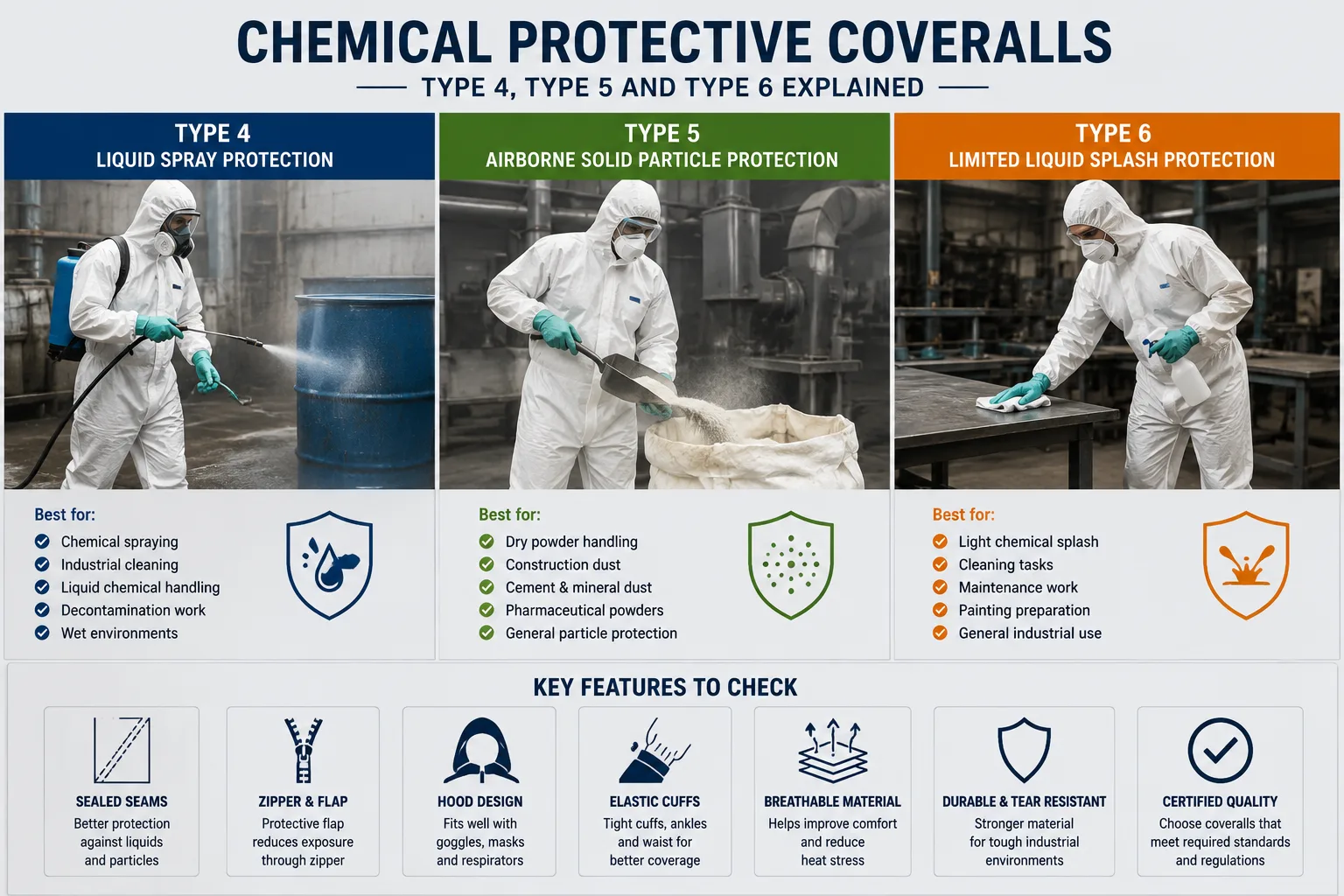
Type 4 vs Type 5 vs Type 6 Chemical Coveralls
Chemical protective coveralls are often described by type. Type 4, Type 5, and Type 6 are common categories buyers see when comparing disposable or limited-use protective clothing.
Type 4 Coveralls: Liquid Spray Protection
Type 4 coveralls are commonly used where workers may face liquid spray hazards. These garments are designed for stronger liquid protection than basic dust or limited splash coveralls.
Type 4 protection may be suitable for jobs involving:
- Chemical spraying
- Industrial cleaning
- Liquid chemical handling
- Decontamination work
- Maintenance in wet chemical environments
- Some agricultural spraying tasks
When choosing Type 4 coveralls, pay close attention to seam construction, zipper protection, hood fit, and wrist and ankle closure. Liquid can enter through weak points, so design details matter.
Type 5 Coveralls: Airborne Solid Particle Protection
Type 5 coveralls are commonly used for protection against hazardous dry particles and airborne solid particles.
They may be used in environments involving:
- Dry powder handling
- Construction dust
- Cement dust
- Pharmaceutical powders
- Industrial contamination control
- Maintenance in dusty areas
- Some controlled asbestos-related work
- General particle protection
For particle protection, check the coverall’s fit carefully. Gaps around the wrists, ankles, neck, or zipper area can reduce protection.
Type 6 Coveralls: Limited Liquid Splash Protection
Type 6 coveralls are designed for limited liquid splash situations. They are commonly used when the liquid hazard is lighter and exposure is less intense than full spray conditions.
Type 6 coveralls may be suitable for:
- Light chemical splash work
- Cleaning tasks
- Maintenance work
- Painting preparation
- General industrial protection
- Light liquid handling
- Dirty or contaminated work areas
Type 6 coveralls are often selected when workers need basic liquid splash protection without the heavier design of higher-level protective clothing.
Quick Comparison: Type 4, Type 5 and Type 6 Coveralls
| Coverall Type | Main Protection Purpose | Common Applications |
|---|---|---|
| Type 4 | Liquid spray protection | Chemical spraying, industrial cleaning, liquid handling |
| Type 5 | Airborne solid particle protection | Dust, powders, dry particles, contamination control |
| Type 6 | Limited liquid splash protection | Light splash, cleaning, maintenance, painting preparation |
This table is a simple guide. Final selection should always be based on the specific chemical, exposure level, working environment, and required standards.
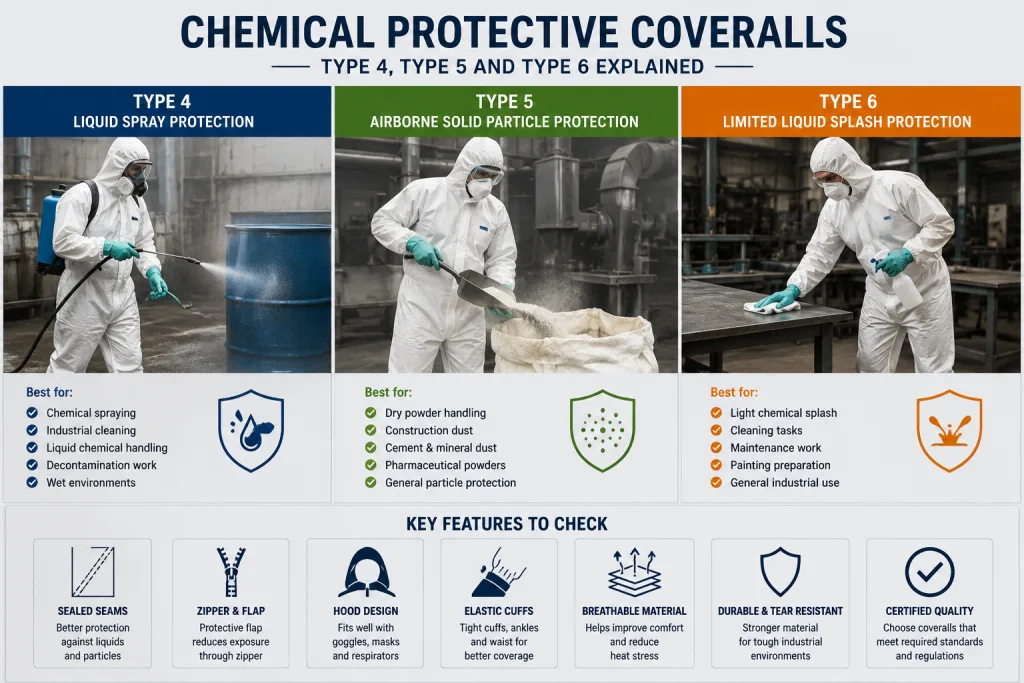
Key Features to Check Before Buying Chemical Protective Coveralls
Not all coveralls with the same type rating perform the same way. Buyers should also check the design and material details.
1. Material
The coverall material affects protection, comfort, breathability, and durability. Some materials are better for dry particles, while others are more suitable for splash or spray protection.
When reviewing material, consider:
- Particle protection
- Liquid resistance
- Breathability
- Tear resistance
- Weight
- Comfort during long work shifts
- Suitability for the working temperature
A coverall that is protective but too hot or uncomfortable may not be worn correctly.
2. Seams
Seams are one of the most important areas of a protective coverall. If seams are weak or poorly sealed, liquids or particles may enter.
Common seam types include:
- Stitched seams
- Bound seams
- Taped seams
- Sealed seams
For higher liquid protection, buyers should pay special attention to seam construction.
3. Zipper and Storm Flap
The front zipper is another possible entry point for contaminants. A coverall with a protective zipper flap can help reduce exposure through the front closure.
Check whether the coverall has:
- Strong zipper
- Adhesive flap
- Double flap
- Secure closure
- Easy opening and removal
This is especially important for liquid splash or spray environments.
4. Hood Design
A hooded coverall provides better coverage for the head and neck area. The hood should fit well around masks, goggles, face shields, or respirators.
A poor hood fit can leave gaps and reduce protection.
5. Cuffs, Ankles, and Waist
Elastic cuffs, ankles, and waist help improve fit and reduce openings where dust or liquid may enter.
Check whether the coverall has:
- Elastic wrists
- Elastic ankles
- Elastic waist
- Thumb loops if needed
- Boot compatibility
- Glove compatibility
For some applications, workers may need to tape the glove and boot connection points.
6. Size and Fit
A coverall must fit properly. If it is too small, it can tear during movement. If it is too large, it can create loose areas that catch on equipment or reduce worker comfort.
When ordering in bulk, prepare a proper size breakdown before requesting a quotation.
7. Compatibility with Other PPE
Chemical coveralls are rarely used alone. In many workplaces, they are part of a full PPE system.
Workers may also need:
- Chemical-resistant gloves
- Safety goggles
- Face shields
- Respirators
- Safety boots
- Shoe covers
- Protective sleeves
- Tape or sealing accessories
When buying coveralls, think about the full protection system, not only the garment.
Common Applications for Chemical Protective Coveralls
Chemical protective coveralls are used in many industries. Below are some common examples.
Chemical Handling
Workers handling liquid chemicals, powders, or contaminated materials may need chemical protective clothing, gloves, goggles, and respiratory protection.
Industrial Cleaning
Cleaning work can involve splash, spray, dirt, chemicals, and contaminated surfaces. Coveralls help protect workers’ clothing and skin.
Painting and Spraying
Painting and spraying can expose workers to liquid mist, overspray, and particles. Protective coveralls help reduce contamination and keep workers cleaner.
Pharmaceutical and Laboratory Work
In controlled environments, coveralls may be used to reduce contamination and protect workers from powders or substances.
Construction Dust Control
Some construction tasks produce heavy dust, powder, and debris. Type 5 coveralls may be used where particle protection is required.
Agriculture
Agricultural workers may need protective clothing when working with sprays, fertilizers, pesticides, or dirty environments. The correct coverall depends on the chemical and exposure level.
Oil and Gas Maintenance
Maintenance teams may face oil, dirt, chemicals, splash, and industrial contamination. Coveralls can be part of the required PPE set.
Disposable vs Reusable Chemical Coveralls
Many chemical protective coveralls are disposable or limited-use. Disposable coveralls are useful when contamination risk is high or when cleaning the garment is not practical.
Reusable protective clothing may be used in some environments, but it must be cleaned, inspected, and maintained correctly.
Before choosing disposable or reusable coveralls, consider:
- Contamination risk
- Cost per use
- Cleaning requirements
- Storage conditions
- Worker comfort
- Disposal rules
- Project requirements
If the coverall is damaged, torn, heavily contaminated, or no longer suitable for the task, it should be replaced.
Common Mistakes When Buying Chemical Protective Coveralls
Many buyers focus only on price, but chemical protective clothing should be selected carefully.
Common mistakes include:
- Choosing Type 6 when stronger liquid protection is needed
- Ignoring seam construction
- Not checking zipper protection
- Ordering the wrong size range
- Forgetting gloves, goggles, masks, or boots
- Not confirming certificate requirements
- Using damaged or contaminated coveralls
- Assuming one coverall works for all chemicals
- Ignoring worker comfort and heat stress
- Not training workers on correct wearing and removal
The right coverall should protect workers, fit properly, and match the job.
Buyer Checklist for Bulk Orders
Before requesting a quotation for chemical protective coveralls, prepare the following information:
- Application or industry
- Chemical or hazard type
- Required coverall type: Type 4, Type 5, Type 6, or combination
- Quantity
- Size breakdown
- Hooded or non-hooded design
- Seam requirement
- Material requirement
- Color requirement
- Packaging requirement
- Certificate or standard requirement
- Destination country
- Delivery timeline
This information helps suppliers recommend suitable products and prepare an accurate quotation.
FAQ
What are chemical protective coveralls used for?
Chemical protective coveralls are used to help protect workers from chemicals, dust, particles, liquid splash, dirt, and contamination in industrial workplaces.
What is the difference between Type 4, Type 5 and Type 6 coveralls?
Type 4 is commonly used for liquid spray protection, Type 5 for airborne solid particle protection, and Type 6 for limited liquid splash protection.
Are chemical coveralls reusable?
Some coveralls are disposable or limited-use, while others may be reusable depending on the material and manufacturer instructions. Damaged or contaminated coveralls should be replaced.
Do chemical coveralls replace gloves and respirators?
No. Coveralls protect the body, but workers may also need gloves, goggles, face shields, respirators, safety boots, or other PPE depending on the hazard.
Can one chemical coverall protect against all chemicals?
No. Different chemicals and exposure levels require different protection. Always check the application, chemical type, and required standards before choosing a coverall.
What should I check before buying chemical protective coveralls in bulk?
Check the protection type, material, seams, zipper flap, hood design, cuffs, sizing, certificate requirements, packaging, and compatibility with other PPE.
What industries use chemical protective coveralls?
Common industries include chemical handling, industrial cleaning, painting, agriculture, laboratories, pharmaceuticals, construction, oil and gas, and waste handling.
Need Chemical Protective Coveralls for Your Team?
Choosing the right chemical protective coverall depends on the hazard, exposure level, work environment, and required protection type. ACEPPE supplies protective workwear for industrial, construction, chemical handling, cleaning, maintenance, and general workplace safety applications.
If you need Type 4, Type 5, Type 6, or other protective coveralls, send us your application, required quantity, size range, destination, and certificate requirements.
Our team can help recommend suitable protective clothing and prepare a professional quotation for your project.
Contact ACEPPE today to request a chemical protective coverall quotation.