


Choosing the right PPE should never start with a random product list. It should start with the real hazards workers face every day.
A PPE hazard assessment helps safety managers, procurement teams, contractors, and business owners identify workplace risks and choose the correct personal protective equipment before injuries happen. Whether your team works in construction, manufacturing, oil and gas, logistics, chemical handling, welding, or general industrial environments, the right PPE can reduce risk and improve workplace safety.
In this guide, we will explain what a PPE hazard assessment is, why it matters, and how to build a practical PPE checklist for your workplace.
What Is a PPE Hazard Assessment?
A PPE hazard assessment is a structured review of the workplace, job tasks, equipment, materials, and working conditions. The purpose is to identify hazards and decide what personal protective equipment workers need.
For example, a warehouse worker may need safety shoes, work gloves, and a high-visibility vest. A welder may need flame-resistant clothing, welding gloves, a face shield, and respiratory protection. A chemical handling worker may need chemical protective coveralls, gloves, goggles, respirators, and safety boots.
The correct PPE depends on the job, the hazard, and the working environment.
Why PPE Selection Should Start with Workplace Hazards
Many companies make the mistake of buying general safety gear without first checking the actual risks. This can lead to two major problems.
First, workers may not be properly protected. Second, the company may spend money on PPE that is not suitable for the job.
Before buying PPE, ask these questions:
- What can hit, cut, burn, crush, splash, or contaminate the worker?
- Is the hazard physical, chemical, biological, thermal, electrical, or respiratory?
- Does the worker need protection for a short task or a full shift?
- Does the PPE need to work together with other safety equipment?
- Are there required standards, certificates, or regulations for the job?
A safety helmet, glove, respirator, coverall, or safety shoe is only effective when it matches the real hazard.
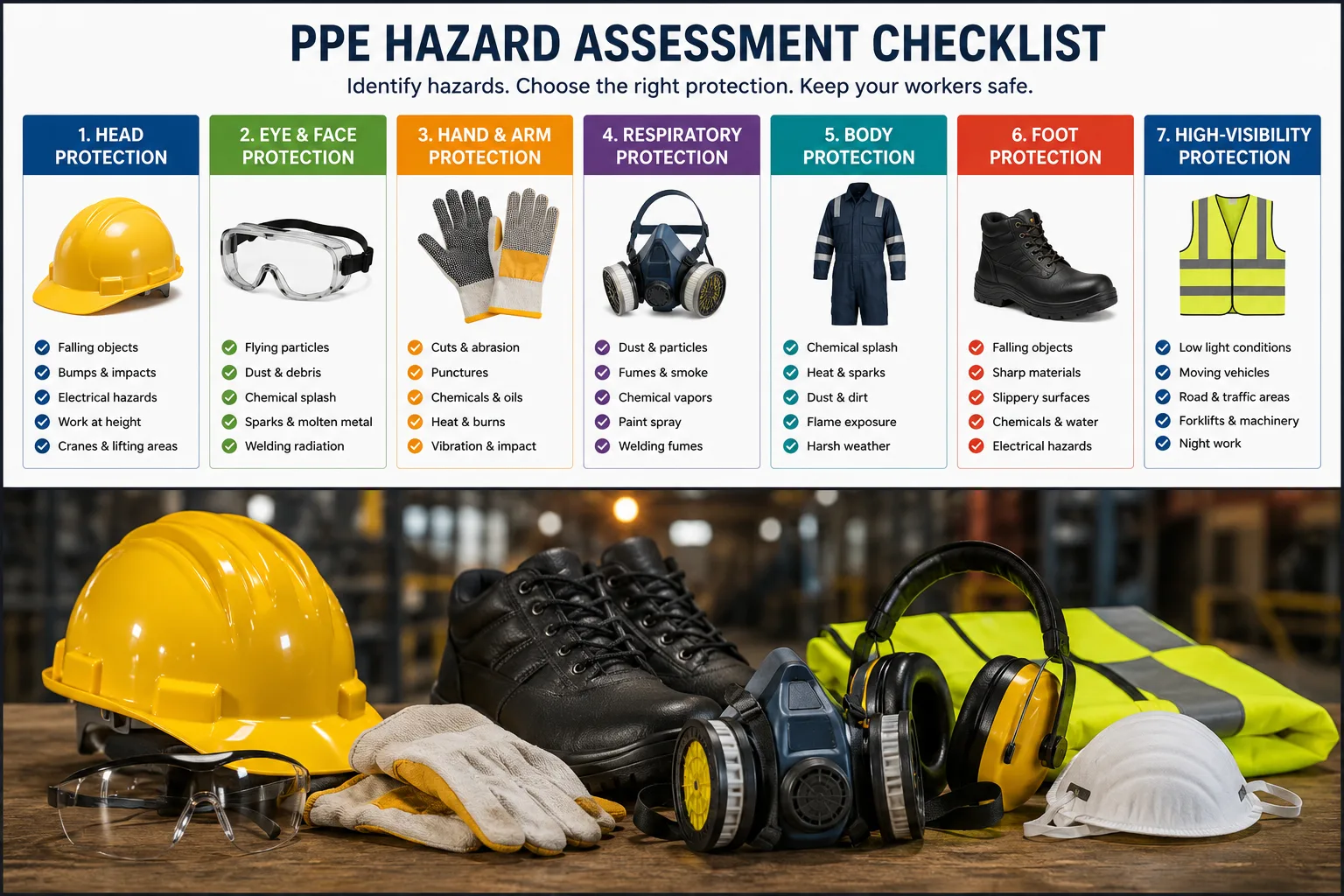
PPE Hazard Assessment Checklist
Use the checklist below to review the main areas of worker protection.
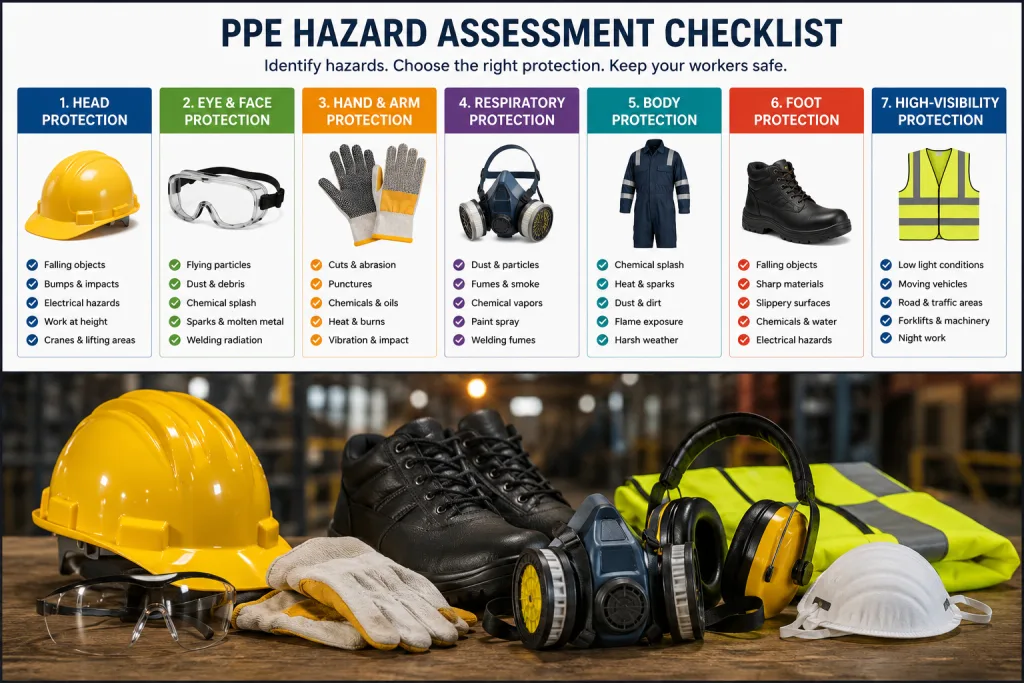
1. Head Protection
Head protection is needed when workers may be exposed to falling objects, bumps, impacts, electrical hazards, or work at height.
Common situations include:
- Construction sites
- Warehouses with overhead storage
- Road and bridge work
- Machinery maintenance
- Mining and oilfield work
- Industrial plants
- Work near cranes or lifting equipment
Recommended PPE may include:
- Safety helmets
- Hard hats
- Chin-strap helmets
- Heat-resistant hoods
- Welding helmets
- Bump caps for low-impact environments
When choosing head protection, check the working environment, impact risk, comfort, adjustability, ventilation, and compatibility with face shields, earmuffs, or welding protection.
2. Eye and Face Protection
Eye and face injuries can happen quickly. Workers may be exposed to flying particles, dust, sparks, chemical splash, molten metal, bright light, or welding radiation.
Common situations include:
- Cutting
- Grinding
- Welding
- Drilling
- Chemical handling
- Painting
- Laboratory work
- Woodworking
- Metal fabrication
Recommended PPE may include:
- Safety glasses
- Safety goggles
- Face shields
- Welding face shields
- Tinted safety lenses
- Chemical splash goggles
For chemical work, safety glasses alone may not be enough. Goggles or face shields may be required depending on the splash risk.
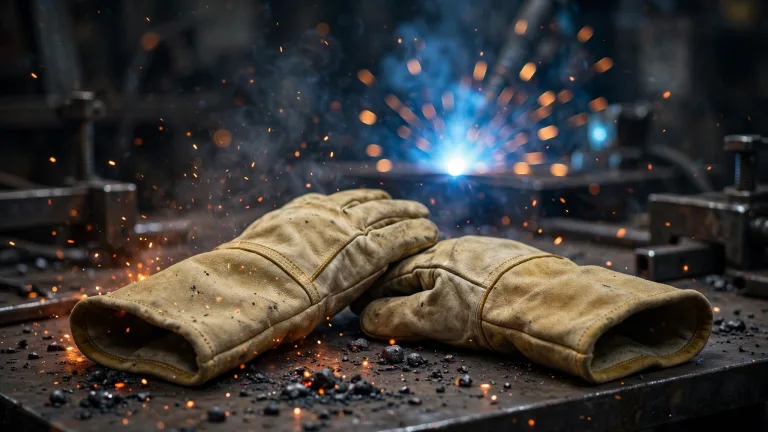
3. Hand and Arm Protection
Hands are one of the most exposed parts of the body in industrial work. Workers may face cuts, abrasion, punctures, chemicals, heat, oil, vibration, or sharp materials.
Common situations include:
- Construction
- Glass handling
- Metal fabrication
- Welding
- Assembly work
- Chemical handling
- Oil and gas work
- Warehouse loading
- Machinery operation
Recommended PPE may include:
- Cut-resistant gloves
- Nitrile-coated gloves
- Latex gloves
- Leather work gloves
- Welding gloves
- Heat-resistant gloves
- Chemical-resistant gloves
- Impact-resistant gloves
- Protective sleeves
When choosing gloves, do not only look at price. Check the hazard type, grip, coating, cut level, flexibility, size range, and comfort. A glove that is too thick may reduce dexterity, while a glove that is too light may not provide enough protection.
4. Respiratory Protection
Respiratory hazards may include dust, fumes, smoke, chemical vapors, paint spray, welding fumes, silica dust, or airborne particles.
Common situations include:
- Sanding
- Grinding
- Cutting
- Welding
- Painting
- Spraying
- Chemical handling
- Demolition
- Construction dust exposure
- Pharmaceutical or powder handling
Recommended PPE may include:
- Disposable dust masks
- N95 or KN95 masks
- Half-face respirators
- Full-face respirators
- Gas masks
- Filters or cartridges matched to the hazard
Respiratory protection must be selected carefully. A dust mask may help with certain particles, but it may not protect against gases, vapors, or chemical fumes. Always match the mask or respirator to the specific hazard.
5. Body Protection
Body protection is needed when workers may be exposed to sparks, heat, chemicals, liquid splash, dust, dirt, oil, weather, or sharp materials.
Common situations include:
- Welding
- Chemical handling
- Industrial cleaning
- Painting
- Road work
- Food processing
- Oil and gas work
- Foundry work
- Maintenance
- Construction
Recommended PPE may include:
- Safety workwear
- Work uniforms
- Flame-resistant clothing
- Chemical protective coveralls
- Disposable coveralls
- High-visibility clothing
- Aluminized heat-resistant suits
- Anti-static workwear
- Rainwear
- Protective aprons
When selecting protective clothing, consider the material, protection level, comfort, breathability, sizing, and whether the garment needs to be disposable or reusable.
6. Foot Protection
Foot injuries can be caused by falling objects, sharp materials, slippery surfaces, chemicals, water, heat, or electrical hazards.
Common situations include:
- Construction sites
- Warehouses
- Manufacturing plants
- Road work
- Oil and gas fields
- Workshops
- Heavy equipment areas
- Wet or slippery environments
Recommended PPE may include:
- Steel toe safety shoes
- Composite toe safety shoes
- Anti-slip safety boots
- Puncture-resistant safety shoes
- Chemical-resistant boots
- Waterproof safety boots
- Protective shoe covers
When choosing safety footwear, check toe protection, sole grip, puncture resistance, comfort, weight, waterproofing, and the working surface.
7. High-Visibility Protection
Workers need high-visibility clothing when they work near vehicles, forklifts, cranes, road traffic, low-light areas, warehouses, ports, or construction machinery.
Common situations include:
- Road construction
- Bridge work
- Warehouse operations
- Loading and unloading
- Airport ground work
- Port operations
- Night work
- Traffic control
- Outdoor construction
Recommended PPE may include:
- Reflective safety vests
- High-visibility jackets
- Class 2 or Class 3 safety clothing
- Reflective rainwear
- High-visibility uniforms
- Reflective pants
High-visibility clothing should be selected based on the work environment, traffic speed, lighting conditions, weather, and required visibility level.
How to Match Hazards with PPE Categories
A simple way to choose PPE is to match the hazard with the correct protection category.
Falling objects require head protection. Flying particles require safety glasses or goggles. Chemical splash may require goggles, gloves, coveralls, and boots. Sharp materials require cut-resistant gloves. Dust or fumes require respiratory protection. Sparks and heat require flame-resistant or heat-resistant PPE. Moving vehicles require high-visibility clothing. Heavy objects require safety shoes.
This process helps procurement teams create a clear and accurate PPE buying list.
Common PPE Selection Mistakes
Many companies buy PPE too quickly without reviewing the real job conditions. This can lead to poor protection, worker discomfort, and unnecessary costs.
Common mistakes include:
- Buying one type of PPE for all workers
- Choosing the cheapest option without checking quality
- Ignoring size and fit
- Not checking required standards or certificates
- Using the wrong glove for the hazard
- Using dust masks where respirators are needed
- Forgetting replacement parts such as filters or cartridges
- Not replacing damaged PPE
- Ignoring worker comfort
- Failing to train workers on correct PPE use
Good PPE should protect workers while still allowing them to do their job properly.
When Should You Update Your PPE List?
A PPE checklist should not stay the same forever. It should be reviewed whenever the workplace changes.
Update your PPE list when:
- A new job task is introduced
- A new chemical or material is used
- Equipment or machinery changes
- Work moves to a new site
- An accident or near miss happens
- Workers report discomfort or poor fit
- PPE becomes damaged or worn out
- A customer or project requires specific standards
- Weather or working conditions change
Regular review helps keep your team protected and helps your purchasing team avoid mistakes.
PPE Buying Checklist for Companies
Before requesting a PPE quotation, prepare the following information:
- Industry
- Job tasks
- Main hazards
- Required PPE items
- Quantity for each item
- Size breakdown
- Color requirements
- Logo or customization requirements
- Required certificates or standards
- Packaging requirements
- Shipping destination
- Delivery timeline
The more details you provide, the faster and more accurate your quotation will be.
FAQ
What is a PPE hazard assessment?
A PPE hazard assessment is a workplace review used to identify hazards and decide what personal protective equipment workers need.
Why is PPE hazard assessment important?
It helps companies choose the correct safety equipment, reduce workplace risk, avoid unsuitable products, and protect workers more effectively.
What are the main types of PPE?
The main types of PPE include head protection, eye and face protection, hand protection, respiratory protection, body protection, foot protection, and high-visibility clothing.
How do I know which PPE my workers need?
Start by reviewing the job task, working environment, tools, materials, and possible hazards. Then match each hazard with the correct PPE category.
Should every worker wear the same PPE?
No. PPE should be selected based on the worker’s specific task and hazard exposure. Different jobs may require different protection.
How often should PPE be replaced?
PPE should be replaced when it is damaged, worn out, contaminated, expired, or no longer suitable for the task.
Can PPE completely remove workplace hazards?
No. PPE helps reduce exposure, but it should be used together with proper training, safe work procedures, supervision, and other safety controls.
Need Help Choosing PPE for Your Team?
Choosing the right PPE can be difficult when your workers face different hazards across different job sites. ACEPPE supplies a wide range of personal protective equipment, including safety helmets, work gloves, respirators, chemical protective coveralls, safety workwear, high-visibility clothing, and other industrial safety products.
If you need PPE for construction, manufacturing, oil and gas, road work, chemical handling, welding, or general industrial use, send us your product list, quantities, size requirements, and destination.
Our team can help recommend suitable PPE options and prepare a quotation for your project.
Contact ACEPPE today to get a professional PPE quotation for your team.